
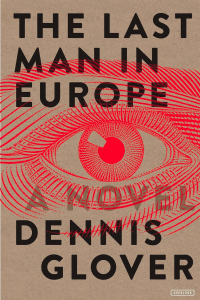
I have found George Orwell a fascinating person for almost as long as I’ve known of his existence. Introduced to his work in middle school, reading 1984 and Animal Farm were a political education – and I was surprised but impressed to learn that Orwell was a man of the left. In my experience people who are well-steeped in one end of the political spectrum have a clannish defense of their immediate neighbors, a kind of a “no enemies to the right/left” mentality, and both of those works are beloved on the right for their takedown of Soviet-esque politics. Orwell, though, not only had courage but integrity: he fought for a cause he believed in, was shot for it, and bore witness to the treachery of Stalinism in Spain. This came up in my recommended queue after re-reading Orwell earlier in the year, and a novel about Orwell was too interesting to resist.
The Last Man in Europe takes us through Orwell’s adult years and is oriented around his writing, specifically events, characters, and situations that informed it, like his experiences in the Spanish Civil War or dealing with aging farm animals. Orwell’s character-conversations were far and away the most interesting aspect of the book myself, as we ‘witness’ numerous discussions between Orwell and H.G. Wells, and once between Orwell and Aldous Huxley where Huxley is plainly playing with the idea of tyranny operating via comfort, i.e. Brave New World. 1984 dominates the book, not by name but because so much of what Orwell experiences is digested and incorporated into his work in progress, and the book pushes to its end with Orwell in a hospital dying, desperate to finish this passion project – not because he’s tired of it, because it was so important to him to get his warning about totalitarianism out there, specifically the idea that the English were not immune to it and that it it was coming from either direction, a seemingly inexorable tide of dull, grey inhumanity. Having done a recent reread of both 1984 and Animal Farm, subtle references to both especially stood out, from Orwell having a boss named B.B. to him sucking on a pen nib after visiting a shabby shop and buying a composition book from the prewar era when quality was higher; these little strokes were appreciated. I enjoyed the book, though the arc of Orwell’s political thinking seemed only faintly drawn. Certainly relevant today, with Britain covered in CC cameras and its citizens subject to arrest for sharing memes or even what they’re thinking, if they’re in a proscribed zone.
Quotes/Highlights:
‘Problem is, of course, that if we ever get beaten, like those chaps did at Malaga, history will record us as traitors. The English Trotsky-fascists who stabbed the revolution in the back. The truth will be whatever Comrade Stalin wants it to be.’
‘We’ve learnt our lesson,’ he said, backing up Brandt. ‘Never trust the communists.’
“Destroy literature, Fred, and it becomes easier to destroy people. You’re even allowed to commit murder these days as long as you call it something else.’ Warburg looked at the bomb-battered street and cocked his head. ‘Area bombing.’ ‘Yes.’
When words lose their meaning, we bomb the past into the ground.
He had shed the camouflage and exposed the single objective of modern politics for all to see: power for its own sake. All else was flummery. Whether they were called commissars, gauleiters or capitalist managers, the essential philosophy of Burnham’s rulers was the same: control, manipulation, coordination – the crushing flat of whatever joy life promised, under the guise of efficiency, productivity and rationality. It would be a world in which true human feelings had no value or place. The end of man.
“The parameters would be easy to set. Just dial in the relevant party ideology, the events of the time, the style – romance, mystery or tragedy – pull a lever, and there you have it, a book at least as readable as all this garbage in front of me. Authors? No need of them. We could even automate reviewing.”
Orwell groaned inside. How mechanical people sound, he thought, when they’re covering up some unpleasant truth. ‘Reactionary? Exploit the suffering of their people? How easy it is to justify killing hundreds of thousands of innocent people just by giving them a label! “You’re a reactionary – here’s a bullet. You’re a Jew – here’s a gas oven.” How can we call ourselves socialists and democrats while excusing a bloodbath?’
It struck him, though, that for all that, they didn’t need Laski or Von Hayek to tell them how to live. They didn’t need books from Gollancz to make them miserable in order to bring the revolution and its day of eternal happiness closer. Their love for each other, the enjoyment they took in life’s simple pleasures, their natural wariness of authority – all the things the revolutionaries had been promising, but dressed up in catchwords like brotherhood and equality and democracy – came to them naturally. They pursued happiness the way a flower pushed towards the light, and a miner sought the surface at the end of each shift.
What he wanted to get across was how present-day politics made life feel: how it changed the sensation of a razor blade on your skin, the meaning of a knock on the door, your capacity for love and loyalty. The ideologists and the managerialists couldn’t tell you those things, especially the last. Love and loyalty could never be understood through statistics, only through experience. The doomed love affair would explain everything; he had to get it right.

 Reading Freely
I have a chart of CCTV coverage somewhere… London came, I think, 3rd after two cities in China…. [lol] Camera’s are *everywhere* here……..!
I *think* I’ve acquired most if not all of Orwell’s non-fiction now. He’s a very important writer especially on politics and British/Imperial society. I really like his work. I’m not sure if I’d read a fictional account of his life though with SO many books either by him or about him out there. I have one coming up ‘soon’ about his relationship with Winston Churchill which sounds super interesting.
He also had a friendship with Malcolm Muggeridge! Muggeridge doesn’t appear in this book, but his name is dropped a few times. I’m interested in reading Hitch’s book on WHY ORWELL MATTERS.
Huh, I wonder what Orwell would have to say of his home country and all of Europe, if he were alive today. So sad. It’s beyond totalitarianism. It’s clown world.
Especially with the elite classes waging lawfare against any dissidents, ignoring elections and jailing those like le Pen who might kick over the bucket.
It’s senseless! Shocking! I cannot believe what I am reading anymore. What the heck happened!? And, how long before it comes to America? 2020 was close enough, but we’re not out of the woods.
Jail….? Didn’t she get 2 years **house arrest** for embezzlement? Sounds pretty lenient….. [grin]… and she’s out on appeal…. so her sentence has yet to be confirmed. Personally I don’t recognize the Europe you guys are talking about… “Beyond Totalitarianism”….? [lol]
I knew she was on appeal, not about the house arrest aspect. Her sentence doesn’t matter so much as the ACTUAL intent of the judication, which is to keep her party from delivering a November ’24 esque surprise to Herr Macron.
I’ve found there’s an interesting break in those who watch the official/approved news and those who are plugged into more direct reporting on both sides of the pond. It’s why Trump and those like him (Meloni, le Pen, etc) continue to surprise the power-elite in DC and Brussels: they’re so used to controlling the narrative they may even buy in to their own product.
Unsurprisingly, we have *very* different opinions of the media…. especially the so-called ‘new’ media….
Oh, I meant to ask….. “Ignoring elections”…..???
The annulled elections in Romania, Labour postponing local elections, that sort of thing.