
Warning: this review contains partial spoilers for Winterkill and Below Zero.
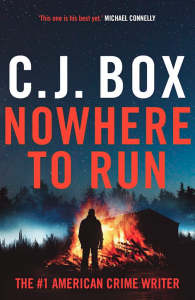
Joe Pickett is finally about to go home to Saddlestring after an exile in Baggs, where the governor sent him to keep a low profile – but there’s something odd going on on the mountain, and Joe wants to get to the bottom of it before he turns in his keys and it becomes someone else’s problem. During the investigation, Joe loses both of his horses and very nearly his life to a set of twins with the last name Grim, and despite barely getting away he wakes in a hospital to find that no one believes his story, especially the bit about seeing a young woman with the twins who matched the description of a missing Olympic athlete. There’s no dead horses on the mountain, no burned-out cabin, nothing to corroborate his report of the last few days. When Joe arrives home to Marybeth, she can see that look in his eye, his desire to return to the mountain with Nate and find the men who attacked him – and bring them to justice, western or otherwise. She begs him to resist the urge, though, for his family: their foster daughter April has returned, but after kidnapping and six years spent bouncing around an unofficial foster system, she’s not the girl she once was – even without puberty aggravating her hostility to those around her. Although Joe makes his promise, another mother arrives at his door weeping and asking for help: the missing Olympian is her daughter, and this is the first lead that’s surfaced in months. What’s more, the governor’s people heard Joe’s testimony and it’s brought up connections to a pair of brothers involved in a politically explosive issue a few years back, and he wants Joe to follow up. Fortunately, Joe is going up the mountain again with Nate, his fugitive outlaw buddy who is both a skilled outdoorsman and a man fearsome in combat.
Nowhere to Run is a return to the real outdoors action that Below Zero’s helicopter antics and power plant showdowns took us away from, putting Joe in such isolation that he’s often in a state of cold dread. Despite the claims of one local who caught sight of them, the men are not ‘Wendigos’, or malevolent spirits; they’re men, men who obviously know how to survive in the mountains despite the best attempts of Wyoming blizzards, encroaching hunters, and the most dangerous of them all: Government Men. Although Joe can appreciate someone wanting to be left alone, and earnestly working to achieve it, he’s the game warden, by gosh, and those men were fishing without a license and harvesting other people’s elk. (Also, they shot his horses, and even a cranky libertarian like myself would be out for blood.) Plus there’s the mystery of the woman, and Joe’s own desire to come back with his head held high. Joe is no Walker, Texas Ranger type fella: he’s an average Joe who’s a poor pistol shot and someone who has been on the losing end of a fight more than one occasions in these books. He doesn’t like waking up in a hospital room with a sneering sheriff mocking his story about two mountain men and a girl on the mountain, so pride joins duty to bring him into the dark forest and the rough slopes of the forest.
I don’t want to say too much about the plot because of spoilers, but the west’s attraction to people who want to drop out of society and escape the grasping fingers of The Man is well on display here. The brothers are even more intense in their hatred of the government than the survivalists of Winterkill: they embody the philosophy of VONU, or structuring one’s life to be ungovernable by dropping out of society all together. There’s some discussion of Ayn Rand in this, though it’s so cursory that I don’t think Box has read her, and it’s almost completely removed from the terror-twins. The drama is all around good here: the suspense & thriller aspects of it are on point, and I liked the conflict between Joe and Nate arising from their shared attitudes toward the state.
Okay, now I seriously need to commit to The Innovators because we’re discussing it in class Thursday. Fenway review will go up tomorrow, but I wanted Box to get all five of the “most recent posts” entries. Pretty sure that’s not happened since I binged the Series of Unfortunate Events back in 2009.
Quotes/Higlights:
He felt oddly disengaged, like he was watching a movie of a guy who looked a lot like him, but slower. It was as if it weren’t really him limping through the trees with holes in his leg and his best horse bleeding to death on the side of an unfamiliar mountain. Joe seemed to be floating above the treetops, between the crown of the pines and the sky, looking down at the man in the red shirt moving toward what any rational observer would view as certain death.
“The easiest way to eat crow is while it’s warm. The colder it gets, the harder it is to swaller.”
Joe said, “It’s hard to believe the West was won with stupid sayings like that.”“I feel like I died and went to heaven,” Farkus said. “I been hunting up here all my life just hoping to see something like this. D’you suppose she’s alone?”
“Don’t let her see you,” Parnell said. “There’s something oddly sirenlike about this situation.”
“Sirenlike?” Farkus said. “You talk in code, Parnell.”
“Shut up, Dave,” Smith said. “You obviously don’t know your classics.”“‘Murder’ is not the right word,” Coon interjected. “She was killed, yes. But it happened in a firefight at the Cline compound in the UP. There is some dispute whether she was killed by law enforcement or by her own family.”
Nate said, “No, there isn’t.” He shook his head, said, “It always amuses me how a family home or small business suddenly becomes a ‘compound’ when you folks decide to attack it.”Joe said, “You are a good man.”
Coon smiled. “I’m a bad bureaucrat, though.”
“That makes two of us.”“Sheriff,” Joe said, “you’ve got an arrow sticking out of your butt.”
“Why, thanks, Joe. I was wondering what it was bothering me back
there.”“We used to have a pretty good country. At least I think we did. Then something happened. It’s our fault ’cause we let it. We used to be a people who had a government,” he said, looking up, his eyes fierce again. “Now it’s the other way around.”

 Reading Freely