
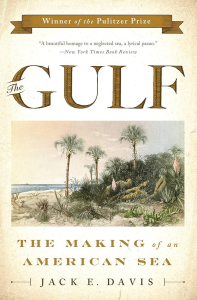
Within the last few weeks I’ve read a couple of science titles, one of which was a big ol’ book that deserves a proper review, but given that my mental energies are entirely focused on my last project for this semester, it probably won’t get. That big ol’ book is The Gulf: The History of an American Sea. Although I’ve lived in a Gulf state (the yee-haw kind, not the terrorist kind) my entire life, being subject to its humidity and hurricanes, I’ve never …read about it properly. Perhaps as with someone who grew up with mountains in the background and takes them for granted, I never looked at it as an object of interest. That changed when I visited Pensacola: on my last visit I was near the Gulf every single day, intoxicated by the energy of the waves and the different beachscapes they made.
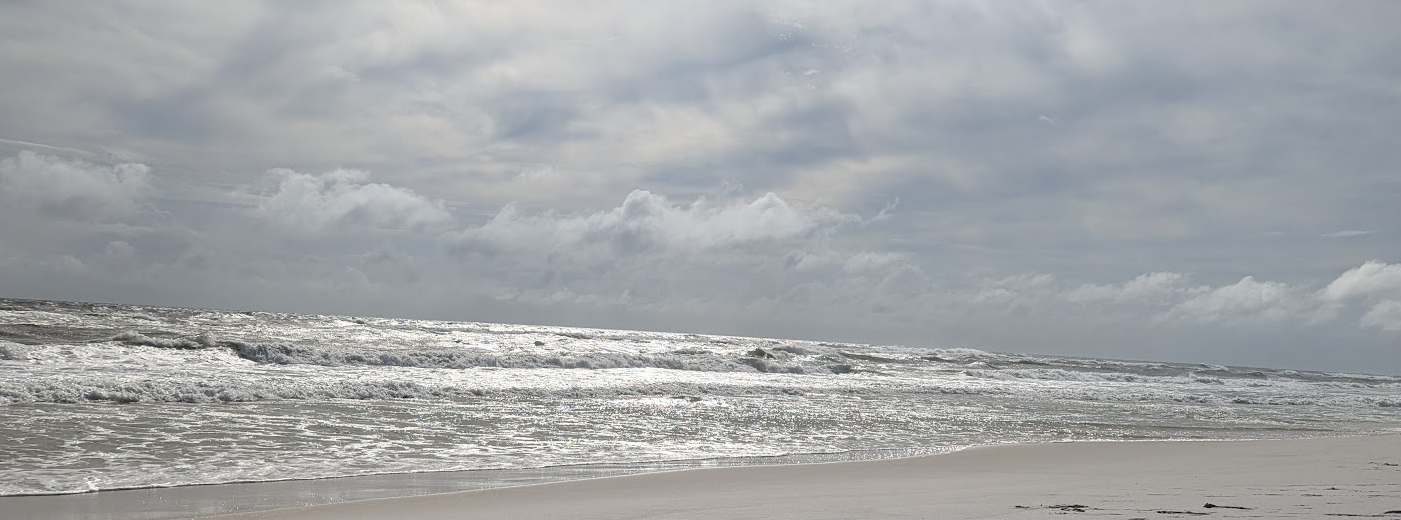
The Gulf is a comprehensive history of the Gulf of Mexico, beginning with natural history and its formation, then moving to the various native American tribes that lived around its rim. These were people largely oriented toward the sea, not the land: in the case of Pensacola, the soil was so briny that agriculture wasn’t a practical option. This was a lesson that took European settlers a while to learn, though once they did they dived into fishing with such gusto that several species came close to extinction. Europeans were all over the Gulf, but especially the Louisiana-Florida rim, so Pensacola and New Orleans both have large parts in the early portion of the book. (I was amused to learn that the Mississippi’s mouth is so obscured by its delta that it was repeatedly passed by from ships looking to establish a fort or colony there.)
The further the book gets into the Gulf being aggressively settled and developed, the more diverse its topics get: there’s an entire chapter on how hunting for tarpon from a curiosity to an obsession, which is bizaare because these huge fish weren’t even being reeled in for eating, but purely because they were difficult to catch but impressive to pull out of the water, being huge and glistening silver. (Tarpon flesh evidently doesn’t taste good to most people.) Other chapters cover real estate and land development, literally in that latter case because wetlands were being “reclaimed” for development before people realized oh, wetlands are actually kinda vital for flood control, not to mention local ecosystems. The oil industry rather takes pride of place in the latter half of the book, but the author also covers the rise of tourism and environmental stewardship.
This was definitely a fun read given the sheer amount of varied history contained within: granted, it helped that the same visit where I bought this book was one in which I spent more time near the wind and waves than I did in my hotel room. Another read last month was really more of a listen: The Skeptic’s Guide to Alternative Medicine, presented by Dr. Steven Novella. I’m very familiar with Novella from his podcast, The Skeptic’s Guide to the Universe, in which he, his brothers, and a couple of friends go through the week’s science news, play games like “Science or Fiction”, and discuss dodgy goings-on in the news, like UFO claims. I used to listen to them on a weekly basis (beginning in 2006 on dial-up!), but it’s harder to find time for hour-long podcasts these days. SGU did a book a few years ago, and through that podcast I was pretty much familiar with all of this content. Novella kicks things off by discussing the rise of the scientific approach to health, and the infrastructure that sustains it — research, studies, etc — and then begins applying its standards to various health claims like “healing magnets”, homeopathy, chiropractic, and so on. This was an easy listen for me because I don’t have a dog in the fight. The only medicine he covers that Novella deems has any redeeming aspect at all is chiropractic, and then only certain and very limited aspects of it: the practice began with a man who was serial creator of quackery. Judging by people’s reviews on goodreads and amazon, their enjoyment of the book was directly tied to their emotional investment in the approaches covered.

 Reading Freely
The Gulf book sounds fascinating. Makes me think of this fabulous book by Winchester on the Atlantic Ocean: https://wordsandpeace.com/2011/05/11/atlantic/
Oo! Thanks for that. I’ve read Winchester before, so that title is one I’ll be looking at.