
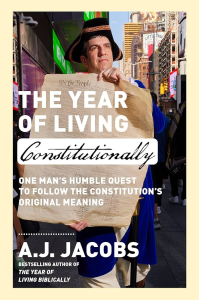
Although I am a fan of A.J. Jacobs’ ludicrous life experiments (trying to take seriously every bit of health advice he was given for a year, trying to literally follow every single rule in the Bible for a year, etc), my eye twitched a bit at this title. I’m a fan of the Constitution, a twenty-year veteran of heaping abuse upon DC regardless of administration for abusing it, and I anticipated that much in this that would annoy me. The Constitution does not apply to individuals, for instance: its entire purpose was to define and limit the scope of the National Government — not people, not the individual States. So harrumph, I said, harrumph! However, the cheap price ($2 on Kindle!), my past affection for Jacobs, and the potential humor to be had in witnessing a band go about in a tricorn hat urging New Yorkers to sign his parchment-paper petition with a quill feather, urged me to try it. While I did find much to annoy, I appreciate Jacobs trying to take the Constitution seriously, and learned quite a bit despite my own familiarity with the founding fathers and their thinking.
Jacobs undertakes several approaches to “living constitutionally”. For one, he decides to do all of his writing with a quill and parchment paper, which entails carrying around a little wooden box to store them in. When he is working at home, he turns off all the lights and works purely by candlelight, to the annoyance of his wife and most of his children, save for one who likes the eccentricity. (That child also loved the fact that Dad also began wearing an 18th century outfit out and about while he was attempting to get people to sign petitions and such.) As Jacobs begins trying to understand rights like “The freedom of assembly”, the right to petition and so on, he tries to exercise said rights in the same fashion that Madison & company would have: he tries to vote by announcing who he is voting for, he creates a petition on a scroll to ask for a Constitutional amendment shifting the presidency to a three-person council instead of an elected monarch, and he “assembles” by inviting people to his home for a dinner to discuss politics, purposely inviting a mix of ideas to foster genuine debate. He also tries to bring back 18th century customs like baking an Election Day cake and preparing some of Martha Washington’s rum punch to give to those at the polls. He also joins up with a group of American Revolution reenactors to further immerse himself in “living history”, and in one of my favorite sections, attempts to get a Congressman to issue him a Letter of Marque so he can go forth on the ocean blue in hopes of intercepting some of America’s enemies.
At the same time that he’s cosplaying the life of an 18th century writer, Jacobs is also reading gobs and gobs of books about the Constitution, both what its ideas meant in their time and how they’ve been applied over the years. He was surprised to discover, for instance, that the Bill of Rights was appended to the Constitution in order to facilitate its passing, and that some of the founding generation regarded it as potentially an issue given that if some rights were specifically enumerated, the government might then assume that it could do as it pleased otherwise. America in the early Republic had a much different culture than our own, with laws that we could now regard as violations of free speech because they governed hurling abuse at the government, or public profanity. Jacobs is also surprised that Congress was meant to be first among equals as far as the government goes, and ends the book convinced that the President and SCOTUS, especially the latter, need to be taken down a few pegs. Although I enjoyed this part of the book for the most part, I wasn’t impressed by Jacobs study given that he doesn’t appear to appreciate the nature of the “Federal” system, especially the fact that the States were meant to be powerful actors in their own rights — with direct control over the Senate, for instance, checking the power of the national government. One amendment he suspiciously never mentions is the Tenth Amendment, which says that “any powers not given to the Federal Government are reserved to the States, or to the people”. In his study of how the Constitution has changed over the years, he also never goes near the Civil War, which dramatically changed the little-c constitution of the Union, making it a national government (by gunpoint) instead of a union of equal States. I don’t know if he sidestepped it because of controversy or something else, but regardless of how much of a Pandora’s box it is, when tackling this subject, it has to be opened.
In short, this was a mixed bag: mostly enjoyable, but with deficiencies — some serious. As much as I enjoyed his attempts to “live history”, it seemed more like a gag than a serious endeavor to understand the thinking of 18th century Americans, especially given how much time he spends judging them by the standards of a self-described “New York liberal”. I liked it far more than I expected, though.

 Reading Freely
It was refreshing, to me, to see a regular person—rather than a lawyer or a scholar—find out more about something very important to Americans.
Very true! At one point he managed to get someone from every state to bake an Election Day cake.
Something all Americans should do. Sadly, we’re so inept of our own Documents. : /
We are. People will know the jist of a couple of amendments and a couple of phrases from the actual document to support their pet political passions, but nothing comprehensive.