
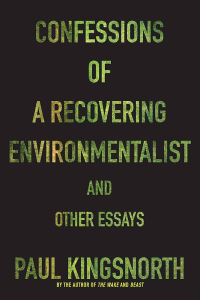
Two years ago I read a Wendell Berry collection of essays edited not by Brother Berry himself, but by someone named Paul Kingsnorth. Being the nosy sort that I am, I inquired of Google who Kingsnorth might be, I knew at once this was a man worth knowing more about — an ardent lover of the wild, a Christian mystic who had abandoned big-city journalism to work the land in rural Ireland. I’ve been reading to read some of Kingsnorth’s published stuff, beyond his substack articles, and meeting him last weekend (ever so briefly) prompted me to get at it. Confessions of a Recovering Environmentalist collects of his published articles, most of which have some connection to environmentalism, the unsustainable nature of our present civilization. The title essay is superb, and the collection as a whole has a strange aura of elegant, sad beauty.
In the main, the essays are linked together in their reflections on the natural world, humanity, and our relationship with it — especially vis a vis the use of technology. If a reader is familiar with the writings of Wendell Berry on industrial agriculture and humanity’s relationship with the land and all the life that dwells therein, they’ll have some notion of where Kingsnorth is coming from — but Kingsnorth is also something of a mystic. Although this was written fifteen years before he converted to Eastern Orthodoxy (he appears to have been practicing a form of Buddhism in this period), Kingsnorth is very porous spiritually here, with a genuine love for Nature and wildness. Not a love for nature as in “Oh, I love hiking/fishing/birding” etc, but that he seeks Nature out as a man in love might, beholds mountains and fields and starlit skies with the same adoration lovers have for one another. He mentions praying in caves frequently, and during his recent trip to Alabama he made a point of visiting the mountainous area of the state so he could pray there. It was this love for nature that made him a ‘green’ in his youth, and in his title essay he documents what was for him the heartbreaking capture of the green movement into the ‘environmental’ movement, one dominated by quants and men in suits and driven not by love of nature and wildness, not by the desire to save beauty for its own sake, but merely so that technical civilization could go on growing and expanding and avoid any messy friction like global warming and rising seas. He especially bemoans the fact that the environmental movement has become hyperfixated on carbon, ignoring other challenges and the fact their solutions to avoid carbon often contribute to those challenges, generally through their high-tech solutions that Kingsnorth views as part of the problem.
It’s not an accident that Kingsnorth featured in a conference called Resisting the Machine, or that he’s presently working on a book called Against the Machine: in one essay here, Kingsnorth reflects on technology and comments that it’s almost as if technology, so intertwined with financial dynamos and power, has developed agency and a will of its own — becoming a gollum, if you will, one that will destroy its creators through their sheer dependency on it, and through what it does to the natural world we are still dependent on even as we try to replace it through strength of will. Joel Salatin and Wendell Berry’s frequent comparison of living soil versus what American agriculture is generally grown in — dead dirt saturated with outside chemicals — comes to mind. Kingsnorth’s essays reveal him to be actively trying to withdraw from this machine: he left big-city journalism behind to buy a small farm in rural Ireland, where he does things like composting his and his family’s manure. Although reflections on tech, nature, and the intersection thereof dominate this collection, there are also a few miscellaneous essays like his fascinating speculation about the prevalence of “green man” art in early Christian churches: he posits that they are references to Anglo-Saxon rebellion against the Norman conquest.
I began reading this Friday evening and it completely derailed all other plans (besides sleep and work) until I’d finished Saturday afternoon. I really wish I’d read this before I met Kingsnorth so I could have had something more meaningful to say other than “Thanks for The World-Ending Fire“: I’ll definitely be reading his other collections!
Quotes/Highlights:
You can best serve civilisation by being against what usually passes
for it. – Wendell BerryI saw that the momentum of the human machine – all its cogs and wheels, its production and consumption, the way it turned nature into money and called the process growth – was not going to be turned around now. Most people didn’t want it to be; they were enjoying it. All the arguments, all the colourful campaigns, all the well-researched case studies were just washing up on the beach and expiring quietly on the sand, like exhausted jellyfish. There was no stopping what we had unleashed. We were going to eat everything, including ourselves.
When things fall apart, the appetite for new ways of seeing is palpable, and there are always plenty of people willing to feed it by coming forward with their pet big ideas. But here’s a thought: what if big ideas are part of the problem? What if, in fact, the problem is bigness itself?
Kohr’s claim was that society’s problems were not caused by particular forms of social or economic organisation, but by their size. Socialism, capitalism, democracy, monarchy – all could work well on what he called ‘the human scale’: a scale at which people could play a part in the systems that governed their lives. But once scaled up to the level of modern states, all systems became oppressors. Changing the system, or the ideology that it claimed inspiration from, would not prevent that oppression – as any number of revolutions have shown – because ‘the problem is not the thing that is big, but bigness itself’
I didn’t know much when I was twenty-one, which was why I thought I knew everything.
For the first time, I realise the extent and the scope and the impacts of the billboards, the posters, the TV and radio ads. Everywhere an image, a phrase, a demand or a recommendation is screaming for my attention, trying to sell me something, tell me who to be, what to desire and to need. And this is before the internet; before Apples and BlackBerries became indispensable to people who wouldn’t know where to pick the real thing; before the deep, accelerating immersion of people in their technologies, even outdoors, even in the sunshine. Compared to where I have been, this world is so tamed, so mediated and commoditised, that something within it seems to have broken and been lost beneath the slabs. No one has noticed this, or says so if they have. Something is missing: I can almost see the gap where it used to be. But it is not remarked upon. Nobody says a thing.
When I look back on this now, I’m quite touched by my younger self. I would like to be him again, perhaps just for a day; someone to whom all sensations are fiery and all answers are simple.
[T]he world has changed. There are more cars on the roads now, more satellites in the sky. The footpaths up the fells are like stone motorways; there are turbines on the moors and the farmers are being edged out by south country refugees like me, trying to escape but bringing with us the things we flee from. The new world is online and loving it, the virtual happily edging out the actual. The darkness is shut out and the night grows
lighter and nobody is there to see it.It took a while before I started to notice what was happening, but when I did it was all around me. The ecocentrism – in simple language, the love of place, the humility, the sense of belonging, the feelings – was absent from most of the ‘environmentalist’ talk I heard around me. Replacing it were two other kinds of talk. One was the save-the-world-with windfarms narrative; the same old face in new make-up. The other was a distant, sombre sound: the marching boots and rattling swords of an approaching fifth column.
The environment is the victim of this empire. But ‘the environment’ – that distancing word, that empty concept – does not exist. It is the air, the waters, the creatures we make homeless or lifeless in rocks and legions, and it is us too. We are it; we are in it and of it, we make it and live it, we are fruit and soil and tree, and the things done to the roots and the leaves come back to us. We make ourselves slaves to make ourselves free, and when the shackles start to rub we con dently predict the emergence of new, more comfortable designs.
If a flush toilet is a metaphor for a civilisation that wants to wash its hands of its own wastes as long as they accumulate somewhere else, then a compost toilet is both a small restitution, and a declaration: I will not turn my back on the consequences of my actions. I will not hand them over to someone else to deal with. I will not crap into clean drinking water and flush it down a pipe to be cleaned with industrial chemicals at some sewage plant I have never visited. I will fertilise my own ground with my own manure, and in doing so I will control an important part of my life in this world, and that control will give me more understanding over it. I will claw something of myself back. Even in the rain, even in winter, I will deal with my own shit.
We wanted to live more simply; or perhaps just more starkly, because life here is rarely simple. Our kids were just getting to school age, and the idea of sending them to school to systematically crush their spontaneity and have them taught computer coding so that they could compete in the ‘global race’ made us miserable. We wanted to grow our own food and compost our own shit and educate our own children and make our own jam and take responsibility for our own actions.
” I’ve thought for years that the best way to put a spanner in the consumer dystopia that is unfolding is to ground yourself in a place and to learn to do things with your hands – actually learn to do them, not just write about learning to do them. Grow your own carrots, learn to use an axe and a scythe, know where the sun falls and what the trees do and what is growing in the laneways. Get to know your neighbours, put down roots and stay even when you don’t want to stay. Be famous, as Gary Snyder so wonderfully suggested, for fifteen miles.”
But certainly the endpoint of a culture that focuses on human desire above all things, rejects all previous ways of living, worships machines, sneers at the spiritual and sees the world as a collection of components to be taken apart and analysed in the service of utility, is a world in which humanity disappears further and further into narcissistic virtuality, ‘improving’ its own capabilities with its technology while the world
burns around it.I discovered John Betjeman, the chronicler of the death of Middlesex, in my early twenties. I discovered old-fashioned poems about places I knew – Harrow, Greenford, Rayner’s Lane, Ruislip in guises that meant nothing to me. It was like seeing a picture of your mother at eighteen, young and free and with no idea you will ever be born. Here was a county of whispering pines, enormous hay fields, elm trees, meadowlands, low, laburnum-leaned-on railings. The evocation of its loss was strong and clean and managed to raise a nostalgia in me for something I had never been part of. For it wasn’t the world I knew. I knew pavements and park railings and cul-de-sacs and council estates and concrete street lamps and white dogshit and the remains of old air-raid sirens. Compared to its past richness, my Middlesex was a drab monoculture. It was, in Betjeman’s words, ‘silent under soot and stone’. But I liked it, because it was where I came from.
I wonder now whether we could Middlesex the whole world. I wonder if we could replace the rainforests with plantations, fish out the seas until only a couple of commercial species are left, carpet the moors in turbines and dam all the rivers and build endless suburbs over what remains of the hay meadows that are now used to grow maize for silage. I wonder if we could busy ourselves with our microchips and machines, turning the world into a planetary farm to support our digital appetites and sinking deeper into our machine-led narcissism as we do. I wonder if we could deplete the diversity and richness of this wild world by 80 or 90 per cent – and within a few generations see it all forgotten, even by those who noticed its going. I wonder if, raised in this culture, with all the new toys to play with, wearing our Google Glasses, sitting in our self driving cars, we would even notice, or care?
I have written about retreating and withdrawing several times before, and it has often brought down on my head accusations of ‘defeatism’ and the like from the activist minded. But it’s not about defeat, or surrender. It’s about pulling back to a place where you can nd the breathing space to be free and human again. From that, all else follows, if you can pay attention.
I’ve recently begun reading the collected writings of Theodore Kaczynski. I’m worried that it may change my life. Some books do that, from time to time, and this is beginning to shape up as one of them.
Illich’s critique of technology, like Kaczynski’s, was really a critique of power. Advanced technologies, he explained, created dependency; they took tools and processes out of the hands of individuals and put them into the metaphorical hands of organisations. The result was often ‘modernised poverty’ in which human individuals became the equivalent of parts in a machine rather than owners and users of a tool. In exchange for ashing lights and throbbing engines, they lost the thing that should be most valuable to a human individual: autonomy. Freedom. Control.This culture is about superstores, not little shops, synthetic biology not local community, brushcutters not scythes. This is a culture that develops new life forms rst and asks questions later; a species that is in the process of, in the words of the poet Robinson Jeffers, ‘break[ing] its legs on its own cleverness’.
Say what you like about religion, but at least it teaches us that we are not gods. The ethic that is promoted by the de-extinctors and their kind tells us that we are gods and we should act like them. While it may sometimes pose as conservation or environmentalism, this is in reality the latest expression of human chauvinism; another manifestation of the empire of homo sapiens sapiens. If it marches forward it will usher in the end of the animal, and the end of the wild. It will lead us towards a New Nature, entirely the product of our human-ness. There will be no escape from ourselves. We might call it Total Civilisation.
I wonder if there has been a society in history so uninterested in the sacred as ours; so little concerned with the life of the spirit, so contemptuous of the immeasurable, so dismissive of those who feel that these things are essential to human life. The rationalist vanguard would have us believe that this represents progress: that we are heading for a new Jerusalem, a real one this time, having sloughed o ‘superstition’. I am not so sure. I think we are missing something big. Most cultures in human history have maintained, or tried to maintain, some kind of balance between the material and the immaterial; between the temple and the marketplace. Ours is converting the temples into luxury apartments and worshipping in the marketplace instead. We are allergic to learning from the past, but I think we could learn something here.
Which way are we going to walk? What are we going to choose? Spiritual teachers throughout history have all taught that the divine is reached through simplicity, humility and self-denial: through the negation of the ego and respect for life. To put it mildly, these are not qualities that our culture encourages. But that doesn’t mean they are antiquated; only that we have forgotten why they matter. This is not something we ought to be proud of.
I have always associated England with small, secret things, and Britain with big, bombastic ones. Britain to me is empire and royalty, Satanic mills and the White Man’s Burden. England is the still pool under the willows where nobody will nd you all day, and the only sound is the fish jumping in the dappled light. It’s a romantic vision, I know, but then nations are, like people, at least partly romantic things.
[A] little England sounds pretty good to me. An England that pays attention to its places rather than wiping them out in the name of growth; an England that doesn’t have imperial designs; an England that doesn’t want to follow America into idiotic wars for the sake of prestige. An England that stops trying to ‘punch above its weight’, and instead asks why it is punching at all.
I don’t want to sound as if I’ve read too much science ction, but I’m on board with both Kelly and Kurzweil to this extent: this thing [Technology] is bigger than us now. It is developing a degree of autonomy, and it is using us, somehow, to create itself. I know this sounds like a conspiracy theory, but it’s not really a theory, it’s more of a hunch: a conspiracy feeling. We are surrendering the freedom to be human in exchange for the freedom to live in confected dreams: dreams in which nature is dead, except for the pretty bits, and bad things never happen, and nobody dies, and there is nothing to life but entertainment and everything we see we can control, because we have created it.

 Reading Freely
OK, I REALLY REALLY need to read this guy, and also go back to Berry!!
Thanks for sharing all these important passages
My pleasure! As mentioned, he converted to Orthodoxy via Romanian monastery that had set up shop in Ireland just a few years ago. I’m thinking his new book will be absolutely fascinating.
Ah yes, I know which monastery you are talking about
Pingback: Top Ten Tuesday: Suspense/Scary Movies I’ve Seen in 2024 | Reading Freely
I need to read this book. It is in none of the many libraries near me in the Houston metroplex, so I probably need to buy it.
I’ve never read any of Wendell Berry essays. I probably need to do that, too.
Thank you!
I love, love, love, Wendell Berry.
What book would you recommend of Wendell Berry’s? I am very interested in both nature and spirituality.
Ooooh. Your question makes me realize I need to start re-reading his essay collections. “The World Ending Fire”, edited by Kingsnorth, may be a good place to start because it’s a big cross-section of WB’s work — and it’s how I found Kingsnorth to begin with! If you’re wanting to go with a work that Berry himself organized, though, he’s most known for The Unsettling of America.
There’s a book on Berry and religion which I’ve not yet read. He’s reverential, but not…creedal, if that makes sense. He has Kingsnorth’s awe toward creation, but the closest I’ve read him remarking on religion was in the novel Jayber Crow, my introduction to him. In that, a prospective seminarian with deep questions about God is caught up in a flood and winds up in a town called Port William, where he begins working as a barber and putting into practice the advice his mentor gave him — to “work out the answers” to those questions. A few quotes from JC:
==============================
“You have been given questions to which you cannot be given answers. You will have to live them out – perhaps a little at a time.’
And how long is that going to take?’
I don’t know. As long as you live, perhaps.’
That could be a long time.’
I will tell you a further mystery,’ he said. ‘It may take longer.”
=======================
One Saturday evening, while Troy was waiting his turn in the chair, [he said] “They ought to round up every one of them [war protesters] and put them right in front of the communists, and then whoever killed who, it would all be to the good.”
There was a little pause after that. Nobody wanted to try and top it. I thought of Athey’s reply to Hiram Hench.
It was hard to do, but I quit cutting hair and looked at Troy. I said “‘Love your enemies, bless them that curse you, do good to them that hate you.’”
Troy jerked his head up and widened his eyes at me. “Where did you get that crap?”
I said, “Jesus Christ.”
And Troy said, “Oh”.
It would have been a great moment in the history of Christianity, except that I did not love Troy.
Yes, I loved (loved!) Jayber Crow! I’ve added the two nonfiction books by Berry you have mentioned to my wishlist. Maybe someone will be-gift me one of these for Christmas…
Jayber Crow remains my favorite, too, though “A Place on Earth” and “The Memory of Old Jack” were also standouts for me. That one story where Matt Feltner walks the boundaries of his farm one last time, remembering walks with his own father before sitting under a tree and passing away, gets me every time.
Pingback: The Best of 2024 – Year in Review! | Reading Freely