
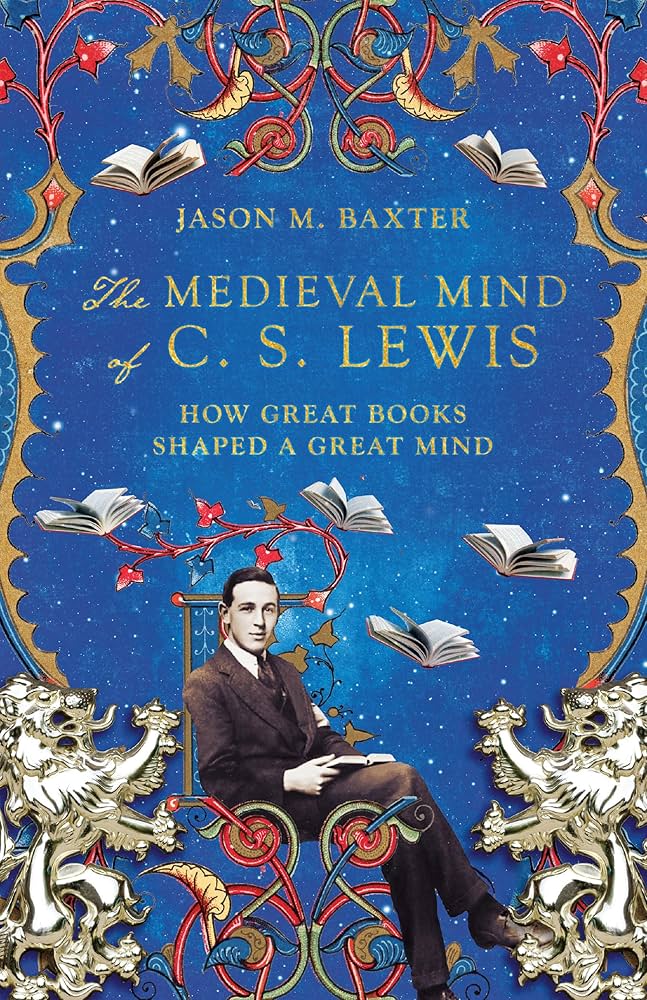
Most people encounter C.S. Lewis as a Christian apologist or an author of stories — either the children’s series of Narnia, or his fascinating “space trilogy”, which combined mythology, medieval cosmology, and character drama to good effect. His occupation, though, was as a don of literature — especially medieval literature, and Baxter here argues that Lewis was more at home in medieval Christendom than in modernity. The Medieval Mind of C.S. Lewis illustrates how medieval culture permeated Lewis’ fictional work, and reflects on his love for Dante and appreciation for the medieval model of Creation. While I was already aware of Lewis’ fondness for the medieval mind — his Disarded Image was a tribute and explanation to it — I found much to appreciate about The Medieval Mind, showcasing as it does a large part of one of my very favorite author’s personality. I was especially interested in the idea that medievalism permeated Narnia — not because of the kings and queens, but that Lewis had written the books with medieval atmosphere in mind: Baxter and evidently other authors believe that each of the Narnia books was written with one element of the medieval cosmology in mind, each element dominating a particular book. The focus is largely on that cosmology — the geography that Dante navigates in the Commedia — and not so much on politics. For a Lewis fan, this should definitely be of interest.
Coming up: I’ll be finishing Living in Wonder this weekend, then reading a Kingsnorth title to finish my goal of reading one book by each author at the Resisting the Machine conference last weekend.
Highlights:
It was this professorial Lewis who in a 1955 letter lamented that modern renderings of old poems made up a “dark conspiracy . . . to convince the modern barbarian that the poetry of the past was, in its own day, just as mean, colloquial, and ugly as our own.”
Music is philosophical therapy, bringing the soul back into tune with the great Conductor’s universe.
Standing in a medieval cathedral gives you a kind of x-ray vision of the world. Meaning is everywhere, full and rich. The material world has been gathered to a saturation point. In a cathedral, then, the spiritual world feels like it is leaking in, and our response is to want to soar up and through and out.
In sum, while the medieval cosmos was alive, a great living being, a world that moved because it experienced desire, for modernity the world is made up of passive lumps of matter, waiting to be acted on by forces, suspended within space.
There doesn’t seem to be a moment in Lewis’s adult life in which Dante was not close at hand and vividly present in his thoughts. The Florentine was a constant interlocutor. Just as when Augustine wanted to talk about love or loss, and would reach into his mind to try to find language adequate to capture the power of the experience, and would inadvertently begin quoting passages from Virgil, Lewis would open his mouth to say something moving and personal and find himself quoting Dante.
Purification must precede illumination; and illumination precedes unity. For the medieval mind, you could not skip to the end: you had to be religious before being spiritual.
“I say my prayers, I read a book of devotion, I prepare for, or receive, the Sacrament. But while I do these things, there is, so to speak, a voice inside me that urges caution. It tells me to be careful, to keep my head, not to go too far, not to burn my boats. I come into the presence of God with a great fear, lest anything should happen to me within that presence which will prove too intolerably inconvenient when I have to come out again into my “ordinary” life. I don’t want to be carried away into any resolution which I shall afterwards regret. . . . This is my endlessly recurrent temptation: to go down to that Sea (I think St. John of the Cross called God a sea) and there neither dive nor swim nor float, but only dabble and splash, careful not to get out of my depth and holding on to the lifeline which connects me with my things temporal.”

 Reading Freely
Sounds fascinating, thanks for presenting this book
Pingback: October 2024 in Review | Reading Freely
Pingback: The Best of 2024 – Year in Review! | Reading Freely