
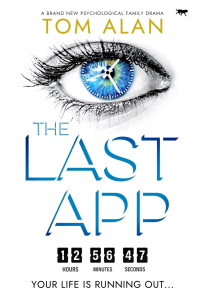
If there was an app that could crunch all the numbers of your medical history, diet, lifestyle, etc, and predict how many days you have to live — would you try it? The Last App opens with that premise, featuring an aging and set-in-his-ways doctor celebrating his birthday by buying one of the “LifeTime” devices to decide whether or not he should retire or keep working a few more years. More to the point, he’s also bought his family devices, including little eleven-year-old Will, his great-grandson. When Mick’s status as the first British customer of LifeTime turns him into a spokesman, the family’s life is changed — and some of its members endangered.
I was all-in on this book from the beginning: I loved the main character from the start, an obdurate old fogey who had never gotten on board with the 21st century and took delight in the little pleasures of life like golf, whiskey (pretty sure this book was sponsored by Bushnell’s), and good cigars. Mick is the paterfamilias of his clan, and loves treating the kids to a weekend feast. They’re not sure what to make of his sudden embrace of the newest gadget, and even more surprised when he realizes he can make the projected life expectancy go up by changing his diet, lifestyle, and habits. Out with whisky and cigars, in with powerwalking and quinoa! Mick becomes a minor celebrity in Norfolk, and the LifeTime company seizes on the opportunity to make him their shining poster boy — bringing the family along for the ride. Meanwhile, Mick’s son-in-law Andy works for LifeTime( and was pressured into selling him the devices), and his stock is soaring — but he’ll learn the company has some shady secrets and little compunction about protecting them.
Although this is…..very technically SF, it’s more of a general thriller with a slight SF finish: this kind of data-crunching software is probably available today, though in not so easy a package: I haven’t gone in for the whole fitness-tech craze like many people, so I don’t know how sophisticated they are. My last phone and its health app insisted they could detect my pulse, BP, and O2 content, and that was ten years ago. What pushes the book more into SF territory is the “LifeBuddy”, an integrated subdetermal chip and display that constantly analyze diet, exercise, etc, to provide minute-by-minute recommendations and LifeTime projection. It can also scan the QR codes of food products to determine their general healthiness, and their specific healthiness for the user’s particular needs — you may need more potassium right now, but not so much tomorrow — and oh, look. LifeTime’s health food line is optimized for your needs!
The above may have made this sound technical, but it’s much more of a family and crime thriller than any Crichton-esque dive into tech. I’d say it’s very accessible to the average reader, and it touches on matters that are already affecting us today — like the faith invested in big data’s algorithms and predictions, not counting for data that may be compromised or polluted. In Mick’s case, the LifeTime predictions for his entire family were made by him filling out surveys about their medical histories and diets — not something he’d necessarily be expert on, especially seeing as the reader and his family can tell he’s starting to lose his memory. I can’t fathom a company making serious health claims on that basis, and I’m sure Britain has something like HIPPA that would prevent outside access to Mick’s family’s medical records — he couldn’t sign off on releasing them! Alan also has a few political axes to grind, as he constantly takes potshots at British PMs and the privatization of the NHS: oddly in this book the UK has joined the United States as ‘an associate state’, but all it appears to mean in terms of the book’s plot is open borders between the home country and her most obstinate offspring: the action is constantly shifting between Utah and Norfolk, England.
I found this quite fun in general, and have already checked out another title by the author.
Highlights:
A touch of eccentricity is best achieved by not worrying about what other people think.
Mick sails serenely on, the Titanic out of Southampton dock.
He marvels at how much of his wall space is taken up by books and music; it’s like a Bayeux tapestry of his life. No wonder Paula’s and Steve’s places are so drab and empty-looking, what with their Kindlings and Eye-Pobs – his memories are there in front of him every day.
You know,’ he continues, dropping the book next to his other to-be-reads and slumping back into his armchair, staring at the ceiling like he’s forgotten she’s there in the room with him, ‘there are moments when I read a particular sentence or paragraph, that I can feel, I can really experience where I was, who I was with, when I first read it. It’s like the words are stored in my brain somewhere, and the rereading of them accesses that little box and opens it. But it’s not just the words that are inside; it’s everything else that was going on at the time. I read some of Catcher last week and suddenly I remembered Bill Bailey, I was sharing a flat with him at the time, and I could smell the curry he used to cook. I almost went out into the kitchen to check I hadn’t left something on, burning. Isn’t that remarkable?’
‘When the world is destroyed, it will be destroyed not by its madmen but by the sanity of its experts and the superior ignorance of its bureaucrats…’ —John le Carré, The Russia House
‘No worries,’ says the medic who’s making the closest examination. ‘Were you planning a home delivery?’
‘No,’ says Paula, hesitantly.
‘Well, you’re having one,’ she replies. ‘All hands on deck, please. Warm water, towels, chop chop!’
Related:
The Patient will See You Now, Greg Topol. On med-tech shifting power into citizens’ hands.
Optimal, J.M. Berger
The Circle, Dave Eggers

 Reading Freely
Sounds like the ‘associate state’ business was a cynical ploy to sell the book both in the UK and US…. [lol]
Medical records are HARD to access (even for doctors) unless you get a court order or are a hacker. LOTS of them are still on paper – so good luck with a company accessing that! Overall sounds like a moderately interesting idea.
I’m so blown away that you read a book a day 😂😂
Not usually! I usually land around 12 a month, but these were really quick reads…and I don’t have any immediately-pressing assignments so I could just relax the last two nights. Ramping up for more schoolwork, though. 😉
Pingback: September 2024 in Review | Reading Freely