
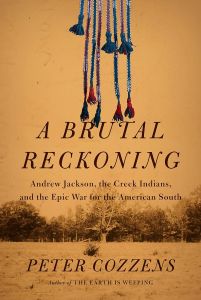
I live in a place named for people no longer present: the Alibamu[*], part of the Creek confederacy which was driven from the southeast after the Battle of Horseshoe Bend. I loved history even as a child, and it was fascinating and haunting to me to think that a people’s presence could simply be erased from where they had been. Brutal Reckoning is the story of how that came to be, which first establishes the historical background before giving a full history of the rise and collapse of the Creek Confederacy. Extensively documented and fair-minded, neither sparing grisly details nor marinating in them to shock the reader, it recommends itself easily to readers interested in the Creek peoples or the settlement of the Alabama-Mississippi territories.
Brutal Reckoning won me over in its opening pages, as it does a dive into the history and culture of the Creek Confederacy. The arrival of Hernando de Seto was calamitous for the native polities of the upper gulf region, not because of de Soto’s martial brand of tourism (what’s Latin for “I came, I saw, I grabbed some locals and left”?) but for the Old World diseases the New World’s immune system had no answer for. Cozzens covers how the Creek Confederacy emerged from that great devastation — not as an organized polity, but a highly decentralized, clan-based population of interrelated but often rivaling groups, with an economy based on hunting & some agriculture. Cozzens then tracks the ongoing effects of European trade and colonization, which created a growing number of Métis, or mixed, people — and accordingly, a mixed culture. After the British and the Creeks established regular relations, the Brits assigned a trader — to each Creek town, usually a Scots-Irish merchant who would marry into the local population. When Britain’s need for trade & tax increased, it offered more trading licenses — with deleterious results. A merchant who settled in a given town and had family ties to it felt some sense of kinship and responsibility towards its people: more mercenary traders had no compunction against soliciting as many deerskins as he could from the Creeks and rewarding them with as many ardent spirits as they’d buy. Cozzens’ account details how the Creek economy and society began reeling from this, at the same time as some Creeks were moving towards European-style agriculture and creating factionalism that would lead to civil war.
This first third of the book sets the stage for how complicated the rest of the book is, with very fuzzy and often chaotic lines between groups as both European and American & native powers vied for power on the continent. Despite the name of the Creek Confederacy, it was not an organized polity, and there were no central leaders: occasionally some talwas authority or religious figure would develop a following and inspire a movement, but if they were defeated their supporters would melt away in a moment. In addition to basic clan rivalries, there were talwas-specific rivalries. These were further complicated by the Creeks’ differing responses to European settlement, and later on the expansion of the American government: some might embrace colonial agriculture while at the same time opposing American expansion. European trade unsettled prexisting balances of power, as well as social structures, with a mixed-sex economy quickly becoming more dominated by male-led enterprises like ranching. The métis population plays an enormous role in this book, and across sides: this may owe to mixed-culture peoples having an advantage in leadership in diplomacy, with a foot in both camps, or because Cozzens draws so much on letters and memoirs from the métis themselves. Divided loyalties are a core part of what makes this history so interesting because boxed-up and convenient thinking don’t apply. Redstick leaders might militantly attack other Creeks and Americans, while at the same time maintaining their own plantations (complete with captive slaves, Creek and African) — far from being reactionaries living in the woods. William Weatherford, who led the Redstick assault on Fort Mims, didn’t even support the Redstick cause: he had been forced into it after his family was taken hostage by Redstick leaders, and then became increasingly saddled with its cause and bound in brotherhood with the men he led so that he became the man most associated with the Redsticks, so much so that it was he who surrendered himself to Andrew Jackson after the bloody Battle of Horseshoe Bend. Of course, a lot of this conflict also takes place within the context of the War of 1812: the Redsticks remained obdurate for so long, despite repeated defeats at the hands of Generals Claiborne and Jackson, in part because they believed the British would come to their aid. Both DC and London were preoccupied with the northern and eastern seaboard, though, so for the most part we have here American and Creek volunteers versus other Creeks, chiefly the Redsticks: once Jackson was able to secure regular Army troops, things come to a dramatic and bloody climax.
This is an impressively thorough history, and saturated with primary resource quotations from letters, memoirs, and reports. I suspected from the start that Cozzens would err on the side of Zinn-style history, given that he referred to the first European explorers of the region as intruders, but as the book developed I became impressed by his ability to render both the humanity and brutality of all parties involved. This is a book full of awful savagery on both sides, a grim reminder of how terrible a thing the human being at war is. Those who still subscribe to the patronizing noble savage myth will find here Creeks who delighted in taking captive brides from other Creeks long before Civilization descended upon them, and torturing male captives extensively until at least they perished — and they will shudder to read of women being raped and killed and their pregnant bellies spilled open. I’d liken it to nature red in tooth and claw, but given the human mind there’s something far more unsettling at work here: not passion, but deliberation, as victorious US Army soldiers burn towns and club children on the basis that they’ll grow up to be full-sized Indians one day. Speaking of violence, Andrew Jackson cuts a large figure here, but Cozzens does a good job of avoiding caricature. We find the backwoods orphan, coming to age amid poverty and climbing his way to respectability and authority, brooking no attack on his honor — quick to duel, and so utterly stubborn that he leads campaigns while wracked with pain and nausea and dealing with men who are unpaid and unfed. Although he’ll later catch opprobrium for the Trail of Tears, here he’s less easy to dismiss — a fierce, defiant, and resilient leader of men who — upon meeting William Weatherford — readily recognized him as a great and worthy opponent, more admirable than the men on the East Coast who Jackson supposedly answered to. (Quintessential Jackson: expressly told by President Madison to leave the Spanish alone, Jackson decides to take Pensacola regardless, because the Redsticks and Brits were using it.) He is at his worst when abandoning his former allies — all Creeks lost their lands following the Treaty of Fort Jackson, not just the Redsticks — on the basis that had the Redsticks won the inter-Creek war, those allies and their talwas would have been lost anyway.
This is substantial history, easily the most thorough treatment of the Creek War I have seen in my many years of searching for the same. I appreciate its balanced tone which does not shy away from injustice, but doesn’t attempt to turn itself into a political work; the saturation of primary source materials was especially helpful in seeing all individuals as they were, rather than heroes and villains in a narrative that excites the brain but does not have the substance of truth; the writing is easy to follow, and the illustrated plates were attractive. I will definitely be reading more of Cozzens, as he’s written several histories about the Indian Wars as well as the Civil War, including one on the Battle for Stones River which I encountered in God Rest Ye Merry, Soldiers.
[*]: It means “Thicket-clearers”.
Related:
The War of 1812, John K. Mahon. A beefy history of the war which includes an account of the Creek War within it.
Chainbreaker’s War: A Seneca Chief Remembers the American Revolution
The Spanish Frontier in North America, David Weber
The Other War of 1812, James Cusick
Battle for the Southern Frontier: The Creek War and the War of 1812, Mike Bunn and Clay Williams. A much abbreviated history of the war(s).
Andrew Jackson and the Miracle of New Orleans, Brian Kilmeade. Pop-history but fun.

 Reading Freely
Pingback: July 2024 in Review | Reading Freely
Pingback: The Best of 2024 – Year in Review! | Reading Freely