
This week has seen a little action on the Science Survey, as I read titles for the Local Astronomy and Cosmology & Astrophysics sections.
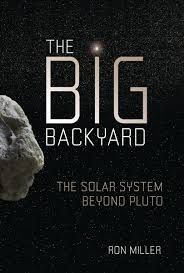
First up, The Big Backyard is a short look at the outer reaches of our own solar system, drawing on the New Horizons mission to offer a new look at Pluto, the Kupiter Belt, and the Oort Cloud after a preliminary section on the solar system’s formation that explains why the distant backyard of the solar system is the way it is. Most of the interest for me came in the Pluto information, because it’s a seriously interesting little ice-ball in space. The author refers to it as a binary planet along with Charon, in a brazen dismissal of IAU orthodoxy. Pluto has a lot more going on than previously expected: it evidently still has an active core, one that’s possibly creating new mountains, and there’s reason to believe that a layer of liquid water exists under its crust. When it’s close to the sun, as it is now, it has a bit of atmosphere — enough for haze and winds. It’s presently moving further away from the Sun, and as it does its atmosphere will become frozen ice on the surface. All very interesting stuff! If you’re interested in the New Horizons mission itself, last year I read Chasing New Horizons, on the decades-long process of getting a proper Pluto survey done. Interestingly, the volume is illustrated with art, not photographs.

After this I read The Milky Way: An Autobiography of Our Galaxy, by Moiya McTier. This is a history of the Milky Way delivered in a personal voice, with mixed levels of anthropomorphizing: Milky describes neighboring galaxies in the local groups as if they were friends, rivals, or barely tolerable neighbors, but also reiterates she doesn’t have eyes to roll, that sort of thing. There’s more anthropomorphizing than not: Milky relates to the stars as children, and talks about black holes as though they were pockmarks or scars: the big one at her center as a source of great internal trauma. (There’s even a little suicide intervention footnote at the end of that chapter.) McTier, who is pursuing an interesting speciality of combining science and folklore, deserves credit for approaching this field in a unique way: instead of an imposing text with tables and graphs and the like, this is a very approachable way to learn about the formation of the galaxy, the importance of dark matter in the same, why galaxies take different shapes, the life cycle of different kinds of stars, and so on. She also highlights a number of astronomers who have gotten overlooked by pop-history approaches to astronomy that hit a few big names. The limit of the personal approach, though, is the person: Milky struck me as frequently vain and conceited, generally deriding humans unless we were telling stories or studying her. (I was reminded a little bit of the version of Joan Crawford in Mommy Dearest…) Of course, people are a matter of taste: what I regard as obnoxious others might find charming. I’ve certainly been friends with my share of boors! This is certainly a novel approach to science: if you’re curious about the stars but spooked by straight-edge approaches, An Autobiography may be just the ticket for you. Personally, I enjoyed the referesher but think I’ll just re-watch the original Cosmos again. (…I was listening to its soundtrack while reading both of these, so I’m in the mood.)
/

 Reading Freely
I *so* need to read more space stuff. I used to be totally fascinated with it…
It doesn’t get as much book-love as biology/animal behavior/anthropology, that’s for sure.
Ditto. The vast majority of my Science reading is Biology related in one way or another. Maybe it goes all the way back to my school days when the only science subject I studied to 16-17 was Biology.
Pingback: May 2024 In Review | Reading Freely