
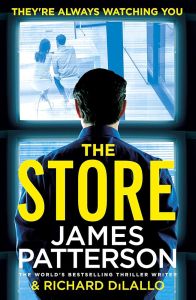
At a last huzzah in New York, surrounded by former writers who the modern economy has made superfluous, Jacob and Megan announce to their friends that they are doing the unthinkable: they’re joining The Store. The Store dominates the American economy, just as its delivery drones fill the skies and its lobbying dollars fill the pockets of politicians happy to write laws that give it even more authority and greater profit margins. But Jacob and Megan haven’t decided to sell out, not really: they’re going to beard the lion in its den by joining The Store and then writing a tell-all. Uprooting their lives, they move across the country and settle into their new home in the company town of New Burg and get to work investigating. What they find is an utter creep show: their neighbors and coworkers act like drones with perpetual smiles on their faces, and there’s always the feeling of being watched and listened to. It would be difficult enough to make the transition from New York intellectuals to factory workers in any situation, now they’re living in what feels like a cult, where the only normal people are stoned all the time. His kids, while initially uncomfortable, are quickly sucked into involvement with Store programs, smitten by the new technology, but Jacob and Megan continue to be alarmed by the weirdness of their new lives — especially by the things that begin happening when Jacob doesn’t settle down and become a good producer-consumer clone, but continues asking questions and taking notes — harrassment from cops, the disappearance of neighbors who had shared confidences. Increasingly, too, Jacob feels like Megan is pulling back from the project, becoming more comfortable within The Store as she rises through its ranks — and soon, Jacob is on the run, all alone.
Although remniscient of Rob Hart’s The Warehouse and Dave Eggers’ The Circle and The Every in subject, The Store is…well, what I expected from James Patterson: it’s airplane literature, fast and mostly empty. Eggers’ worldbuilding and execution were deeply unsettling beause they were so plausible: its characters’ behavior were warped in ways a reader could recognize: The Warehouse succeeded because it was so closely based on the actual practices of Amazon warehouses — and in both, the inhumanity appeared, emerged from practices that were simply meant to be efficient or profitable. Here, though, The Store is set up as a creepy villain: it turns its employees into cultists, it surveils everything, etc, and there’s no apparent reason for it beyond “The Store is the baddie and the reader needs to really dislike them”. Why would any company creep new employees out by having their house filled with stuff liked that which they’ve bought before, ambush them with unsettling smiling human robotics who all say the same catch phrases, and film people constantly? It was all too forced for me, and while there was some mildly interesting character drama between Jake and his wife as she becomes less resistent to The Store’s culture, this was completely ruined by the twist ending which reveals that Jake is not the most reliable of narrators. More’s the pity considering he’s about the only character with any degree of development. Ultimately, this made for OK lunch reading — I did knock it off in two settings, so I can’t say it was uninteresting — but it’s far from the level of the aforementioned works, and not substantially interesting or memorable at all. Possibly suitable for older relatives who like complaining about Amazon.

 Reading Freely
I had *some* hope for this book to begin with – which I read in close proximity to ‘The Warehouse’ – but it went *rapidly* downhill. I thought it was one of the worst books I’ve read in a LONG time & vowed from that point never to buy, and rarely to read, another Patterson book. It read like a *very* thinly veiled attack on Amazon probably because they’d peed him off in some way. Laughably bad!
My review is here: https://cyberkittenspot.blogspot.com/2021/11/just-finished-reading-store-by-james.html
Honestly, I don’t even think it was an attack on Amazon — I think he just wanted to make a novel out of people’s fears of Amazon, because beyond making the store’s origin very similar to Amazon’s, there wasn’t any solid criticism. Even the warehouse scenes didn’t bother incorporating actual Amazon practices the way Warehouse did.