
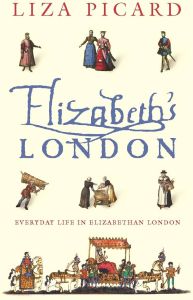
Let us travel to a city which, in great part, no longer exists: Tudor London, much of which has been erased by time, fire, and ‘progress’, which holds burying swimming pools under concrete as a capital idea. I first read Picard a few years ago, with her Victorian London, and later visited Restoration London though I neglected to review it. Picard begins here with the physical setting of London, particularly the prominence of the Thames, and moves from a discussion of its bridges and gates into the city proper. After we’ve examined some of its notable buildings, many lost now, we move into the last two thirds of the book, which examine society during the era of Elizabeth.
This is not an easy time to be alive: not only are there the standing medieval threats of disease, war, and being executed for an impressive amount of crimes, but Elizabeth’s is zealous in the defense of her legitimacy and will brook nothing that smacks of disloyalty to the Church of England and thereby to Bess herself. (The law’s consequences are not necessarily logical: some people got death for minor things, while a servant woman who poisoned her bosses had her ears cut off, her forehead branded, and was tied to a post for some time.) I mentioned in the book on Victorian London that the mount of detail Picard brings up is impressive. That’s still the case here: there are extensive section on Tudor-era food and clothing, on sewers and schools, on the growth of the Inns of Court and of the international scene where Elizabeth is vying against the powerful Hapsburg who have holdings clear from Austria to Spain. There’s less content on the poor here than in the Victorian book, possibly because less has survived on them. Oh, they’re here — and they’re in a bad way, because Henry VIII seized all of the monasteries and seized their possessions to enrich himself and his friends, closing schools and shelters that used to house orphans and the poor. (This book provided a partial answer to my question of why people would go into service: many girls who were orphaned were taken to households to be raised as servants: as bad as being a maid working sixteen hour days is, it beats prostitution or death.) The section on the poor is more about their being poor, though, and less about their culture. I was amused to learn that beggars required a license, but not all ‘beggars’ were people dressed in rags and sitting miserably in the street: instead, they could be college students who had spent all of their money on mead parties at the ol’ bear-baiting round, or mariners who had been discharged and, having mysteriously lost their money at the local brothel, were looking for a way to get home.
Happily, Picard devotes a chapter to religion: one of my gripes with Ian Mortimer is that he pretends it doesn’t really exist, which — given the deep union of culture and religion — is inexplicable. Even if one is a strident secularist who doesn’t understand what religion means to people, an attempt should at least be made. I wouldn’t say Picard goes as far as trying to plumb the English religious mind, but she does knowledge its large role in English society – -especially in this period, when priests were required to remind parishioners that if they did anything papey, like pray with beads, they were damned. The dreary curse of Puritanism was also leading paintings and shrines to be destroyed. They hadn’t yet rubbed all of the fun out of life, though — have to wait for Crumwell for that — as this was the age of Shakespeare, and we take a look at leisure activities like games that are proto-sports. Elizabeth’s London is a solid survey of City life in the late-Tudor age, but readers looking for information on society in general should keep in mind that Picard keeps tightly to her subject, to London itself, and so doesn’t address European politics or the Age of Discovery.
Related:
A Time Traveler’s Guide to Elizabethan England, Ian Mortimer
The English People on the Eve of Colonization, Wallace Notestein
Victorian London, Liza Picard. I also read Ben Johnson’s London but neglected to report on it.
A Visitor’s Guide to Jane Austen’s England, Sue Wilkes
The Time Traveler’s Guide to Restoration Britain, Ian Mortimer
A Time Travelers Guide to Medieval England, Ian Mortimer

 Reading Freely
I really need to start reading about the Tudors again…. [muses] Interesting period of our history, for lots of reasons……
Very, especially the religious chaos – Henry VIII’s “We’re Catholic except I’m the pope”, Edward’s “No, we’re UBER PROTTIE!”, Mary’s ”No, we’re Catholic”, and Elizabeth’s “No, we’re Catholic except these bits which I’ll jail you for and we’ll call ourselves Protestant!”.
Ah, the good old days – when people here actually *cared* about religion… [lol] I do find it fascinating how we started to divest ourselves of it – not without a little bloodshed along the way though!
Hardly divested — only adopted a new one that hasn’t made itself obvious just yet. Some things are only visible from a distance. In college I began realizing certain political ideologies were attempts at ‘modern’ religions, like Marxism and fascism. I’d say there’s an individual-consumer religion at work, and then a budding identity-religion that’s growing off of it.
Well, religious observance as well as people identifying as any particular religion has been dropping here steadily since at least the 1950’s and probably for much longer before that. The last census (2021) recorded the proportion of people who said they were Christian was 46.2%, down from 59.3% in the last census in 2011. As you can imagine some more conservative/right-wing commentators were most disturbed by the findings. Those who said that they had no religion went up to 37.2% from 25% ten years previously.
I’ve seen arguments that Britain was never really as religious as some people have made out. There are numerous records of common people being criticised or fined for not taking their religion seriously and the upper classes have often used religion as a tool (or a weapon) rather than a belief.
I think our religious wars and regular persecutions throughout our early history first turned religion from a public thing to a private one – someone I’ve known for decades recently surprised me when he talked about his faith and I had zero idea he was/had been a believer. I think most people I know are aware of my opinion on the subject. Religion in England is an odd thing – especially if you compere it to the USA. But the decline in affiliation/belief here is also shadowed across most of Europe – the western bit anyway – again for good historical reasons.
When you say ‘adopted a new one’, what do you mean by that? Consumerism?
At the bottom of my comment I posted a few ideas — individualist-consumerism and a new subsidiary, identity-ism. Some scholar a century or two hence will no doubt have a firm label that we would not recognize.
Ah, my brain must have skim-read that bit…! Although Consumerism is certainly an addiction & maybe even a fetish I don’t think its a religion or will ever be one or a substitute for same. I think it can be grouped in with Social Media as an endorphin provider though…. [grin]
I’d classify the latest identity fad in a similar fashion to the other fads that pass through western society from time to time – like the hoola-hoop or beehive haircuts. I think the ‘significance’ (if it actually has any) is blown out of proportion by the news hungry media. Future historians will look back on it, and out reaction to it, with a bemused shake of the head and roll of the eyes. I suspect that it’ll collapse in on itself – having no real foundation in reality – within the next 5-10 years (if it lasts *that* long!) and we’ll wonder what all the fuss was about.
I’m thinking of consumerism & individualism fusion – ’the wretch, concentered all in self’ attempting to build/expand/develop that self through possessions. I don’t even mean status symbols: people fill their homes with things that others will never see, developing some identity that they obsessively build upon until suddenly their bedroom looks like Jimmy Fallon’s in “Fever Pitch”. Erich Fromm wrote about that a little in “To Have or To Be”, which I should re-read…it’s been nearly 20 years at this point!
https://i.pinimg.com/474x/b7/85/e7/b785e77ebc750b34a771bf3e420e4227.jpg