
This week I’ve been finishing two works of nonfiction: Kirkpatrick Sale’s Human Scale Revisited and Ross Douhat’s Bad Religion: How We Became a Nation of Heretics.
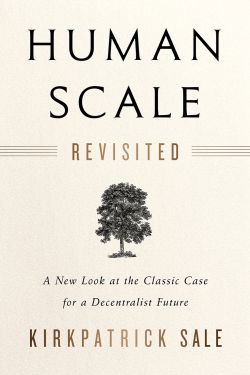
Human Scale Revisited is, as its title implies, an update to Sale’s original Human Scale, which argued that everything has a limit beyond which further growth will tend toward its destruction. He begins the book first by re-introducing that concept (“The Beanstalk Principle”), and then exploring specific applications in society and technology, from probing the optimum size for human cities to the enormous promise that decentralized/distributed power via solar panels offers, wrapping up with a critical look at the ‘need’ for states. Some of this is updated from the original book, like the study of how organizations gain in function, peak, and then become encumbered by that size, and some strikes me as new: I don’t remember the essentially anarchist arguments of the latter third of the book, nor Sale’s delightful support of movements to re-localize their own politics. Sale is one of those authors who, like Bill Kauffman or Ed Abbey, cannot be boxed up, politically: he refers to himself as an eco-leftist, but his critique of government and analysis of big-biz monopolies could come straight from the Austrian school, and he regards populism as a natural expression of peoples’ discontent with being dominated by big business and big government.I enjoyed this thoroughly, but I’ve been highly sympathetic to localism and Sale’s critiques of the Cult of Big for over ten years: before I ever read this book I’d written a post called “The Emperor Drives an AT-AT” expressing my own thoughts on the subject.) I’m definitely going to be reading more Sale.

Bad Religion: How We Became a A Nation of Heretics addresses the sudden fall from influence of mainline Protestantism, and the explosive growth of pseudo-Christianities like the prosperity gospel, as well as Christianities that effectively worship Uncle Sam instead of Jesus The fundamental shift is one of Christianity becoming ego-oriented: – not ego as in “Benny Hinn is the greatest”, but rather on Christianity being about one’s personal feelings, so that a religion that used to both bind and shock, comfort and provoke, instead becomes an exercise in self-fixation. Although this is obviously linked to the explosive rise of consumerism, Douhat also reflects on Gnosticism at length, given its orientation toward the ego, and points to the explosive rise of narcissism. There’s a lot of teeth in this book, from Douhat’s criticisms of liberal Christianity, which has so watered down its message that there’s no reason to go to church save for feeling nice and being sociable, to his attack on politically-oriented Christianity, both left and right, that has become distracted by power, and deceived itself into thinking it is possible to build paradise on Earth. There’s a lot of food for though here, though I’m not confident I’ve adequately digested it. It’s one I picked up during a $1 sale a few years back, though, so I may revisit it.
Highlights:
In their quest to be inclusive and tolerant and up-to-date, the accommodationists imitated his scandalously comprehensive love, while ignoring his scandalously comprehensive judgments. They used his friendship with prostitutes as an excuse to ignore his explicit condemnations of fornication and divorce. They turned his disdain for the religious authorities of his day and his fondness for tax collectors and Roman soldiers into a thin excuse for privileging the secular realm over the sacred. While recognizing his willingness to dine with outcasts and converse with nonbelievers, they deemphasized the crucial fact that he had done so in order to heal them and convert them—ridding the leper of his sickness, telling the Samaritans that soon they would worship in spirit and truth, urging the woman taken in adultery to go, and from now on sin no more.
Given the climate of the 1960s and ’70s, these choices were understandable. But the more the accommodationists emptied Christianity of anything that might offend the sensibilities of a changing country, the more they lost any sense that what they were engaged in really mattered, or was really, truly true. In the process, they burned their candle at both ends, losing their more dogmatic parishioners to more fervent congregations and their doubters to the lure of sleeping in on Sundays.
“Liberal religion is adept at releasing energy,” James Hitchcock wrote in a 1977 essay, “freeing people from established obligations and prohibitions, but not at refocusing it.”
At its best, the prosperity gospel can be well-meaning, openhanded, and personally empowering; and it thrives as few other forms of Christian faith do in the soil of modernity. But like many forms of liberal Christianity, the marriage of God and Mammon half-expects somehow to undo the Fall, through the beneficence of Providence and the magic of the free market. In its emphasis on the virtues of prosperity, it risks losing something essential to Christianity—skipping on to Easter, you might say, without lingering at the foot of the cross.
An understanding that there can be strength in weakness and defeat; an appreciation for the idea that there might be greater virtue in poverty and renunciation, suffering and purgation, than there is in abundance and “delight”; a hard-earned wisdom about the seductions and corruptions associated with worldliness, power, and wealth. Shorn of these aspects of the faith, Christianity risks becoming an appendage to Americanism—a useful metaphysical thread for a capitalist society’s social fabric, but a faith that’s bound, perhaps fatally, to the rise and fall of the gross domestic product.
The narcissist may find it easy to say no to others, but he’s much less likely to say no to himself—and nothing defines the last decade of American life more than our inability to master our own impulses and desires. A nation of narcissists turns out to be a nation of gamblers and speculators, gluttons and gym obsessives, pornographers and Ponzi schemers, in which household debt rises alongside public debt, and bankers and pensioners and automakers and unions all compete to empty the public trough.
From our Hallmark cards to our divorce courts, the American way of love has become therapeutic to its very core. It emphasizes feelings over duties, it’s impatient with institutional structures of any sort, and it’s devoted to the premise that the God or Goddess Within should never, ever have to settle.
Yet many conservative Christians often make a similar mistake; they emphasize the most hot-button (and easily politicized) moral issues while losing sight of the tapestry as a whole. There are seven deadly sins, not just one, and Christianity’s understanding of marriage and chastity is intimately bound to its views on gluttony and avarice and pride.
We are waiting, not for another political savior or television personality, but for a Dominic or a Francis, an Ignatius or a Wesley, a Wilberforce or a Newman, a Bonhoeffer or a Solzhenitsyn. Only sanctity can justify Christianity’s existence; only sanctity can make the case for faith; only sanctity, or the hope thereof, can ultimately redeem the world.

 Reading Freely
I *really* enjoyed Sales’ ‘Rebels Against the Future’. I can’t believe I read it SIX years ago now. It’s about time I had a bit more Sale in my life I think…!
He has one about “Bioregionalism” which I’m going to take a look at. Stumbled on an odd alt-history series yesterday — will post something tomorrow, I think. Self-published, terrible cover, interesting premise.
Pingback: January 2024 in Review | Reading Freely