
Considering that I’m about to finish my first read for 2024, it’s high time for looking back on the past year and all that. At the close of 2023, I had three goals: to finish off Mount Doom, make solid progress on the Classics Club II, and focus on more ‘good news’. I didn’t completely level Doom, but I met my primary goal of reading or discarding 80 books . Classics Club work was tolerable, and I’m not sure about the ‘good news’. I did read a lot about baseball and did a presidential series that re-humanized presidents of the 20th century who I otherwise tend to reduce to their loathsome policy decisions, so that’s something.

So, big picture, how’s the year look? Physical books, after flagging ebooks for the last couple of years, bounded back to account for just half of my reading (50.25%) — no doubt helped by my year-long assault on Mount Doom, with added support from my Blast from the Past 90s kidlit spree. I suspect ebooks will mount a counter offensive next year. Nonfiction gave fiction its usual beating, with a 65/35 split. The year’s most interesting trend, I think, was the sudden eruption of audiobook titles: I’ve read the odd audiobook in years past, but this year they accounted for nearly ten percent of my reading! Now, what were some of my most-highlighted Kindle titles?
- The Reactionary Mind: Why Conservative Isn’t Enough, 84
- The Chaos Machine: How Social Media Rewired our Minds 82
- The Unpersuadables: Adventures with the Enemies of Science, 80
- Feminism against Progress, Mary Harrington, 80
- Diary of a Psychosis:How Public Health Disgraced Itself, Tom Woods, 51
More pie!
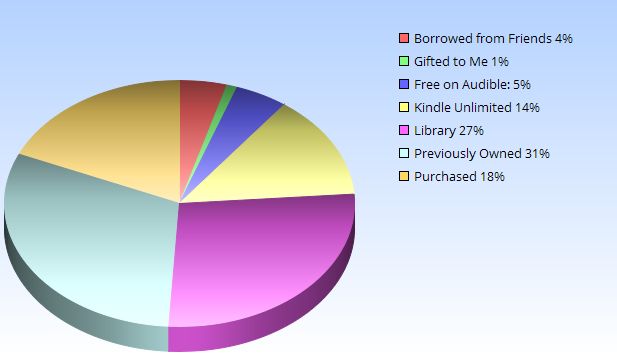
I am not happy that 20% of my reading was new purchases, but a lot of that was the Blast from the Past 1990s kidlit series, so it’s not terrible. I certainly made heavy use of my Kindle/Audible subscriptions, though I will probably discontinue both in the coming year. And now, the recap subject by subject, with this year’s top ten in bold.
History — well, you know the story. History never needs any help to dominate my reading, but received it anyway this year through a spring and summer baseball obsession, an autumn presidential fixation, and my recurring themes of Read of England and Space Camp. Favorites in this category were The Glory of their Times, which featured actual audio interviews from baseball’s golden age; Faces Along the Bar, a social history of workingmen’s saloons; The Lives They Saved, on the ‘boats’ of 9/11 and early responders on the ground; Amy Shira Teitel’s Breaking the Chains of Gravity, on space-oriented aviation and early rocketry before the Space Race started. Mike Collins’ Carrying the Fire is now the astronaut memoir mark to beat.
Science was fine by the numbers, but the only “Well, blow me down” book was Will Storr’s The Unpersuadables: Adventures with the Enemies of Science. Other Minds, on octopus intelligence and sentience, was also notable. I didn’t quite reach 20 which was my secondary goal.
Politics and Civic Interest had a healthy year, mostly thanks to that presidential streak. I started off with Adventures with Ed, followed by a lot of presidential reading, and then shifting into effects of social media and big tech on politics — particularly mental health and polarization. The Chaos Machine lead the way there. On the presidents, I especially enjoyed Team of Five, The Residence, and First in Line — the first on how former presidents work together to assist their successors; the second, a look at the White House’s staff and what light they shed on executive families; and the last on vice presidents.
Historical fiction had a year that was OK by the numbers (just managed an average of one a month), but quite good in terms of quality. Not only did I continue and finish James Holland’s “Sharpe’s World War 2”-esque series featuring a West Country sniper named Jack Tanner, but I finally tried and was blown away by The Four Winds. I also revisited a couple of old favorites, David Liss and Simon Scarrow.
Science fiction didn’t even exist until the second half of the year, and as penance I devoted October’s reading to it, with a special focus on early computer-oriented and cyberpunk novels from the seventies and eighties. While Neuromancer and Shockwave Rider were unforgettable, my favorite from that month was True Names: it helps that it was a straightforward story without the structural quirks of both Gibson and Brunner’s work. My favorite for the year, though, would be Daniel Suarez’s Influx. No real surprise there: I’ve yet to read a Suarez title that didn’t rock my world.I also visited a few Star Trek titles, with Greg Cox’s Child of Two Worlds being a favorite: it’s set on Pike’s Enterprise, but has no SNW connection.
Moving on to General Fiction. While almost all of my fiction reading can usually be dumped into either historical or science fiction, this year I had a lot of variety and explored some new-to-me genres like western and urban fantasy. I also continued reading Sean Dietrich, a southern humorist whose speciality is books that are the equivalent of stick-to-the-ribs comfort food. Rhett C. Bruno’s “Black Badge” books were unexpectedly absorbing, combining a western with supernatural elements. I found them because the Audible narrator, Roger Clark, is the voice and physical model for Arthur Morgan in RDR2. A Man Called Ove by Fredrick Backman was a favorite.
Religion and Philosophy definitely had an off year, despite my reading The Jewish Annotated New Testament for most of it. Outside of that, I enjoyed Paul Among the People, which introduced me to Sarah Ruden, and made it plain that Paul considered in his time was far more humane than modern Christians (who see him through a glass, darkly) appreciate.
In the area of Society and Culture, I introduced myself to Jon Ronson via his Adventures with Extremists, and delighted in a book I discovered via substack, Feminism against Progress
Technology and Society got a little love this year with some help from my going back to grad school: there’s a lot of overlap here with other categories, but both The People vs Tech and The Chaos Machine are worth mentioning.
So, what’s next in 2024? I have a few ideas brewing now that Mount Doom is no longer the forbidding presence it once was, but January will be a set-aside “fun month”. After that I’ll move into more structure: in addition to my standing challenges of the Classics Club, Science Survey, and Reading Dixie, I’m also hoping to check out parts of Europe that I usually miss (Iberia and eastern Europe, specifically), and revisiting southeast Asia. “A World of Cities” , which I was thinking about as a theme for 2022, will almost certainly be realized this year, as now I have access to oodles of urbanism-related books.

 Reading Freely
I think you had an excellent reading year. I’m not sure why reading on my Classics Club list dropped a bit last year, but I hope to read more from the list this year. I would be most interested in looking for The Unpersuadables: Adventures with the Enemies of Science and your favorite science fiction titles, I think.
You rocked your reading goals this year! Very nice. I’m impressed at how varied your reading is and also how much nonfiction you read. It’s almost all fiction all the time for me, although I do like good narrative NF read.
Happy New Year!
Susan
http://www.blogginboutbooks.com