
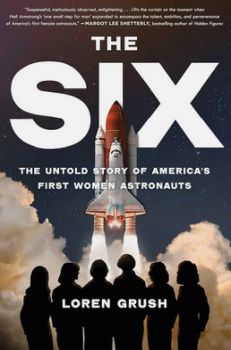
432 paages
When NASA was formed and began looking for astronauts, they settled on test pilots as the initial base: such men were already known quantities, with proven physical and intellectual gifts that could be applied to the pioneering work of Mercury and beyond. Although the Lovelace clinic tested a group of women (funded by Jackie Cochrane, holder of multiple aviation records) and maintained that female astronauts had advantages of reduced size and weight compared to men, NASA had no interest in complicating matters. Jet pilots, meaning men, continued to be the focus of NASA’s interests to put an American in space. After the moon landing prompted a shift in NASA’s mission, though, the parameters shifted: NASA wanted a diverse array of mission specialists for Skylab and the in-the-works shuttle program, and that meant people who weren’t military — who might be oceanographers or surgeons, say. The Six opens with how its subjects reacted to the Apollo program and came to be drawn to the idea of being an astronaut, and then after following their lives into the 1970s, we shift into their ASCAN phase and then follow each woman’s first mission. The result is a very enjoyable history of the early Shuttle period that occasionally drifts into gossip and whining, but is on the whole solid.
As someone who has read 48 astronaut-related books to date, I was familiar with half of the women here — Ride and Reznik appear prominently in other memoirs like Mike Mullane’s, for instance. Even so, it was good to get a direct focus on them, because I didn’t know anything about Sally Ride other than her status as an overachiever and something of a jock. The biographical was especially welcome for Kathryn Sullivan, for instance, since her Handprints on Hubble, was utterly work-focused and said precious little about who she was as a person.The book makes clear that considerable care went into choosing the first female astronaut: all of the women were accomplished, but — as with John Glenn becoming The Face of the Mercury 7 – NASA also needed someone who was good on camera, who wouldn’t be bullied by reporters but could return their volleys with grace. That was Ride, and it helped that she was the most accomplished using the new Shuttle’s operating arm, which would be crucial to deploying a package in her first mission. Although the six were connected together through their status as pioneers who had to put up with reporters asking asinine questions and a level of discomfort from the boys whose club they were invading, ultimately the shape of their training made them forge closer bonds to the people on their respective crews. Rhea Seddon, for instance, got so close to her trainer Hoot Gibson that they became NASA’s first astronaut newlyweds. Unfortunately, the author sometimes drifts into soap-opera territory, informing us that _____ began seeing ______, not realizing that ______ was now kind of into him, etc. We’re talking about six members of the largest astronaut class in history, who are completing their training as the Space Shuttle, which will create an entirely new era in NASA history, is itself being finalized — and Grush keeps resorting to locker-room gossip. (The same thing happened with Astounding, a history of early American SF that kept readers apprised of the authors’ sex lives. Why? Why?)
Given the subject matter, some degree of editorializing is present and perfectly predictable, so that most contemporary readers can read it and feel so very good for having The Right Opinions and shaking their heads in union at Those Awful Chauvinists who didn’t think a pregnant woman had any business in a T-38. It’s not constant, though, and there’s so much good content on early shuttle missions I generally forgot about the author’s occasionally attempts to lecture and gossip. “The Frog and Prince” mission is especially interesting, given that the Shuttle was carrying a French payload specialist, and a Saudi princeling: despite the crew’s worries about getting along with a Saudi, especially the women, the only awkwardness came from NASA’s bureaucrats meddling so as to not cause offense to the oil-lords of Aramco. The book goes forward to ’86 and the body-blow that was the Challenger explosion, which claimed the lives of Judy Reznik and her crewmates, including America’s first citizen in space — teacher Christa McAuliffe.
I for one thoroughly enjoyed this history of six accomplished women who were a key part of making the early Shuttle program such a success: the author’s occasionally tendencies to gossip and opine are a very minor part of this joint biography of six accomplished, driven women and the cause of discovery they served.
Highlights:
With the Shuttle system fully assembled in front of her, Sally didn’t feel like she was standing before an inanimate spacecraft, but rather a monstrous breathing animal. The Shuttle’s liquid propellants periodically vented like steam from a kettle, causing the vehicle to hiss and moan as if it were alive. It took all of Sally’s will to focus on just moving forward.
Some [astronaut candidates] tried attempts at humor. When one candidate was asked why he wanted to be an astronaut, he responded: “My father was an astronaut. My grandfather was an astronaut. My great-great-grandfather was an astronaut.” “Have you ever had amnesia?” one interviewer asked Sally. “I don’t know. I can’t remember,” Sally joked.
On August 21, 1981, George Abbey was standing in his office on the eighth floor of Building 1 when he heard a noise outside his window. He turned to see a man dangling from a rope, dressed in overalls. It wasn’t just any man, though. The stranger unbuttoned the straps of his overalls to reveal a Superman costume. The Man of Steel then pounded on the glass while singing “Happy Birthday” to George, who that day was turning forty-nine. As soon as the dangling crooner finished the song, he rappelled to the ground and disappeared from sight. George just stood there and blinked.
“We have liftoff!” Crip called out. In that moment, Sally knew she was no longer in the driver’s seat of her life. “All of a sudden, I felt totally helpless, totally overwhelmed by what was happening there,” she said later. “It was just very, very clear that for the next several seconds, we had absolutely no control over our fates.” Completely at the mercy of NASA’s army of engineers and mechanical prowess, Sally surrendered herself to the space shuttle Challenger as it burst forth through the clouds, thrusting its precious cargo into the stratosphere. The Shuttle twisted through the air, rolling onto its back as it took a glorious swan dive into the sky.
But as she looked down at the nighttime side, watching the twinkling lights of the world’s cities and infrastructure below, a thought struck her: “Right down there in one of those little patches of light right now, there could be a little girl looking up at the sky and pointing upward and saying to her mother, ‘Look, mommy, it’s a satellite.’ And she’s pointing at me.” It reminded her of when she was a little girl, pointing out satellites in the sky to her parents. Now she was that satellite in the sky. And perhaps that girl down on Earth could one day travel to space like Kathy did—or even farther.
“Up here, Ellison, the sun’s shining in,” Mike said over their headsets. “At least we’ve got the crew arranged right for people who like the warm and cool—got you out of the sun.” Flight controllers spoke into Judy’s ear, asking her for a communications check. Feeling particularly amped that morning, she yelled in reply, “COWABUNGA!”
Related:
Fighting for Space: Two Pilots and their Historical Battle for Female Spacecraft, Amy Shira Teitel
Through the Glass Ceiling to the Stars, Eileen Collins. The first female ISS commander.
Handprints on Hubble, Kathryn Sullivan. Interview with Sullivan from early 1970s.
Fly Girls: How Five Daring Women Defied the Odds and Made Aviation History, Keith O’Brien

 Reading Freely
48(!) astronaut books….. IMPRESSIVE! [lol]
50, actually. I hadn’t added those two Mir books from August ’23 yet. XD
Pingback: Space Camp Readings | Reading Freely
Sounds great. I think the graphic novel biography by Ottaviani I read used this one and others for his documentations