
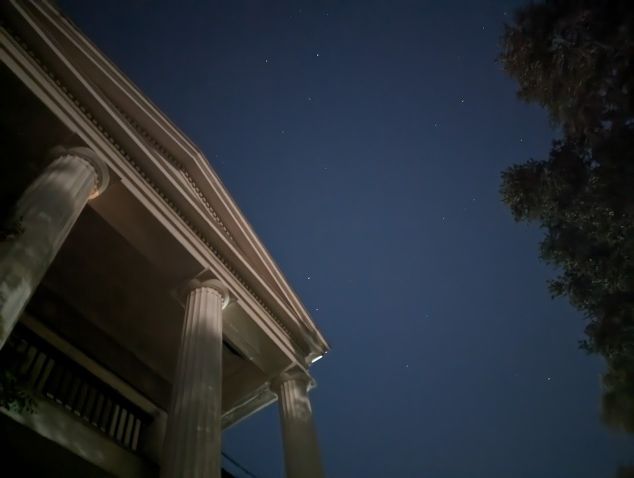
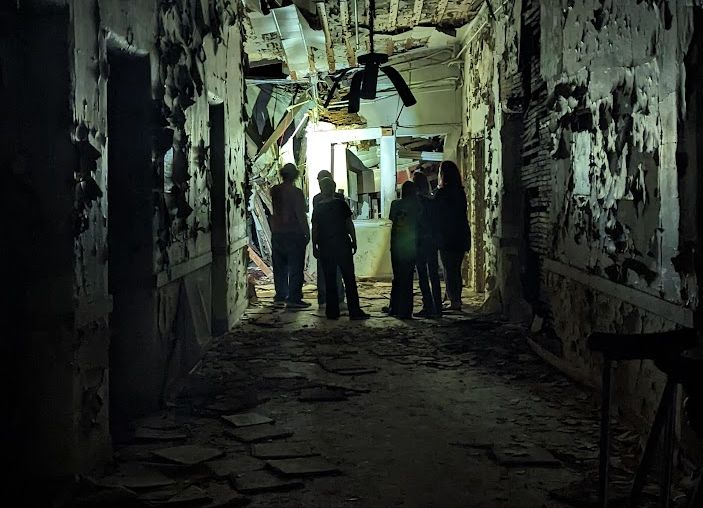
“Everybody good where you are? Okay. We’re going dark. All lights out.” In the long-abandoned upstairs hallway of King Memorial Hospital, known more recently as Dunn’s Rest Home, a group of ghost-hunters and urban explorers all pocket their cellphones or turn off their flash lights. Darkness returns to this decaying space — marked by paint peeling in waves from the walls, floors covered in fallen tiles from drop ceilings that lived up to their name, and miscellaneous waste from the building’s past lives and past explorers. Abandoned cigarette packages mix with print-offs urging patients and staff to moderate their water use during this period of rationing. Their attention turns to a small box on the floor, emanating a red light. If a spirit is near, most of them believe, the box will detect its energy and light up. Although moonlight breaks in further down the hall from an area of the building broken open by a tornado, the darkness is deep and thick if not comprehensive. The device glows steady red, and everyone listens to their own breathing, feels the sweat tricking down their backs, and tries not to make a sound.
I am one of that party, there not for ghosts but for history. I’m my library’s local historian and was asked by a local journalist to brief him on the history of this building. He was facilitating the investigation of the building by a group of ghost hunters, with permission of the building’s legal owner. As it happened, I didn’t need to do any research: I knew much of this building’s story from my own prior hunts. After listening to my spontaneous and excited lecture, he said — “You know what? Why don’t you join us? ” I jumped at the chance. I’ve wondered about what this building looked like from the time I returned to Selma in 2010 even before I’d searched for its story, and I loved the idea of seeing part of the inside.
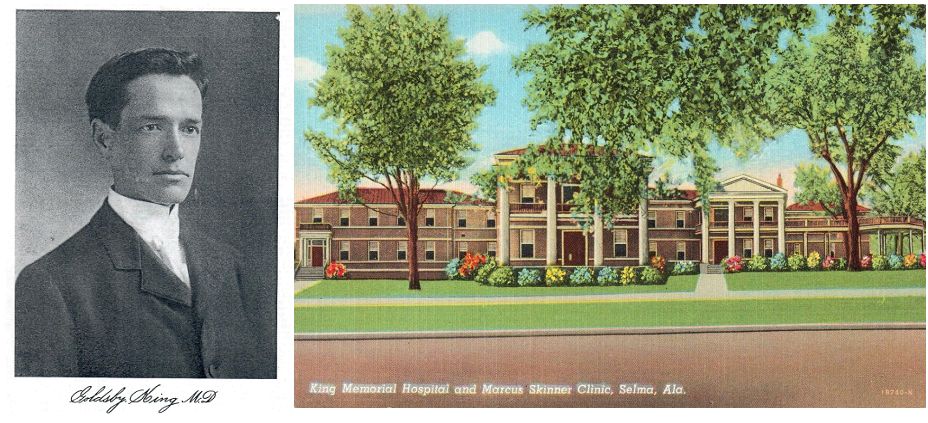
The building’s origin lays sometime in the late 1870s, when the heart of it was constructed as a residence for young Dr. Goldsby King. King was a remarkable young man, evidently orphaned in his teen years when he appears in papers as the ward of a prominent local physician. Dr. Thomas. As Goldsby’s father was a banker, it would appear Thomas had a decided effect on his young ward’s future career. King would study medicine in the Carolinas, and Germany, and at John Hopkins before returning to Selma to begin a practice. He was obsessed with medicine and soon held the position of City Physician — an important post in an age of deadly epidemics. The city hospital wasn’t a stable institution by any means: in the 1870s it was abolished as a cost-saving measure. Perhaps that motivated Dr. King to create the King Sanitarium.
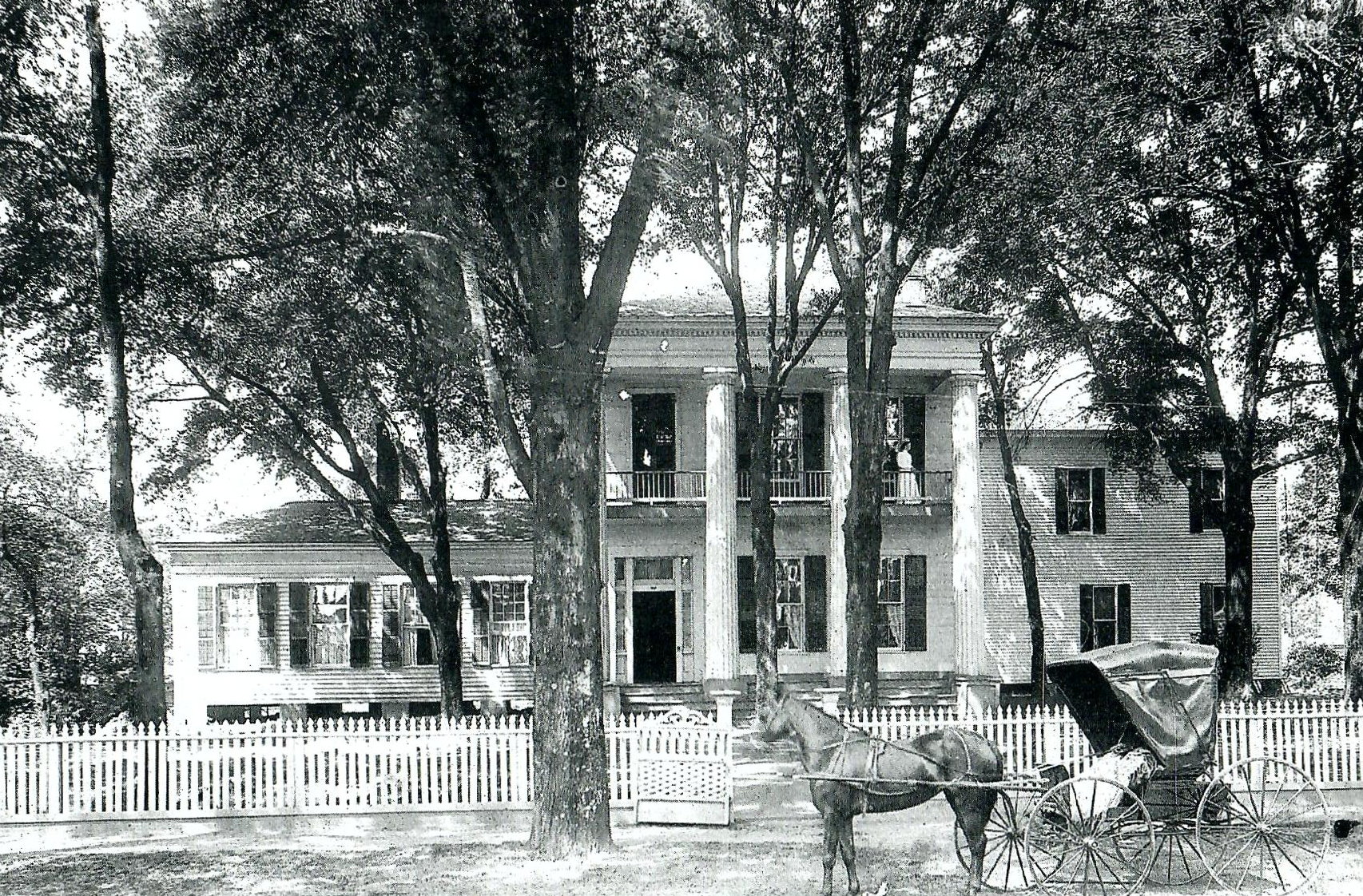
The residence on Mabry expanded and opened as Selma’s first private hospital in 1896, and soon established itself as one of the South’s finest. There was a reason for that: not only was King an obsessive student of medicine, but he spared no expensive on making his hospital the best it could be, from the silverware to the linens.
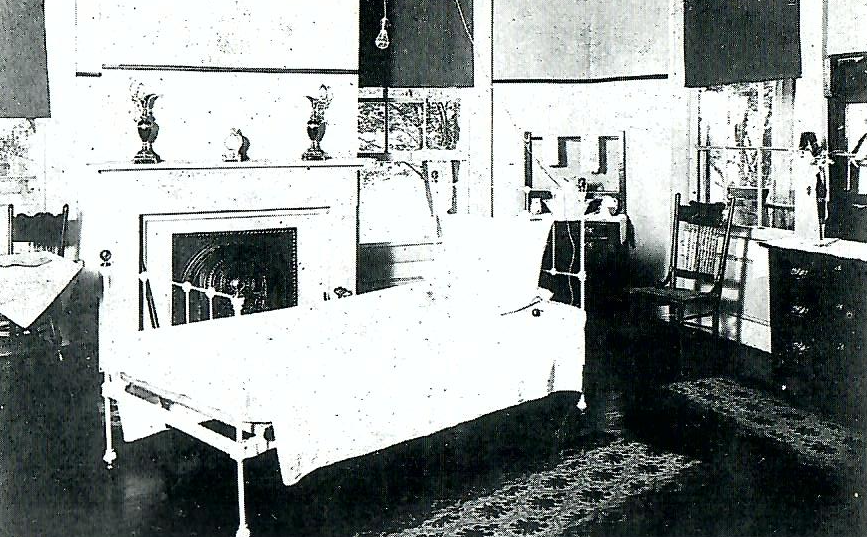
The hospital had its own breed of Jersey cows to provide fresh milk and butter; he and his wife grew flowers for the patients’ rooms. The latest medical instrumentation was continually sought after, and the thorough medical library grew by the year. King was a physician in the best sense of the word; he attended not merely to the needs of the body, but to the person. He paid attention to the patients he served, taking care to straighten portraits and even to avoid wearing a tie that they might find garish. So pleasant an atmosphere did he create that one Selmian remarked the best part of her summer was a two-week stay at Dr. King’s. When teased for the wealth he lavished the building, King replied — “Other rich men have their yachts. My Hospital is my yacht.” Dr. King died abruptly in 1920, but his hospital (renamed the King Memorial Hospital) lived on until the 1950s, at which point the building was purchased by another party and became a nursing home until the early 2000s.
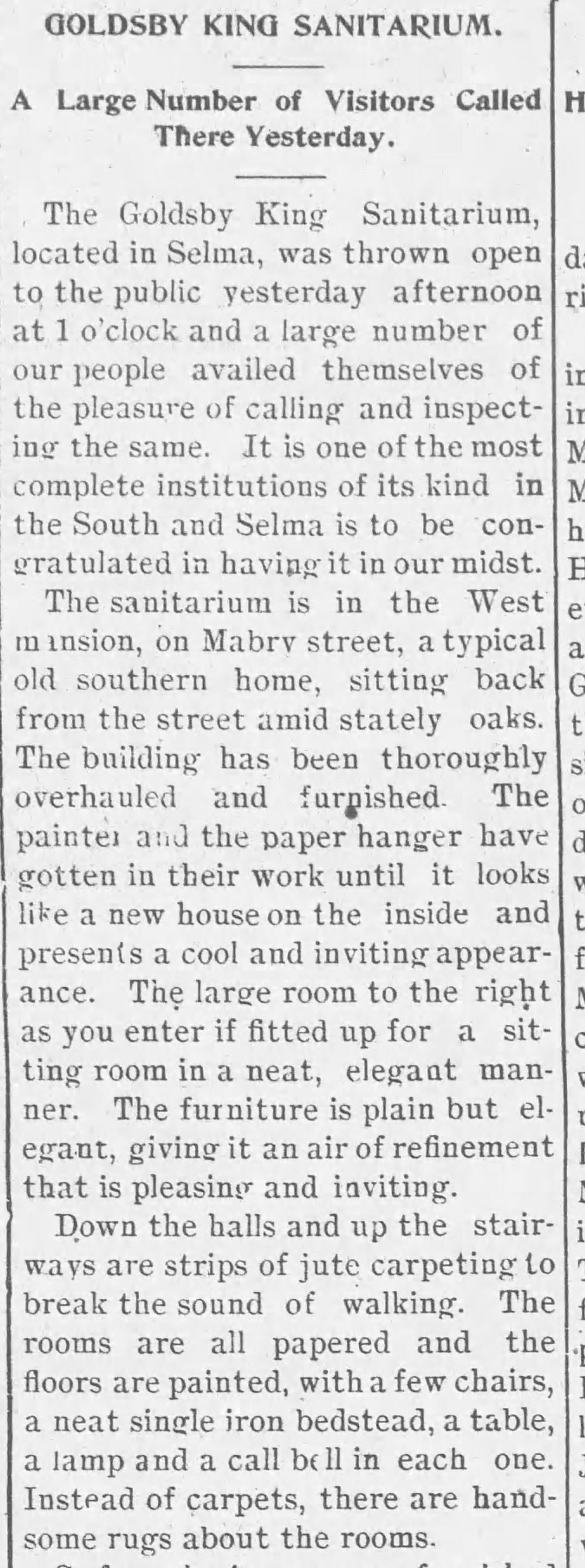
Goldsby King is the reason I was so interested in this building. I find him remarkable — a prince of a man, a Selmian who should be known, not forgotten. He was born into privilege, beset by tragedy, but determined to live a life of benevolence and service. A bit like Batman, but without beating up criminals. A mind such as his could have enjoyed no end of acclaim, but he wanted to serve his city, to make the Central City the true Queen of the Black Belt. I wanted dearly to see the building he’d created, although I knew it has undergone at least three major renovations — in the 1890s, 1950s, and 1980s. How much of the original building’s interior remains, I can’t say: the staircase is so sturdy it may be original brick, but one can’t tell, covered as they are by 1980s plastic cladding. The no doubt handsome ceilings are obscured by that modern creation of drop ceilings, which provide a useful function of giving wires and such a place to live but cover up beauty with cheap plastic tile. Most of what is visible is modern: pipes, sprinklers, old alarm bells. The occasion was an unusual one for me: I am not a ghost-hunter, and indeed would count myself more as a skeptic on that front. I am not, as I was in my early twenties, wholly closed to the idea that something lays beyond our material realm: indeed, I have experienced at least two of C.S. Lewis’ “stabs” of joy – not giddiness, but moments of transcendence in which I realized if there is not something else out there, there is at least something profound happening that needs to be reckoned with, responded to. I threaded an odd line this night: largely a skeptic, but at the same time recognizing that the people around me believed in the possibility that some trace aspect of human lives past still remained here, that some fragment of their personalities existed and could be contacted. I took them seriously without taking their ideas seriously, if that makes any sense, and was content to observe and reflect while at the same time focusing on what I was there for — which was studying the building.

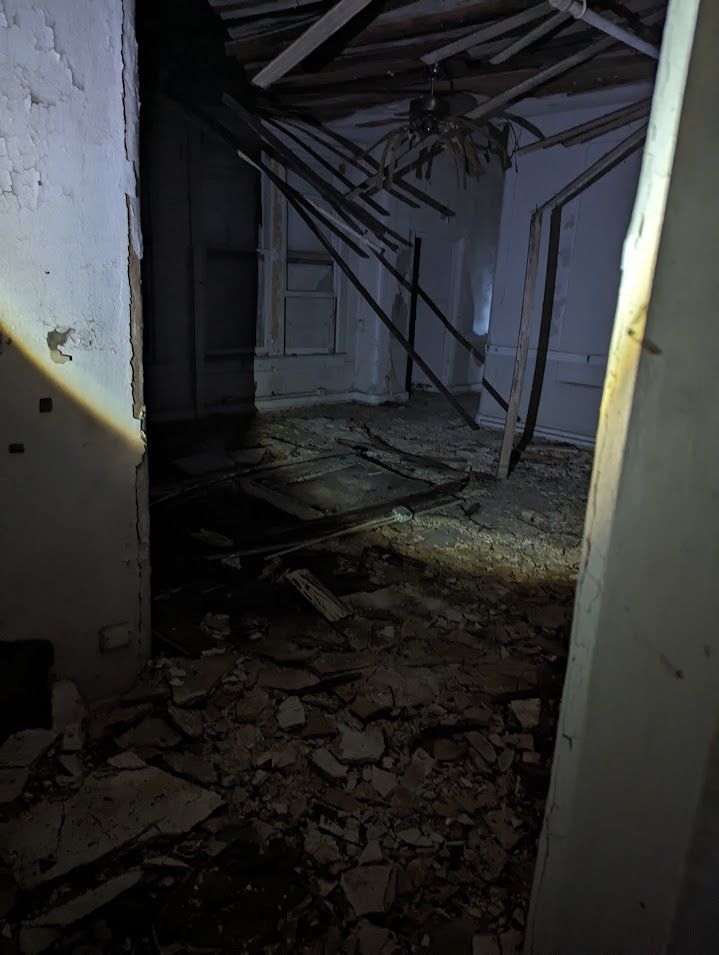
Although I knew from the papers that the building had been renovated in the 1980s, and that this had been a nursing home as late as 2000, it was hard to reconcile that with what I saw inside. Parts of the building had completely collapsed: from one hallway we could look up into the hallway of an inaccessible part of the second story, seeing even the doors to patients’ rooms on left and right. Parts of of the building had been boarded up as wholly unsafe: prior to my coming here, I was emailed by a city councilor and friend who told me he lived in the neighborhood, and had watched the building physically deteriorating by the day since this area was ravaged by the January 12 tornado. He urged caution. I longed to be able to see this space as it was in Dr. King’s day, but knew that was impossible. Still, I paid attention to what which endured — were those wooden walls original, or added? As a historian I constantly fixated on small details — the model of a soap dispenser, the nature of a print out on the floor, the font used by a cigarette package. Those details were little revelations, little keyholes into this building’s past. Parts of it were labyrinthine; I could tell that it began as a private residence and was later expanded into a maze of add-ons.
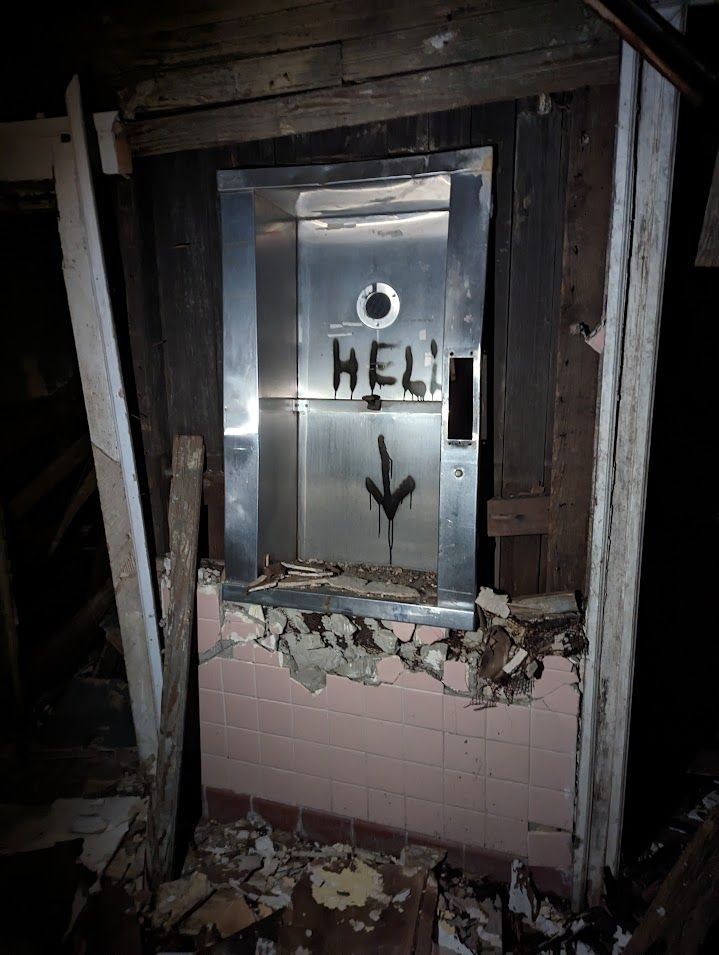
We had partial access to three levels of the building: the ground floor, which consisted of a former library (no books, alas), a kitchen with a dumbwaiter to Hell and presumed office spaces; an upstairs which would have had patients’ rooms; and a sublevel that had been home to the psychiatric unit and had been partially co-opted by homeless people (one of whom was studying for the GED — I hope you did well, Brandon, wherever you are now.). We were extremely careful about where we went: the building had been scouted during the day, though I assume the lighting conditions were similar as to when I arrived at night, given the lack of electricity and the fact that most of the accessible areas were interior rooms with no windows. If I had been alone, I would have undoubtedly been creeped out by range of decay — but as it happened, I was among friends. I knew the journalist who invited me, for instance, and several of the guests — including a nurse who worked here in the 1990s and Selma Sun’s publisher who is also a flautist I’ve sung with on occasion. We were not alone, but together on an adventure — for some of them, into a dark realm with the salient chance of running into spirits, and for all of us, into a dark and decaying building which we were wary of. The archest of skeptics would tread softly here, given the abundance of fallen wood with protruding nails, the possibility of wildlife, and frankly the real chance of the floor caving in and surrendering us to whatever lay Below. In large part, we had to guess at the nature of the rooms based on the detritus that remained: this had a dumbwaiter and a lot of plumbing, so it was possibly the kitchen; that area had rooms with padlocks on the doors and even a particular padded room that was soundproofed, so this was probably a psychiatric unit.
As far as the realm of the spirits go……well. Various people were holding “EMF Readers”, including myself as requested. These went beserk in the presence of visual light, but were largely dormant most of the time — aside from some upticks that were not consistent. There were also devices on the floor that were thought to be sensitive to some kind of ghostly energy, but were inactive most of the time I was there. The exception came during a period immediately after that “lights off” moment, in which one of the ghost hunters made an adjustment to the device increasing its sensitivity. Thereafter it lit up a few times but would abruptly stop as soon as people began asking questions. Some people had apps on their phones that would translate ‘background energy’ into audio, and after the group I was in had done exploring upstairs and downstairs, we returned to the revelation that several spirits had used the app to say hello, and that one of them was five and that her body was around somewhere. I volunteered that a mass of bones was discovered near this property when digging the foundation for a nearby house: they’re suspected to be bones removed from surgery. I was a little amused to hear spirits from the beyond apparently speaking through Siri. Another piece of equipment used was some kind of recorder that the ghost hunters said could pick up audio emanations that we could not hear before capture by the machine. People were all over the place as far as credulity goes: some were very skeptical when a given device lit up, trying to make sure no one’s phones were nearby and creating false positives; another, when she realized her device had turned off at some point, heard the suggestion that the spirits had turned them off. Evidently the spirits were active earlier in the day, and had told the group — “Be careful, leave,” — but were now preferring to stay silent in the dark. The nurse said the place had been regarded as haunted in her day, especially by the night shift.
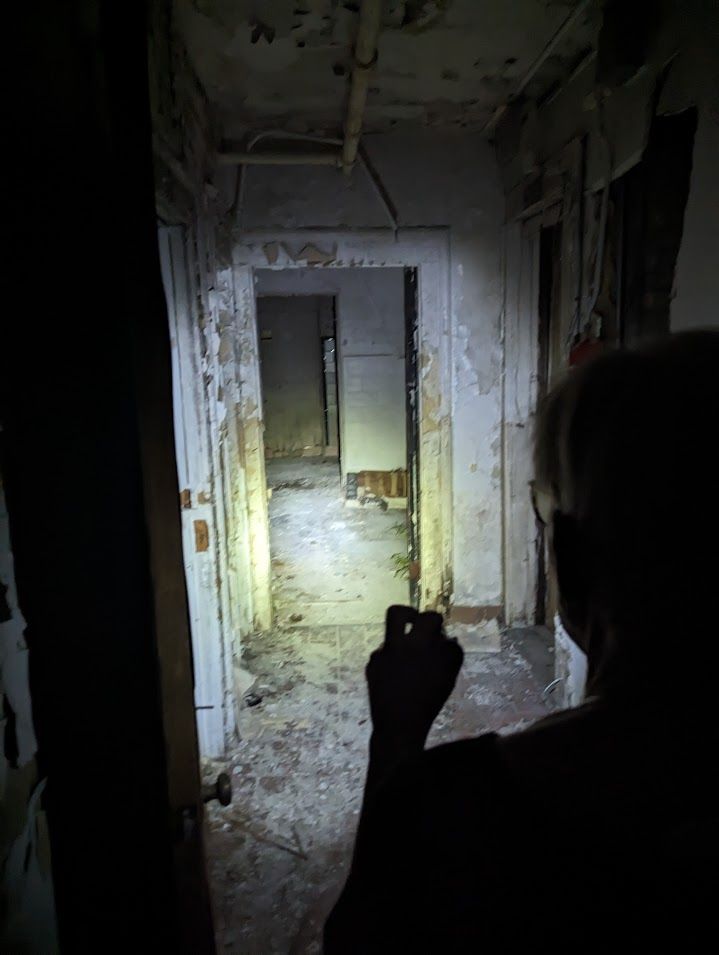
All in all, I enjoyed the evening. It was strange, of course — strange to be around people who ardently believed something I didn’t, strange to be in a building so decaying — and exciting in ways. We were not in a safe place: navigating to the psych ward meant climbing over a part of the building that was visibly collapsing, and there was a pit in the kitchen that we were all told to avoid. The dumbwaiter nearby informed us it went to Hell, and when a friend of mine pointed out there was a switch and put her hand on it, I joked with her that this is the part of the movie where the audience is screaming at her not to touch the switch,and if she does we’ll spend two hours running for our lives and bemoaning that she should have just left it alone. We could have gotten lost: when returning from the psych ward, we made our ways back largely by a chain of graffiti that we’d remembered. (“Okay, there’s the weird line about messiahs….there’s the weird symbol that’s probably a —- ….and here’s the boardroom! Okay, now we just have to climb over the pit again.”) Part of of me, I’ll admit, wondered if something might happen — even if it was just created by our minds, so primed by this place of decay. There was a funny moment when a door opened by itself, but that was just one explorer who had figured out another route into a hallway, and then opened the door at an angle to give us a laugh.
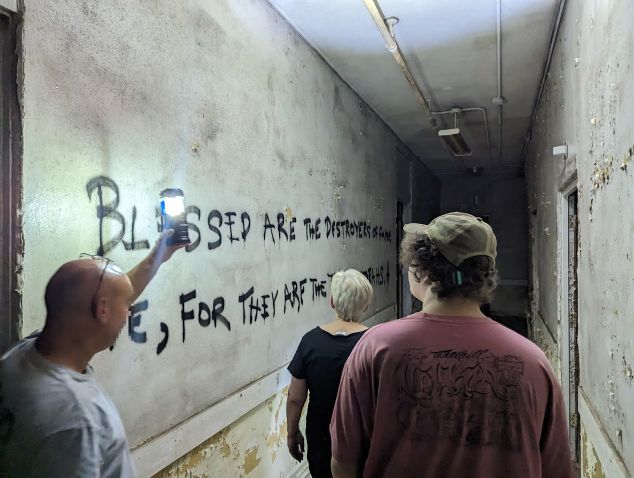
I never experienced anything otherworldly, and nor I think did anyone else — there were brief flashes of interest for some in our party, but the common view was that there were too many people making too much noise, or that the spirits had said what they wanted to say earlier, before the live stream. One person who identified as a psychic said there was great sadness in the building, but if I was forced to hang out after my death in an abandoned property occasionally invaded by teenagers, Satanists, and the like I’d be fairly glum, too. There are those who believe this property can be saved, and I hope they are right. Certainly, the older parts have solidity to them, built before we resorted to cheapness like balloon-frame walls. These walls were thick and steady, and although the modern drop ceilings had surrendered to time, the rafters exposed by them looked good. But we postmoderns, we are conscious only of our brief moment in the temporal spotlight, and we neither appreciate what was built for us, nor do we build for those who follow us. Would that more men like Goldsby King lived among us!

 Reading Freely
Wow!
Your Dr King must have been an amazing person. I was very amused by he and his wife keeping a Jersey cow to provide the patients with good quality milk and even more so by learning they grew flowers for their patients. Their kindness was extraordinary.
Like you, I’m very interested in buildings and am a sceptic when it comes to ghosts. If I see it for myself, I’ll believe it, but until then…
I occasionally visit derelict commercial buildings for work and most recently, frightened myself with my own reflection in a mirror! The next terrible thing was dead mice underfoot. Although that was a new-ish building, they also deteriorate quickly when not in use.
Years ago I worked for an organisation whose abandoned buildings had heritage status, which was much more interesting. There was one lovely old Art Deco building amongst them that was said to be haunted but the scariest thing for me there was the asbestos. It wasn’t as derelict as the King Memorial Hospital, luckily.
Thank you for sharing your adventure, I enjoyed your post very much.
He was known to serve the needs of black Selmians, which in the 1880s (the start of Jim Crow/Segregation) would have been borderline scandalous at the time. I don’t think they were admitted, but he must have made house calls. I found evidence a little later in the early 20th century that black patrons were admitted to the hospital for surgeries, but immediately transferred to Good Samaritan (a Baptist-funded, Catholic nun-operated hospital for the poor) for recovery.
I’ve watched ‘urban geography’ videos a few times over the years….one thing I was thinking about was the presence of other people in the building, but we didn’t see any signs of immediate residence. I’ve seen urban explorers react to realizing they were being followed/watched after they reviewed their footage on youtube.
For Selma’s Dr King to have made house calls to black patients at that time makes him all the more worthy of admiration. I can imagine that he would have had to deal with opposition from people who didn’t approve, but hopefully he also inspired others during his lifetime to treat other people with dignity and kindness.
I watch some Australian urban geography YouTubers, too, but have never seen them realise they were watched or followed. It sounds scary. The squatters would have a sense of ownership over ‘their’ space.
Sounds like FUN – especially as you were an SME (Subject Matter Expert) at the event. Are you being invited back?
Oh, and *loved* the switch comment. I would’ve been the one either clicking it or shouting at the person who was about to – STOP!!!
Sorry, I thought I’d replied to this. I don’t know if this same group will re-visit Selma, but I got the impression that I’d suitably impressed the locals involved (though, frankly this building is an outlier — I couldn’t give lectures about just ANY random building in Selma) that if they investigated again they’d ask me to contribute what I could.
Tell me if I’m wrong but was Dr. Thomas, who King was a ward of, Dr. Thomas P. Gary?
I’ll have to dig back into my King notes to see if I can find a full name for the doctor, but I would have been using Thomas as the man’s last name. I just looked up Dr. Gary’s obituary (18 Dec 1907) and it doesn’t list any connection to Goldsby King, though given their Selma residence and professions they would have certainly known each other.
Pingback: Haunted house BNB? + WWW Wednesday | Reading Freely