
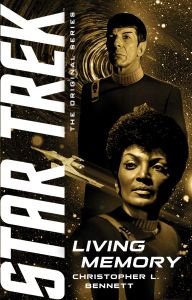
When Starfleet begins analyzing a series of disruptive and potentially dangerous flares in space, Commander Pavel Chekov realizes there’s a pattern: these flares mostly in places visited by the Enterprise on its five-year mission, albiet in reverse order — and the one exception is a place visited by Uhura. As more flares happen, one in the middle of a city, a death toll begins and Starfleet fixes an accusatory gaze toward the former comms officer whose personal memories were erased by the NOMAD probe, who can recall nothing about her leaves from this time to contribute to the mystery or defend herself. But she’s not alone: the Enterprise crew, despite being on different ships and assignments, rally like the family they are. Admiral Kirk, meanwhile, has a bit of a problem, as a pilot program he endorsed to incorporate a group of young people bred for war into Starfleet (teaching them the ways of peace and Shakespeare-quoting) is causing some strife and a wee bit of murder — and worse, he and Bones are smitten with the same woman, a vocal opponent of the program. Oh, the drama.
Whenever I return to the original series, it tends to be for particular episodes — “Arena”, “Balance of Terror”, etc, and so I’d forgotten about the whole “Space probe tries to exterminate everyone on Enterprise” plot that also caused Uhura’s memories to be wiped…at least, until next week’s episode. Living Memory explains how Uhura bounced back so quickly, using one Federation member planet’s mind-structuring technology to restore her technical/explicit skills — but not her actual memories. Uhura and friends begin exploring Uhura’s past, talking to her family and friends from her Academy days to learn what project she might have been working on so devotedly, and this forces Uhura to face parts of her past she was previously willing to pretend didn’t exist. Although the Uhura A-plot is the novel’s strength and great attraction, the moral issues posed by the Warborne group were interesting, especially given that Bennett does not create simple antagonists or characters, but allows the argument to become truly complex and fascinating to the reader to consider.
Bennett is a Trek author who reliably delivers good reads, and this was another solid one. Motion Picture era books are relatively rare, so I was glad to dig into this one and see the Enterprise crew just as they were beginning careers apart from the salad days of their five-year mission.
Highlights:
“Some officers pride themselves on punctuality,” Kirk said. “You should try it sometime.”
“Ha, ha. If I have to be insulted, I’ll just go find Spock so I can get it from an expert.”“Resisting temptation means nothing if the temptation is not present. The one time they were offered a justification, they took it.”
“After resisting it as long as they could.”
“True resistance does not yield.”“I will not dignify that sophomoric insinuation with a reply.”
“Sophomoric is next year. I’m just freshmanic.” He shrugged. “And if I flunk my exams, I’ll be freshmanic-depressive.”“We have believed ourselves to have no leads before. Further investigation has produced new ones.”
“Which have all gone nowhere.”
“That is not predictive of future outcomes.” She laughed. “You know, Doctor McCoy is wrong. Your logic can be very comforting at times.”
Sulu had smiled. “ ‘It is a capital mistake to theorize before one has data. Insensibly one begins to twist facts to suit theories, instead of theories to suit facts.’ ” He had shrugged at her stare. “Captain Spock likes to quote Sherlock Holmes.”
Let’s just say that spending time with Jim and Spock tends to get a fellow thrown in an inordinate number of prison cells. I guess some of that rubbed off on you too.”
McCoy reached over and touched her hand. “You want to believe in everyone. It’s a wonderful quality. But it means you’re bound to be disappointed sometimes.” After a moment, she pursed her lips and tilted her head.
“Well, I guess you’re right. For instance, I believed you’d be a better cook than this.” He feigned offense.
“My dear lady, I am a doctor, not a restaurateur.”It proved what Surak had taught: No life was incidental. The death of a foot soldier or an innocent bystander could have consequences greater than the death of a king or a general, for all lives were interconnected in intricate and unpredictable ways.
Related:
Bennett’s annotations at his website Written Worlds

 Reading Freely