
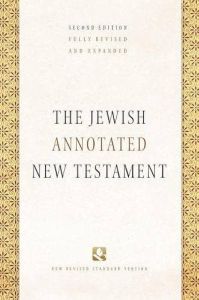
ed. Amy-Jill Levine
856 pages
(Yes, this book is why I’ve been so quiet the last two weeks.)
The relationship between Christianity and Judaism has fascinated me ever since I bolted from the Pentecostalism in which I was raised, and began rebuilding my worldview from the ground up, investigating the bones of religions and philosophies to figure out where the truth was. While listening to Jewish lectures at simpletoremember, I was struck by how very different the Judaism expressed there was from the background of the Gospels, particularly in the role of Satan — who leaps from being a mere accuser of humanity to being the Archfiend, the would-be rival to the Almighty in that blank page between Malachi and Matthew. Over the years, I’ve read various books exploring the eruption of Christianity from first-century Judaism, and have eyed this volume (owned by my several priest friends) covetously for a decade. Now, I’ve finally tackled it and and am happy to report that it’s a worthy resource for understanding the world in which the New Testament came into being, and for appreciating the intertangled evolution of both Judaism and Christianity.
The work is divided into two parts: the New Testament itself, subdivided into the Gospels, the Epistles, and Revelation, each with an introductory essay; and then the contextual essays following Revelation. As annotated would indicate, though, there are also in-text comments throughout, spotlighting a custom, a translation, a moment unique to a particular Gospel, etc. These are especially interesting in Revelation, given its fantastic imagery and numerology. These aren’t merely a line or two, though, but often run for several paragraphs –as when the authors analyze the use of “Sanhendrin”, or comment on themes that a particular Gospel is marked by. These comments frequently link to the essays that constitute the bulk of the JANT’s unique content. The essays are substantial, addressing everything from the backgrounds of the New Testament (Jewish life in the first century, the political situation with Rome, the varied manifestations of Jewish thought and belief) to the relationship between Jewish thought & art to the Christian civilization in which most Jews lived within through the 20th century. There are a great multitude of topics within, which would appeal to readers with varying interests. One essay concerns Philo, for instance, a Jewish philosopher whose tripartite view of Deity presaged the Trinity. Some essays would be at home in any study Bible, like the background pieces or the study of how the Jewish and Christian communities came at establishing their respective canons. Interestingly, some of authors often refer to The Old Testament, not because they are Christian but to differentiate the Hebrew scriptures-as-canonized-by-Christians from the Hebrew-scriptures-as-canonized-by-modern-Jews. The Ortho-Catholic tradition includes Jewish texts that are not written in Hebrew, for instance, and which were later dropped by rabbinic Judaism and most Protestants — though most of the latter were just shuffling along in Luther’s footsteps, and he wanted to drop even more of the New Testament than that. Other essays are more concerned with the New Testament within the Jewish tradition — connecting the parables to examples used in midrash interpretation of the law, as well as the way Jews have varied in their approaches to Jesus and Mary over the years: in the medieval era, we can find both insulting nicknames adopted to refer to Jesus, Mary, and Peter while at the same time the use Christian imagery in Jewish art. I wonder if Chaim Potok was aware of that when creating his Asher Lev.
This is a deep book, one that I’ve read slowly over the course of eight months but even still don’t feel as though I’ve done more than broken the surface on. I anticipate returning to it again and again, especially the essays. Although I’ve read into the background of the New Testament before, I still found much of value here, particularly in the book’s general demonstration that first-century Judaism was less a formal, organized Religion and more of a religious culture, with a variety of sects with different emphases — and likewise Christianity, given that the Dead Sea Scrolls and Nag Hammadi texts are brought in for more context. The Sadducees, for instance, were oriented toward worship and the Temple; the Pharisees were oriented more towards the Torah, and the interpretation and adherence to thereof, and more closely connected to post-Temple rabbi-led Judaism than Temple Judaism. The authors argue that Christianity and Judaism was we know it both emerged from this variety of Jewish thought, and are effectively sister religions — a conviction shared by many Christian authorities today, who regard Judaism as an elder brother.
Again, this is a very worthy book for students of the Bible, Judaism, and Christianity, and in the future I want to try the Jewish Annotated Apocrypha and The Jewish Study Bible, all part of this same series. There are a couple of things I’d quibble with in this (one author attributes the Great Schism to arguments over whether the Eucharist used unleavened bread or not — the biggest issue was papal authority, made most salient during the filoque controversy), but those are minor details.
Some quotes:
The New Testament refers to Jesus as “rabbi,” transliterating the Hebrew title into Greek and defining it as “teacher” (Jn 1.38; 20.16). Ironically, this makes Jesus the earliest attested person in literature to bear the title “Rabbi.”
All this “Mary-naming” suggests that these are real, first-century Marys. An author who is writing fiction, and who wants to create memorable characters, would have chosen a variety of names for the heroes and heroines. However, as epigraphic and additional literary evidence suggests, in Jewish society at the time a quarter of the female population bore the name Mary.
[quoting Albert Schweitzer] “But it was not only each epoch that found its reflection in Jesus; each individual created Jesus in accordance with his own character. There is no historical task which so reveals a man’s true self as the writing of a Life of Jesus.” Many of the early historians Schweitzer studied were liberal Protestants, and their reconstructions of Jesus tended to portray him as a liberal Protestant. Along the way, they also “de-Judaized” Jesus, stripping him of his Jewish identity and context.
This type of liturgy was unique to the ancient world. No such form of worship featuring the recitation and study of a sacred text by an entire community on a regular basis was in evidence at this time; we know only of certain mystery cults in the Hellenistic-Roman world that produced sacred texts, which were read on occasion, and then only to initiates. The self-laudatory tone of the Jewish sources in this respect may well reflect their authors’ desire to trumpet this unique form of worship.
One prominent rabbi from the second century believed that crucifixion nails might be worn on the Sabbath (and by implication at all other times), because they were believed to have healing power. Others questioned the value of this remedy and branded it idolatrous (Heb darkhei ha-Emori, lit., “the practices of the Amorites”; cf. the discussion in m. Shabb. 6.10). The power of such nails is known from non-Jewish sources as well, and one could imagine that such nails would have been a sought-after commodity.
The process of translating Jesus’ Jewish–identified Aramaic into Greek sometimes extends to an erasing of Jesus’ Jewish context. Thus, while Jn 1.38 refers to Jesus as “Rabbi” (followed by a parenthetical explanation, “which translated means Teacher”), nearly everywhere else in the New Testament Jesus is addressed with Greek terms that obscure his Jewish identity. In Mt 9.20, when the woman with a bloody discharge comes up behind Jesus and touches the “hem of his garment” (KJV) or “the edge of his cloak” (NIV) [Gk tou kraspedou tou himatiou autou], she is touching his tsitsit, the ritual fringes mandated in Num 15.38 and Deut 22.12, which is similarly (mis)translated in the Septuagint as kraspedon, meaning hem, edge, or border.
Related:
The Misunderstood Jew: The Scandal of the Jewish Jesus, Amy-Jill Levine
Between the Testaments, D.H. Russell
Jesus and the Jewish Roots of the Eucharist, Brad Pitre
The Crucified Rabbi: Judaism and the Origin of Catholic Christianity, Taylor Marshall

 Reading Freely
Haven’t read any ‘Belief’ based books for a while now. Maybe I should dip my toe back into that pool at some point… [muses]. Not with this though… Something… simple…. and short….
Hah, yeah. This one took attention — and time! I might try Levine’s “Short Stories by Jesus”, since it’s on KU. Oddly, she’s done a book on Advent. May check out what a cafeteria-observant Jewish NT scholar has to say about it.
I *do* have a few books on Werewolves that have been howling at me from the shelf they’re sitting on… [muses] Might slip one of them into my October reading… [grin]
….interesting. Fiction, nonfiction?
3 Non-Fiction:
Wolves & Werewolves by John Pollard (1964)
Werewolves by Elliot O’Donnell (1912)
The Book of Werewolves by Sabine Baring-Gould (1865)
Oh, the things I pick up in weird out of the way bookshops…. [lol]
1865?! That one should be especially quirky.
Indeed, I do hope so! [grin] The author was (he died in 1924) an archaeologist, folklorist & parson. He was apparently convinced that Lycanthropy was real, but as a mental condition rather than actual shape-shifting magic. Interestingly, when the book was written the belief in Werewolves was still very real in parts of Eastern Europe and elsewhere.
Pingback: September 2023 in Review | Reading Freely
Sounds like an interesting perspective.
I’m a Christian, but in my scholarly research on Scripture, I have much appreciated the work of Robert Alter, among other Jewish scholars.
I used to be able to read Biblical Hebrew and Biblical Greek, so that helped – though I’m rusty in my Hebrew right now
Wow! That’s quite an achievement. I think most seminaries only require one language! Alter’s bibliography looks interesting — I think my library used to have his book on the Torah until it grew legs and walked off.
In the older days (late 80s), the Roman Catholic seminarians in my French city did study Biblical Hebrew and Greek.
Yes, Alter is amazing!
Pingback: Amazon just congratulated me for being a Kindle addict | Reading Freely