
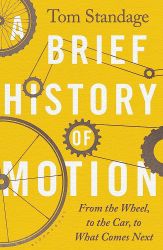
Tom, Tom, Tom. You know drinking and driving is a bad idea, but what did you do? You followed A History of the World through Six Glasses with this A Brief History of Motion: From the Wheel to the Automobile. Granted, we did have An Edible History of Humanity between the drinks and driving, so it could be worse. A Brief History of Motion may not be as generally attractive to a mass audience given the subject (everyone drinks and eats, but not everyone is necessarily into coaches and cars), but it’s as fun and informative as I’ve come to expect from Standage. He begins with the wheel and the evolution of carts and coaches, then shifts into modernity with bikes, trains, and automobiles. As expected from a writer of social history, Standage focuses on the social and cultural aspects of these forms of transport. In the Roman world, for instance, we learn that men regarded wagons and coaches as a very womanly way to get about, and preferred riding horseback — a conceit that continued until coaches continuing development made them valuable as status symbols. The bicycle and automobile chapters are far more expansive, as Standage points out the ways bicycles altered courtship rituals, and how cars up-ended not only American business, but American society as a whole. General Motors business model (creating multiple brands to appeal to different layers of the market) became normative, and motoring culture created multiple new businesses around it, from fast food to shopping malls. (Jim Kunstler and Jane Holtz Kay have covered the same, though with considerably more hostility) Although I’ve read a lot about transportation over the years, Standage delivered more than a few surprises — like his argument that Hitler’s promotion of the car industry in Germany attributed more to it bouncing out of the depression than the war. He also takes down a few misunderstandings along the way, like the old canard that GM and a few car parts companies conspired to buy out street car lines and immediately close them. I believed that one myself until reading a few books on streetcars (Fares, Please! and Romance of the Rails) that made me realize streetcar lines were folding like Germany in 1945 by the time GM’s buyout if one company happened.) Standage wraps up the book with a look at carsharing apps and the like that may move us closer to a future where people don’t have to be burdened with the financial costs of a car just to participate in society, while compromising with the fact that we’re more or less stuck with all this car infrastructure for the time being, instead of getting to live in proper towns where people can get around on foot, bicycle, bus, etc. This is one I’m happy to recommend: it’s the book Are We There Yet? wanted to be but didn’t come close to being.
Highlights:
For the Romans, right-side driving also had positive religious connotations. They likened life to a forked path where the virtuous choice was always on the right, and when entering temples and other buildings, they tried to ensure that their right foot was the first to cross the threshold. This is why sinister (the Latin word for “left”) also came to mean “evil” or “unlucky.”
Facing the threat of the expanding Ottoman Empire, Hungarian commanders adopted a new tactic: arranging wagons on the battlefield in a ring and chaining them together to form a wagon fort, a mobile defensive fortification that could resist cavalry charges. The wagons, equipped with gunports, also acted as protected platforms from which men could fire a small cannon or an early form of gun called an arquebus. This cutting-edge combination of wagons and gunpowder weapons made armored knights on horseback look suddenly old-fashioned. And that may explain why men across Europe decided that riding in fancy wagons was not so embarrassing after all—provided they were referred to as coaches, a name borrowed from the country where this new idea had emerged.
This half-hour commuting distance may sound arbitrary, but an analysis of urban layouts by Cesare Marchetti, an Italian physicist, suggests that one hour is, on average, how long people are willing to spend traveling to and from work each day and has been for centuries. (Some people’s commutes are much shorter or longer; this is an average across a whole city’s population.) Marchetti suggested that this time limit defined the size of cities. No ancient walled cities, he found, had a diameter greater than three miles, so assuming a speed of 3 mph, walking to the center from the edge of such a city, or back again, took no more than half an hour. Faster means of transport, starting with horsecars, let cities expand as this half-hour average travel budget allowed people to go farther. Marchetti’s analysis found that the city of Berlin increased in size precisely in accordance with improvements to the speed of transport. Before 1800 its radius was about 1.5 miles, and as faster means of transport were introduced, starting with horsecars and streetcars, its radius expanded in direct proportion to their speed.
Next up: it’s a race between sexy medieval ladies and the moral imagination in film and literature.

 Reading Freely
Cool! This is already on my Wish List.
Yes! The Hungarian coach thing was amazing.
Oh, I have a surprise coming up….a book covering something you occasionally feature at your place.
Intriguing… [lol]