
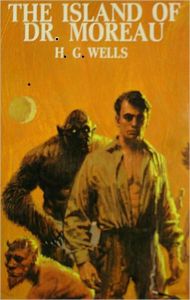
“It was not in eating the apple that I sinned, but in overstepping the mark set for me. ” – Adam, Paradiso.
Adrift at sea, a young biologist named Prendick – who had taken to natural history to relieve himself from the burden of inherited wealth and a life of ease — is rescued by a boat carrying a menagerie of critters and some rather strange passengers. The ship’s captain has been driven to drunkenness by the stress of these passengers, and when the floating party approaches their destination, Prendick finds himself abandoned to the seas once more – only to be rescued by the islanders. There’s something a little strange about them, but Prendick – disoriented from his near death and the turbulent circumstances can’t quite put his finger on it. Is it just him, or does that man have….slightly pointy, slightly furry ears? The island appears to be some kind of scientific outpost performing gruesome biological experiments, and when Prendrick flees the compound to find sanctuary in the jungle, he encounters sights even more harrowing than the frenzied screams from inside the outpost. As the story develops, Prendick learns that the chief scientist, Doctor Moreau, is attempting recreate animals in man’s image via vivisection , twisting pigs and leopards into human form regardless of pain or propriety. Prendick’s sympathy for the creatures so distorted by Moreau’s experiments turns increasingly into disgust at their uncanny mix of human and beastly features, made worse after events transpire and Prendick finds himself alone with the beast-folk and quickly assuming Moreau’s detachment and disdain for them. The tale reminded me strongly of Frankenstein, though with less humanity. Were it told today, Moreau’s obscenities would have been performed in part with genetic modification, I’m sure. Prendick’s own moral fall –beginning as a principled, sympathetic man who ends up as cold to the beast-people as Moreau, and as suspicious of other men’s own beastly natures – testifies to the darkness in each of us. This is a SF-horror story of lasting relevance, making me think about the ghoulish practice of aggressive ‘affirmative care’ for people, mutilating bodies with chemicals and surgery — or the spectre of transhumanism in general, of people trying to make robotic ubermensch of themselves.

 Reading Freely
My overall impression was this this was Well’s critique of how God left us as ‘half-made things’ more animal than human… My review is here:
https://cyberkittenspot.blogspot.com/2006/09/just-finished-reading-island-of-doctor.html
Great observations about Prendick! I had forgotten how much he changes over the course of the book. So many of his decisions are made out of pure terror, but I wonder how much of Moreau he did end up internalizing. As long as the other real men were around, Prendick felt the ability to side with the Beast-People from time to time; otherwise, he felt terrified of them and the inclination to treat them as the “other.” It is an odd dynamic.
I think it goes to show how complicated our brains are….different bits want to take different actions based on the same stimuli, but we choose moment to moment which bit to listen to depending on the circumstances and what we think is most practical.
Great insights into this brilliant story. Wells was on a roll when he wrote this semigothic sci-fi masterpiece. The film version starring Charles Laughton is not to be missed.
So I gather! I’m reading a biography of him at the moment and was surprised that he wrote so many of his classics back to back.
Wells is definitely one of, if not THE, most important SF authors ever. He helped to define the genre back in the day when it was still being called ‘Scientific Romance’. I know he gets compared to Verne a lot, but I think Wells is a *much* better, and much more important, author.
I’ll second Cyberkitteen re: Wells’ imprtance to sci-fi. His ideas include time travel, alien invasions, the “mad scientist” with a riff on the idea of doppelganger, and with Moreau he imagines the scientific world a century into the future with the expansion of genetic technology. One of those would have made his name – plus his storytelling ability is impeccable.
Pingback: Midyear Review & June 2023 | Reading Freely
Pingback: Reads to Reels: The Island of Lost Souls | Reading Freely
Pingback: Teaser Tuesday: American-style chess | Reading Freely