
Short rounds time!
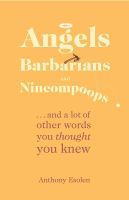
Angels, Barbarians, and Nincompoops is a wonderful romp through a few score words in the English language. Esolen has always impressed me as a man deep in word & song, saturated by the beauty of language — and here he is like a boy, playing with his favorite words and showing them off to the reader, with too much delight to keep to himself. Given how serious Esolen’s other works tend to be, I enjoyed this both for its content, and to experience Esolen’s joy at his subject. It’s a lovely mix of etymology, history, and a dash of Esolen’s characteristic cutting wisdom. . Originally purchased for Read of England. Some quotes!
The bureaucrats who sat heavy upon the soul of Scripture, lying like lead within its bosom as they translated it from Greek into the Unglish of a certain version I dislike intensely and will not name, turned up their noses at angel or herald. They say that a messenger came from God to Abraham on Mount Moriah, which in our tongue makes him sound like a telegraph boy from Western Union. “God to Abraham: stop. Hands off the boy. Stop. Faithfulness duly noted. Stop.” Lovers of beauty in language and liturgy to such translators: STOP!
But that wasn’t the old word for fruit in general. That old word was aeppel: Modern English apple. That’s the origin, there, of the idea in English that Adam and Eve ate an apple. What they ate was a fruit. In medieval iconography, it’s usually a pear. It could have been a peach or a pear or a pomegranate—or an apple.
We also would never have had the scornful name for the late nineteenth century in America: The Gilded Age. That was when writers like Mark Twain and William Dean Howells suggested that the virtues of the newly rich industrialists were like gilt on wood or plaster: glittery and thinner than paper. If that was the Gilded Age, what is ours? We might hire for the job a sick cousin of gold and gild: The Jaundiced Age, yellow with the bile of a dying liver.
The hat gives us a clue that the French word is the same as the Italian persica, peach (cf. German Pfirsich). The word literally means the Persian thing. The peach wasn’t native to western Europe, but was brought back west by Roman traders with the Persians, who lived in modern day Iran.
My favorite related word, though, is idiolect. No, that is not the special speech of politicians. That is denoted by the technical term gibberish. Nor is it the language of bureaucrats, educationists, and people who parrot their pronouncements: that is jargon, argot, patois. It is not the language of a reasonably well-defined subgroup, like the people who live on the Orkney Islands: theirs is a dialect. Nor the words and sayings and linguistic constructions of people who share a social class (patois), or a line of work (argot, jargon). An idiolect is a form of the language peculiar to one person alone. He goes beyond the idiom of his neighbors, and says things that only he says, or that only he says in the way that he says them.
The point is that human freedom and flourishing depend not upon our having choices, but upon our having the inner freedom—a liberating virtue, hard-won—to make right choices. The wrong choices enslave. It may look like liberty to choose among one of the dishes above, but it’s a liberty to choose which stuff is going to make your gorge rise up. It may look like liberty to have your choice among fifty ways to descend lower than a beast, but that’s a liberty to choose the color of your manacles and fetters. They may come in all the colors of the rainbow, but they are still going to chain you to the post.
Man is always more than man: we must aspire to the transcendent, or we die inside.
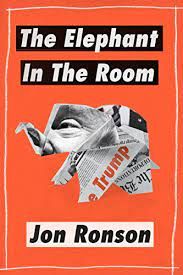
This is…sort of a sequel to Them, in that Ronson builds off his relationship with Alex Jones (established before Jones was famous, when both were curious about the Bohemian Grove meetings and infiltrated a ceremony together) to react to the fact Jones has the ear of the man who might (and would) become el presidente. Entertaining enough, but a lot of it copies Them directly, something I only noticed because I read these back to back. It’s more of a long essay than a book, at fifty pages.
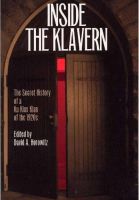
Lastly, Inside the Klavern. This is an odd book, consisting almost entirely of the minutes of an Oregon chapter of the Klan in the 1920s, so it’s chiefly of interest to those with a serious, possibly academic, interest in the ’20s Klan. As far as content goes, this is exactly as exciting as you’d expect minutes of a civic organization to be. There’s much chatter about paying dues, hosting visitors, etc. The casual reader may not realize that the 1920s Klan was much different from the 1870s Klan (which existed to attack carpetbaggers and freedmen) and the 1950s Klan (which existed to intimidate blacks and whites organizing for integration, civil rights, etc). These minutes indicate how different the 1920s Klan really was — racist, yes but more broadly xenophobic and reactionary, incorporating some moral crusades of the day like Prohibition and promoting “100% Americanism”. This was in large part a reaction to the enormous amount of immigration from Europe, which brought with it different religions (greater numbers of Catholics and Jews, for instance, who were arguably more of interest to the ’20s Klan than blacks) and political mores. The Klan of this time saw themselves as just like any other fraternal organization of the time — supporting sick members, helping each other find work supporting one another’s businesses, frequently socializing and the like — but who were ‘woke’ to the cultural and racial problems at hand. They were not wholly ideological, however: some of the later minutes here delve into a local water problem at great length, as though we were reading the minutes of the Rotary club. The Oregon chapter here doesn’t appear to engage in any violence, though the minutes do allude to people being intimidated, including their own members — for crimes like neglecting their families, drinking, or shopping in the businesses of ‘aliens’. Although a lay reader would profit better from a normal history of the ’20s Klan (I can tentatively recommend Behind the Mask of Chivalry, though it’s problematic in parts) this does offer a look into proceedings, rituals, and the like.
Next up….a Jon Ronson audiobook in which a debuntate turned swatiska-wearing pinup girl of a white supremacy movement claims Timothy McVeigh was just a mule for the real architect of the Oklahoma City bombing.

 Reading Freely
Pingback: Midyear Review & June 2023 | Reading Freely
Pingback: The Story of a Brother Whose Nose Was not Broken and Deserved to Be So | Reading Freely