This week at the library: The Great War, politics, sex, and elephants

Dear readers:
Hours ago I returned from my monthly visit to my alma mater’s library, where I found a host of interesting books. Although I’ve have plenty enough on my plate already, being knee-deep into The First World War by John Keegan to start my year-long reflection and study of the debacle,  most of these are on far cheerier subjects. 
  • Plagues and Peoples, or how epidemics shaped human history. (Hey, I said most of them were on cheerier subjects.)
  • A Place on Earth, Wendell Berry; a novel about a father’s response to his son dying in WW2.  (Ibid.)
  • Starship Troopers, Robert Heinlein. My first Heinlein! 
  • The Bonobo and the Atheist: In Search of Humanism Among the Primates, Frans de Waal
  • When Elephants Weep: The Emotional Lives of Animals, Jeffery Masson and Susan McCarthy
  • Daily Life in Anglo-Saxon England, Sally Crawford
  • Silent Thunder: In the Presence of Elephants, Katy Payne
  • The Gift of Good Land: Further Essays Cultural and Agricultural, Wendell Berry
  • Ravens in Winter, Bernd Heinrich.
There’s a definite nature theme to this month’s pile, probably prompted by  my yearning for spring. 
We’re off to a rocky start this year, books-wise, as I’ve read a handful of books I liked well enough and a few I was disappointed in. There are a couple of reviews outstanding, for Shop Class as Soulcraft and Wendell Berry’s Sex, Community, Economics and Freedom. The latter’s eclectic nature defies adequate summation, at least for now.  Sex was also the theme of The Red Queen, which I enjoyed. Related to Soulcraft and Berry is Toward a Truly Free Market,  which presents an  economic idea which EF Schumacher was influenced by in writing small is beautiful. (I owe that one a review as well….)  Comments for Toward a Truly are just about done.
So, I’ll be balancing the misery of the Great War with some fun books on animal behavior, and the toe-curling pleasure that is Wendell Berry, who is for me the literary equivalent of warm chili and a great big quilt sewn by Granny.  There’s such a feeling of being at home when I step inside his mind.
Happy reading, everyone! 
Posted in Reviews | Tagged | 4 Comments

The Liberty Amendments

The Liberty Amendments:  Restoring the American Republic
© 2013 Mark Levin
257 pages

The United States Constitution was written by men who appreciated their lack of omniscience, and who therefore included in Article V means for amending their handiwork, for fixing through Congress and the state legislatures any problems that might arise. How do you solve a problem through Congress, however, when Congress is the problem?   The solution, says Mark Levin, is right there in the Constitution: Article V, which establishes the means of amendment, provides two. While Congress can vote on amendments, the State Legislatures can independently  call a convention to propose amendments, amendments Congress is obliged to respect.

With that as a starting point, he introduces ten amendments intended to bring the metastasizing national government into hand. The amendments taken as a whole are strongly sympathetic to a states’ rights perspective, as all three heads of the Scylla-like national government are subordinated further to the state legislatures. The legislatures are given the power to override Supreme Court decisions and acts of Congress, and  term limits are imposed on all branches, including on the formerly lifetime Court seats.  Levin’s amendments make it clear that he believes sovereignty lies in the states alone. as he proposes measures intended to stifle the effort of the government to take a life of its own. The Supreme Court is denied a right it has assumed, that of judicial review (judging whether a law is constitutional), and federal programs are given an automatic expiration date that they escape only by submitting to a scrutionous review.  Most of the amendments are general and limited, with Levin arguing from what he believes the founders would have intended or believed; he draws on the Federalist papers, the anti-federalist papers, and the founding fathers’ letters to inform his views. The exception to this is the tenth proposal, which requires photo ID for elections. This is so specific to current political arguments and current technology that it doesn’t deserve the dignity of being attached to the Constitution: let it join the legions of acts of Congress.

As personally sympathetic as I am to any measure limiting the power of the state, and hostile to any measure intended to magnify its power,  something about this book doesn’t sit right with me. Levin speaks often about the founders’ firm belief in checks and balances, but his proposals put so many cards in the hands of the state legislatures something is bound to go wrong. The state legislatures are not havens of sensibility and justice; my own state has a constitution written by planters to disenfranchise the poor, place the burden of public finance on them, and force local ballot measures to be resolved by means of constitutional amendment.  On the other hand, perhaps we’d end up with something like Swiss cantons; that kind of dynamic localism is attractive.  My principle problem with Levin is that he doesn’t bother with a dialogue but writes to people who already agree with him as he presents his case against the dreaded Statists, the Evil Ones.  I don’t know if Levin’s approach is the answer, but it’s not mere talk: in late December, state legislatures sent representatives to George Washington’s Virginia home in Mount Vernon to discuss the possibility of an “Article V Convention“.   Thus, while Levin’s amendments aren’t necessarily ones I’d get behind in total (with the exception of term limits),  his basic premise of states using their article V right to discipline Congress, the Court, and the President has promise.

Posted in Politics and Civic Interest, Reviews | Tagged , , , , | Leave a comment

The Red Queen

The Red Queen: Sex and the Evolution of Human Nature
© 1993 Matthew Ridley
404 pages

The Red Queen begins with a question: why do creatures have sex? Why did it evolve? The answer, Matt Ridley believes, lies in the principle of the Red Queen. A character featured in Lewis Carroll’s  Through the Looking Glass, she announced to Alice that in her world, it took all the running one could do simply to remain in one place. This characterizes the constant struggle for domination between species in the natural world,  a struggle between creatures not only visible to us, but between parasites within our bodies  and our immune systems.  Every move is countered, every success overturned; such is the impetus for evolution. In The Red Queen, Ridley explains his reasoning, and demonstrates how  evolutionary principles subtly drive the expression of human sexuality.

There’s a lot of tension in this work, first when Ridley makes his case and somehow incorporates aspects of evolution from disparate camps (gene-centered, individually-driven, species-based) , and in the heart of the book as he examines the implications. This is especially true in the chapters, “Polygamy and the Nature of Men” and “Monogamy and the Nature of Women”:  while it is true men have a genetic inclination to sow seeds and women one to invest in a partner,  behavior as studied indicates that things are not to trite. In the last chapters of the book, Ridley looks at sexuality as a possible cause of advanced human intelligence (competition and tension between the sexes and individuals), which is amusing given the power sexual interest has to render victims dumbstruck and seemingly foolish.

Since its publication, The Red Queen has proven influential; I knew of it long before I read it because of its place in the literature, being cited often. That may attest to the science, which is is speculative but sensible based on what he presents. He certainly makes for an entertaining author,  one whose arguments are open to virtually anyone regardless of scientific reading;  he begins with a technical, biological edge before spending most of the book on behavior — a softer, fuzzier realm for readers.

Posted in Reviews, science | Tagged , , , , | Leave a comment

This week at the library: prospects for the new year

Dear readers:
The winter solstice is passed and December has ended, beginning a new year regardless of your reckoning. In the past few days I’ve used my time off, and the fact that it’s too cold and dark out to do anything outside, to finish a few books begun in late December — Bernard Cornwell’s Stonehenge, and The Red Queen, a book on sexuality and human nature. With the year anew, what lies ahead? 
January is a kind of penitent season, as people start New Years resolutions to get out of debt and lose all the weight they accumulated eating Christmas goodies.  In that spirit, I’m going to be making an effort to read some books I’ve long intended to read, but have never quite gotten around to. That includes the first book in a Roman historical fiction series (spotted on Seeking a Little Truth), as well as some science fiction.  I will also be resuming the Story of Civilization series by Will Durant sometime this..ah, year.  The problem at this point  is that the last three books all seem to be about the same things:   the climax of the Enlightenment, the French Revolution, and Napoleon.  
In the coming year I will of course have the usual tributary readings; a focus on English culture in April, for St. George’s Day;  a set on the American revolution in late June for the Fourth of July;  some French items in mid-July for Bastille Day, and something in October for Germany.  As previously announced, throughout 2014 I will be reading books on the Great War, one a month.  I won’t be combining the Great War theme with the heritage readings. 
I suspect historical fiction is going to take a hit, because once I read Sharpe’s Waterloo, I will have not only finished Sharpe’s series but exhausted virtually all of Cornwell’s fictional offerings. There remain a few books I’ve not read, like the second in his Grailquest series and a historical romance he wrote under a false name (yes, really), but after a few years of dedicated, wholly enjoyable reading, I’m reduced to waiting for him to write new books. Alas.  
I also think that 2014 will be a boom year for science and nature reading, because I’ve discovered an author whose work I think I’ll take to. We’ll see..
2014 will continue readings in city planning, food, and the like, with everything under the sun also under consideration.  
A year of fascinating reads to you all!
Posted in Reviews | 4 Comments

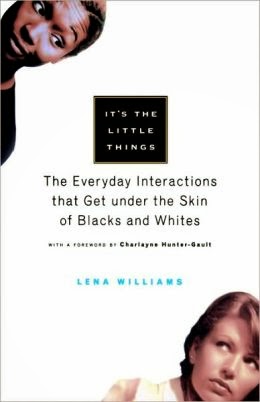
It’s the Little Things

  It’s the Little Things: Everyday Interactions that Get Under the Skin of Blacks and Whites
© 2002 Lena Williams
304 pages

It’s the Little Things is an account of Lena Williams and her family’s grievances with white people, which are legion. Its full title, poorly chosen, teases the reader with a prospect of being a fascinating look into racial or cultural behavior that we are unaware of. The author delivers, however, nothing but a series of complaints, drawn from a data sample of herself, her family, and her friends   It seemed so promising; imagine a book based on interviews in which people were honest  about their observations or questions about the ‘other side’;  this is more like a book of white-people jokes pretending to be one of social inquiry.

The majority of the ‘little things’ are not unique to black/white dynamics in the United States, but are common symptoms of ethnic tension,  with biological or cultural roots. She mentions that both sides complain the other ‘smelling’ funny,  which is an in-group sensitivity.  There are a few  genuinely helpful insights scattered throughout, like the bait-story that enticed me into reading it. There, the author bristles with resentment as she stands in an elevator and witnesses a white woman combing her fingers through her hair.  Because ‘black’ hair looks, grows, and behaves so differently from ‘white’ hair, which is considered the standard of beauty in America, many black women like the author have gone to great expense and bother to force their hair to  look like ‘white’ hair, implementing relaxers and weaves. The woman’s innocent hair-combing was seen as a flaunting of white privilege.  The book often demonstrates how ordinary tension between people can take on racial undertones: although the liberties telemarketers take in using people’s first names to effect an air of friendliness are obnoxious to everyone, the presumption can strike blacks (according to Williams) as offensive given America’s racial history.  As the privileged hair example illustrates, however, ascribing racist motivations to some behaviors is simply preposterous.

The work also makes clear that regardless of claims of equality, people remain different;  even if they are equal before the law, populations still have their own cultures and values, some of which rub against one another. For instance, the author declares that there’s a difference between the black notion of a party, which consists of plentiful food and lots of dancing, and the white version, which consists of finger food, wine, and subtle music serving as a background conversation.    That is indeed two different notions of a party,  but to say they’re black and white versions of a party is bizarrely simplistic.  Anyone with friends or relations in different economic classes can bear witness to the fact that not everyone’s idea of a good time is the same, regardless of skin color. This book’s greatest fault is the limited experience the author draws on to reach her conclusions;  her childhood background and experience are used to describe everyone’s, and that is decidedly not the case. In her world, black people beat their children at the slightest hint of public misbehavior, and feel pressure, when going into town, to dress their best.  She cannot possibly believe this is the case today.  Perhaps she’s drawing merely on her memory alone, but in the world of the mid-20th century, such behavior (dressing for town and stern discipline) would have been the rule among ‘whites’ as well.  The too-personal anecdotes, and the sweeping conclusions based on them, make me think this is a book with an identity crisis; it’s written as a playful riff, but wants to be  taken seriously.

Posted in Reviews | Tagged | Leave a comment

The Best of 2013: Annual Year in Review

Previous yearly wrap-ups: 2007 | 2008 | 2009 | 2010 | 2011 | 2012 

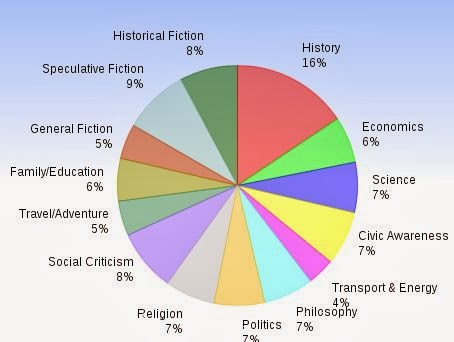
The year turns once more and it’s time to look back on the past’s reading, to think about which books really stood out and to reflect on the year in general. Let’s begin with pie!

As usual, ChartGo did the data-baking, and nonfiction dominated. This year was heavy on civics and society, economic and political philosophy, and bicycles; when I drew up a ‘top twenty’ list,  most of the books fell into these categories. Toward the end of the year I also got into outdoors-adventure books, including a lot of cycling memoirs.

The great theme that emerged from my reading this year was civics, society, and living humanely.  Not only did I read a great many books about the material arrangement of society, like those on city planning, but I also considered thoughtful works on other aspects of society:  culture, politics, economics, and more. Diverse authors who never met one another, who may have not have even heard of one another, have worked in concert inside  my head to prompt a sea change therein. In trying to understand how society works,  so that I might do my part to help create more resilient, healthier communities, I have developed a sharp aversion to the large-scale, top-down, and heavy-handed approaches I once favored, instead now preferring smaller, locally-oriented, and ‘organic’ tacks that emphasize healthy relationships between people, connect them to their physical place, and promote inner reliance or autonomy.  And so, the best from this sweeping category, books in bold indicating membership on the Top Ten Favorites for the year.

Now some highlights from other genres:


General Fiction

History

Science

  • The Little Ice Age: How Climate Made History, Brian Fagan
  • Chimpanzee Politics by Frans de Waal
  • Your Inner Fish; The Universe Within, Neil Shubin.  
  • Two Sides of the Moon, David Scott and Alexei Leonov

Historical Fiction

I read Pride and Prejudice largely so I could read Pride and Prejudice and Zombies, which started out hilarious and then drifted toward the merely silly. I did enjoy Austen, especially for the language. Kerr is a new author to me, and one I’ll read more of;  I’ve read three works by him so far, and all were police dramas/international mysteries set in Germany, often around the 1930s. Dark humor abounds.
Speculative Fiction
  • From History’s Shadow, Dayton Ward.  Treklit and historical fiction, this history of the United States’ attempts to investigate claims of alien life begins shortly after 1947 and 
  • 1632, Eric Flint. What happens when you drop a Pennsylvanian mining town into the middle of 17th century Germany? Good times.

In the long run I think I’ll remember this year most for introducing me to one Wendell Berry, an aging gentleman-farmer from Kentucky whose ideas on the good life are expressed in both essay collections and novels. I encountered Berry first when one of his essays, “Health is Membership”, appeared in The Plain Reader, a collection of essays on the simple life, many of them rooted in the Quaker tradition.  He writes reverently of the need to conserve and live a life grounded in Nature, mindful of the limits it would suggest for the scale of our activities. He champions a nation based on family farms, small towns, and decentralized political power; he writes against and mourns the destruction caused by agribusiness, urban sprawl, and big stick approaches to little problems. His essay collections are wise and often godawful funny, while the novels are painfully beautiful. I read Jayber Crow back in June, and not a day goes by that I don’t think of it– quote aloud from it, even.  Wendell Berry joins the very-elite club of featured authors for me, alongside Isaac Asimov and Bernard Cornwell.

Posted in General | Tagged , | 3 Comments

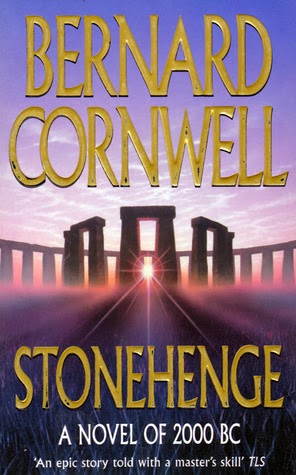
Stonehenge

Stonehenge: 2000 BC
© 2000 Bernard Cornwell
400 pages

         For millennia the hanging rocks of Stonehenge have stricken visitors with awe and mystery. Who  built them, and to what purpose?  Stonehange: 2000 BC  tells the story of those people, the ancient ones, whose dreams and fears were made material in their temple of the sky. Bernard Cornwell is a bonafide master of historical fiction, writing chiefly tales of adventure and war set in Britain’s storied past, but the world of Stonehenge is his earliest treated yet. Stonehenge is largely drama, personal and cosmic, with action throughout, including a battle or two.   It is the story of three brothers:  Lengar, the eldest, whose cruel ambition leads him to murder his father at a wedding and seize the bride; Camaban, born with a club foot and rejected by the tribe, who burns with bitterness and looks to the gods for consolation; and young Saban,  who begins the book fleeing from death,   a race that continues throughout.  Caught between his elder brothers’ constant treachery, Saban must survive the destruction and chaos caused by both, and lead his people to peace.

            Lengar, Camaban, and Saban share a father and little else; their dreams set them at variance with one another, for Saban only wants a quiet life with a woman, kids, and a few healthy pigs while his elder brothers spend the entire book besotted with dreams of grandeur. Lengar wants to be a fearsome warlord who brings the entire region under heel, while Camaban works to become a master sorcerer and restore order to the Cosmos itself.  This is a primeval setting, dominated by a religious worldview that is largely animistic, drenched in blood and steeped in superstition. The overall feel is reminiscent of the magnificent King Arthur trilogy Cornwell penned:  political and religious leaders vie for power, undergird with a metaphysical theme; while Merlin wanted to restore the old gods to Britain to drive out the Saxons,  Camaban wants to end the war between the native gods and bring about an epoch of heaven on earth.  While many find the claim suspect, a temple to the violent sun god serves the glory-thirst  of Lengar, and the challenge appeals to the craftsman Saban. (Not that he has a choice in doing their bidding,  since he has an unfortunate habit of becoming attached to people, a great source of leverage for his sadistic elder.)  The motives for building the temple are thus mixed, and the struggle of its construction is the foundation of the book’s many plot lines, from politics to war. At least a decade passes from the time the first stones arrive to its treacherous consecration.

            Like the King Arthur trilogy,  our main character Saban is a supporting actor in other men’s dramas, but he’s fairly sympathetic. A good thing, too, because he’s much abused;  his is a violent world, and his brothers’ ambitions make it doubly so.  He’s wily enough, and a good fighter,  though not nearly as self-assured or clever as other protagonists.  His life is often in the hands of Fate, which typically comes in the form of possibly-delusional characters who declare that going here or doing this is the Will of the Gods.   Though religious, Saban doesn’t put a lot of stock in such claims; fortunately for the plot, he’s ususally beholden to someone who does – either his brothers, threatening violence, or his girlfriends, who have an unfortunate tendency to become goddesses or prophets.  C’est la vie préhistorique.  

            Stonehenge is an impressive novel, harrowing and dramatic. Like all of Cornwell’s fiction, the world is rich in luxuriant detail. Not only does Cornwell paint the landscape for readers, but the human environment, of actors and legends, is simultaneously fleshed out, using an invented mythology  instead of vexing historic purists by throwing in the Celtic pantheon.  It suffers a little in comparison to the King Arthur trilogy,  but the mystery of the Stones has its own appeal, and seeing the temple appear in stages throughout the tome, as chiefs and priests struggle for power, will doubtless keep readers in thrall.

Posted in historical fiction, Reviews | Tagged , , , | 4 Comments

2013 Cumulative Reading List

Updated for the final time the day before yesterday, below is the list of this year’s reads. Those in bold are superior favorites.

— January —
1. Calico Joe, John Grisham (Fiction)
2. Catching Fire, Suzanne Collins (Fiction)
3. Mockingjay, Suzanne Collins (Fiction)
4. Meat Eater: Adventures from the Life  of an American Hunter, Steven Rinella
5. For the Love of the Game, Michael Shaara (Fiction)
6. Home from Nowhere, James Howard Kunstler
7. The Little Ice Age: How Climate Made History, 1300-1850Brian Fagan
8. Copperhead: Ball’s Bluff, 1862, Bernard Cornwell (Fiction)
9. Battleflag,  Bernard Cornwell (Fiction)
10. Patterns of Home;  Max Jacobson, Murray Silversteinand Barbara Winslow
11. Walkable City: How Downtown Can Save America, Jeff Speck
12. The Bloody Ground, Bernard Cornwell (fiction)

–February–
13. Waiting on a Train: the Embattled Future of Passenger Rail Service in America, James McCommons
14. Pride and Prejudice, Jane Austen (Fiction)
15. The Seven Wonders, Steven Saylor (Fiction)
16. Star Trek Cold Equations: The Persistence of Memory, David Mack (Fiction)
17. The Space Between: A Christian Response with the Built Environment, Eric Jacobsen
18. Pride and Prejudice and Zombies, Seth Grahame-Smith, with apologies to Jame Austen (Fiction)
19. Selma: A Novel of the Civil War, Val L. McGee (Fiction)
20. Railroad Stations: the Buildings that Linked the Nation, David Naylor
21. Pedaling Revolution: How Cyclists are Changing American Cities, Jeff Mapes

— March —
22. On Saudi Arabia: Its People, Past, Religion, Faultlines, and Future; Karen Elliot House
23. A Week at the Airport, Alain de Botton
24. Through Painted Deserts, Donald Miller
25. The Universe Within Us: the Shared History of Stars, Planes, and People, Neil Shubin
26. Shift, Jennifer Bradbury (Fiction)
27. Reviving Ophelia: Saving the Selves of Adolescent Girls, Mary Pipher
28. Hey Mom, Can I Ride My Bike Across America?, John Siegel Boettner
29. Sundays in America, Suzanne Shea
30. Straphanger: Saving Our Cities and Ourselves from the Automobile, Taras Grescoe

— April —
31. 1356, Bernard Cornwell (Historical Fiction)
32. The Death and Life of Great American Cities, Jane Jacobs
33. Rising Powers, Shrinking Planet: the New Geopolitics of Energy, Michael Klare
34. A Spectacle of Corruption, David Liss (Historical Fiction)
35. The Plain Reader: Essays on Making a Simple Life, edited by Scott Savage
36. The New Jim Crow, Michelle Alexander
37. History of the English Speaking Peoples: The New World, Winston Churchill
38. Crunchy Cons, Rob Dreher
39. Chimpanzee Politics, Frans de Waal

— May —
40. eaarth: making life on a tough new planet, Bill McKibben
41. Warm Bodies, Isaac Marion (Speculative Fiction)
42. Buddhism without Beliefs, Stephen Batchelor
43. The Jane Austen Book Club, Karen Fowler (Fiction)
44.  Folks, This Ain’t Normal: A Farmer’s Advice for Healthier Hens, Happier People, and a Better World, Joel Salatin
45. The Revolution: A Manifesto, Ron Paul
46. Garbage Land: on the Hidden Trail of Trash, Elizabeth Royte
47. Star Wars: Fool’s Bargain, Timothy Zahn (Speculative Fiction)
48. The Botany of Desire: A Plant’s-Eye View of the World, Michael Pollan
49. The Invisible Heart: An Economic Romance, Russell D. Roberts (Fiction)
50. Just Ride: A Radically Different Practical Guide to Riding Your Bike, Grant Peterson
51. Chain of Thunder, Jeff Shaara (Historical Fiction(
52. The Long Emergency: Surviving the End of Oil, Climate Change, and Other Converging Catastrophes of the 21st Century, James Howard Kunstler
53. Never Done: A History of American Housework, Susan Strasser
54. How Children Succeed: Grit, Curiosity, and the Hidden Power of Character, Paul Tough

— June —
55. Salt, Sugar, Fat: How the Food Giants Hooked Us, Michael Moss
56. Against the Grain: How Agriculture Hijacked Civilization, Richard Manning
57. Disrupting the Rabblement, Niall Doherty
58. Jayber Crow, Wendell Berry (Fiction)
59. Alexander Hamilton, Rob Chernow 
60. The History of Money, Jack Weatherford
61. The Story of my Experiments with Truth, Mohandas K. Gandhi
62. American Creation: Triumphs and Tragedies at the Founding of the Republic, Joseph Ellis 
63. Gulp: Adventures on the Alimentary Canal, Mary Roach

— July —
64. Edens Lost and Found; Dale Bell, Joseph D’Agnese, and Harry Wiland
65. Simplicity: Essays, Joshua Fields Millburn, Ryan Nicodemus
66. His Excellency: George Washington, Joseph Ellis 
67. The Price of Everything, Russell D. Roberts (Fiction)
68. What It Means to be a Libertarian, Charles Murray
69. Star Trek TNG, Cold Equations: Silent Weapons, David Mack (Fiction)
70. Day of Reckoning, Patrick Buchanan 
71. Getting There: the Epic Battle Between Road and Rail in the American Century, Stephen Goddard
72. Brand Failures, Matt Haig
73. The Choice: A Parable of Free Trade and Protectionism, Russell D. Roberts
74. It Can’t Happen Here, Sinclair Lewis (Fiction)
75. French Kids Eat Everything,  Karen Le Billon 
76. An Outline of French History, René Sédillot. 
77. Hannah Coulter, Wendell Berry (Fiction)
78. A Higher Call, Adam Makos
79. The Unschooling Handbook: How To use the Whole World As Your Child’s Classroom, Marry Griffith

— August —
80. The Conservative Mind, Russell Kirk
81. 1632, Eric Flint (Speculative Fiction)
82. What Are People For?, Wendell Berry
83. Basic Economics, Thomas Sowell
84. Your Inner Fish, Neil Shubin
85. Religion for Atheists, Alain de Botton
86. The Righteous Mind: Why Good People are Divided by Politics and ReligionJonathan Haidt
87. The Making of the Fittest, Sean B Carroll
88. Trains and Lovers, Andrew Maccoll Smith
89. Save the Males: Why Men Matter and Why Women Should Care, Kathleen Parker
90. Radicals for Capitalism: A Freewheeling History of  the Modern American Libertarian Movement, Brian Doherty
91. Paleofantasy, Marlene Zuk

— September —
92. Star Trek: From History’s Shadow, Dayton Ward
93. Two Sides of the Moon, Alexei Leonov and David Scott
94. The Astronaut Wives Club, Lily Koppel
95.  Two Fronts, Harry Turtledove
96. Satisfaction Guaranteed: the Making of the American Mass Market, Susan Strasser
97. Sky Walking: An Astronaut’s Memoir, Tom Jones
98. The Sky Is Not the Limit: Adventures of an Urban Astrophysicist,  Neil deGrasse Tyson
99. Home Economics, Wendell Berry
100. The Disappearance of Childhood, Neil Postman
101. Free to Choose, Milton Friedman
102. The Working Poor: Invisible in America,  David Shipler
103. Born to Buy: the Commercialized Child and the New Consumer Culture, Juliet Shor
104. Field Grey, Philip Kerr
105. Uncommon Carriers, John McPhee
106.  Crabgrass Frontier: the Suburbanization of the United States, Kenneth Jackson

— October —
107. Taft 2012, Jason Heller
108. The New Faithful: Why Young Adults are Embracing Christian Orthodoxy, Colleen Carroll
109.  The Box: How the Shipping Container Made the World Smaller and the World Economy Bigger, Marc Levinson
110. Greek Ways: How the Greeks Created Western Civilization, Bruce Thornton
111. Star Trek Rise of the Federation: A Choice of Futures, Christopher L. Bennett
112. Bicycle: The History, David Herlihy
113. The Fear Index, Robert Harris
114. Misquoting Jesus, Bart Ehrman
115. The Origin of Satan, Elaine Pagels
116. Zealot: the Life and Times of Jesus of Nazareth, Reza Aslan
117. Just the Two of Us: A Cycling Journey Across America, Melissa Norton
118. The Life and Times of the Thunderbolt Kid, Bill Bryson
119. Hitler’s Peace, Phillip Kerr

— November —
120. Let’s Explore Diabetes with Owls, David Sedaris
121. Plane Insanity, Elliot Hester
123. Sharpe’s Siege, Bernard Cornwell
124. A Consumers’ Republic, Lizbeth Cohen
125. Nathan Coulter, Wendell Berry
126. The Screwtape Letters, C.S. Lewis
127. Train TimeRailroads and the Imminent Reshaping of the American Landscape,  John Stilgoe
128. The Last Human, G.J. Sawyer et. al
129. Into Thin Air, Jon Krakauer
130. The South vs. The South, William Freehling
131. The Man Who Cycled the World, Mark Beaumont
132. Martin Eden, Jack London
133. If the Dead Rise Not, Phillip Kerr
134. The Victorian Internet, Tom Standage
135. Sharpe’s Revenge, Bernard Cornwell
136. Down the River, Edward Abbey
137.  No Plot? No Problem! Chris Baty

— December —
138. The Next Christians, Gabe Lyons
139. Into Thick Air, Jim Malusa
140. Things Fall Apart, Harry Turtledove
141. small is beautiful: economics as if people mattered, EF Schumacher
142. Little House on the Prairie, Laura Ingalls Wilder
143. The Other Side of Western Civilization: Readings in Everyday Life, ed. Stanley
144. Black Rednecks and White Liberals, Thomas Sowell
145. A Scientist in the City, James Trefil
146. The Phantom Menace, Terry Brooks
147. The Wolf Strain: A Western Trio, Max Brand
148. The Men Who United the States, Simon Winchester
149. The View from the Summit, Sir Edmund Hillary
150. Sharpe’s Christmas, Bernard Cornwell

Posted in General | Tagged | 4 Comments

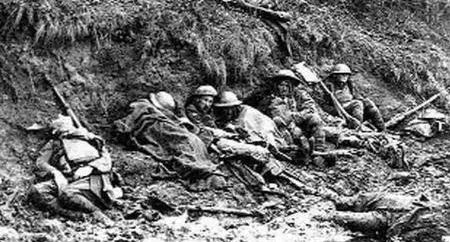
’14: The Year of the Great War

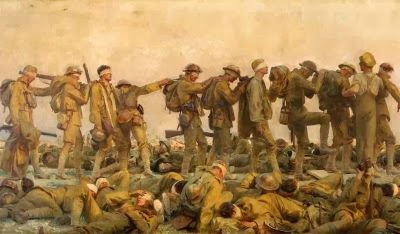
As 2014 marks the 100-year anniversary of the Great War, I’m dedicating part of my reading to reflect on its tragic importance. At least one book every month will focus on the Great War; after beginning with a general history, I’ll explore different aspects of and theaters in every succeeding month. My aim, besides honoring those who were ‘butchered and damned’, is to understand the conflict more than I do presently. Virtually all of my Great War studies in university or out of it have looked at western Europe — either the trenches or the skies. I know nothing of Italy and Austria’s meatgrinding struggle in the Alps, nor do I have any real appreciation of the German-Russian conflict.  To that end I’ll be reading books specific to these areas of the war largely unknown to me. Although I don’t and won’t have a scheduled reading list, below are some of the titles I am considering.

The First World War, John Keegan
La Feu (Under Fire), Henri Barbusse
The Great War in Modern Memory, Paul Fussell
The Great War at Sea, Richard Hough
To Crown the Waves: The Great Navies of the First World War, ed. Vincent O’Hara et al
Wipers: A Soldier’s Tale from the Great War, Jeff Simmons
Forgotten Voices of the Great War, Max Arthur
The Eastern Front, Norman Stone
Rites of Spring: the Great War  and the Birth of the Modern Age, Modris Eksteins
World War 1 Companion, Mathias Strohn, editor.
Collision of Empires, Prit Buttar
Silent Night,  Stanley Weintraub

Considering the way book recommendations multiply like rabbits once a subject is considered in earnest, I’m confident many more will surface. The top three of these will definitely be attempted, as I’ve wanted to read them for a long time;  the others I only discovered after beginning preparations for this.  In addition to learning about theaters of the war I’m largely ignorant of, I also want to explore how the war was portrayed in fiction and culture, to discern its impact on the human soul.

Suggestions are welcome.

“Gassed”, John Singer Sargent

Posted in General | Tagged | 5 Comments

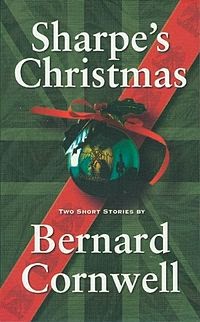
Sharpe’s Christmas

Sharpe’s Christmas
© 2003 Bernard Cornwell
104 pages

Sharpe’s Christmas collects two stories which do the seemingly impossible, in honoring the Christmas spirit while simultaneously being action-adventure tales starring Richard Sharpe. Sharpe doesn’t lend himself easily to Christmas stories; he is not lovely or kind. He is a soldier whose battle-scarred face has frightened women, and whose rifle and cavalry sword have frightened men, from Indian to France.  He is a wonder as a soldier, grimly effective, but dismally unlucky outside the killing fields.  His attempts at love have met in disaster as his beloved ones die or vanish, along with whatever fortune he entrusted to them.  And yet the Daily Mail asked Bernard Cornwell to write two Sharpe-related Christmas stories for them, and so he did.

 The stories are not unusual in their Christmastime setting;  the series has seen battles set around the Christmas season before.  But while there Christmas was the background, here it is the abiding theme.In the first story, “Sharpe’s Christmas”,  Sharpe is participating in the invasion of France, and caught between two forces of Imperial troops in a narrow mountain pass, some of them commanded by an old friend. In “Sharpe’s Ransom”, disgruntled Hussars break into Sharpe’s postwar home in Normandy and hold his wife and child hostage unless he produces the gold  the evil masterspy Ducos framed him for stealing in Sharpe’s Revenge.  After outwitting the dopes guarding him, Sharpe must effect a rescue of his family.  Readers are treated to the usual elements of a Sharpe novel — desperate battles between riflemen and massed columns of French troops, small-scale action by Sharpe himself, plenty of humor (especially between Sharpe and his usual compatriot, Patrick) but with a Christmas twist. Sharpe creates a miraculous victory out of disaster out of nothing but cleverness, skill, and cutting remarks, but the discovery of an old friend allows him to act as an agent of mercy; in “Ransom”, he doesn’t take out the entire band of Hussars singlehandedly, but turns the crisis into an opportunity to win the trust and acceptance of the local villagers, who — being French — resent an English war hero taking up residence among them and taking as his mate a once-noble widow.  Sharpe’s Christmas is as exciting, historically grounded, and funny as any Sharpe novel — but it’s also heartwarming. It’s positively touching.  I thought it quite appropriate.

Posted in historical fiction, Reviews | Tagged , , , , , , | Leave a comment