
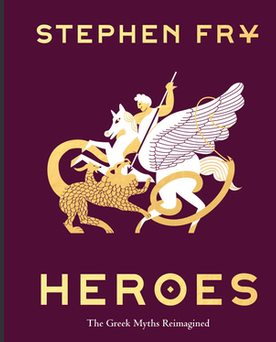
What do I know of the Greek heroes? Precious little. I recognize the phrase, Labors of Hercules, but could not tell you more than a couple of them – cleaning out stables and helping Atlas with the sky for some reason? I know someone named Jason went after a golden fleece, and that someone else fought a man-bull thing that demanded children be sacrificed to it, but that was about it. Stephen Fry’s Heroes covers these heroes and more – Perseus, Theseus, Orpheus, Bellerophon, Atalanta, etc – in his usual winsome way, combining a perfect style of narration with an enviable range of voices for characters. Heroes managed to strike the perfect note between (“I don’t know these stories at all and am delighted to hear them”) and “THIS IS ENTIRELY TOO MUCH TO TAKE IN AT ONE TIME”. As he said in his introduction to Jason and the Golden Fleece, the story requires backstory upon backstory – but it’s all juicy, so dig in! I dug in, and it was juicy indeed.
What is a Hero, in the Greek sense? They’re generally men and some women who have a connection to the gods, and who lived and strove during a ‘transition point’. Whereas Mythos was agog with monsters and humans played a fairly small part, and Troy/Odyssey are largely human dramas with the gods sticking their beaks in, here we have humans and gods working together, the humans often helping rid the Earth of monsters who are still hanging around. Sometimes the humans are ordered to take care of the monsters to work off a debt; sometimes they have to do it while trying to accomplish something else; sometimes, as in the case of Theseus, they do it for the love of the smiting. He came of age and was instructed to take a sword to Athens, there to be recognized by his father – – but rather than going by boat, he insisted on taking the land route that was famously peopled by brigands and giants and such – so that he could arrive with a name and a blade already wet with accomplishments.
Easily the most memorable part of Heroes for me was the story of Hercules – or Heracles, as he’s generally known here. Heracles was re-named such – “Glory of Hera” – in hopes of placating the famously jealous goddess of marriage and the family after he was conceived by Zeus and one of the cloud-gatherer’s numerous earthly liaisons. So furious was Hera that she tried to kill Heracles in the womb, then when he was born turned venomous vipers onto him while he was but an infant. He grew up to be an accomplished young man with a wife and two young boys – but then Hera sent a delusion that provoked Heracles to strangle them, thinking they were monsters! What a vile creature she was, trying or causing the death of innocents. I’m very glad Mary took that ‘Queen of Heaven’ title away from her. Heracles was forced into slavery to atone for his ‘crime’ – which was really Hera’s crime – and thus we get the Labors of Heracles, everything from cleaning out stables to fetching giant beasts and frightening the king who demanded Hercules bring the beasts to him. While Heracles wasn’t wily like Odysseus , between his strength and his own cunning, he was able to knock them out – only for Hera to prolong his sentence. Frankly, I would have started razing her temples if I were Heracles, but he was a good sport (despite his frequent temper) and even stopped her from being gang-raped by a bunch of giants, after which point they became besties.
Speaking of, the Greek myths are not for the faint of heart. The versions I read as kids must’ve been hilariously stripped down, because this story included Orpheus being ripped to pieces by a gang of women who were outraged that the musician had spurned women after his wife died and turned to boys; Medea casually murdering her own brother and throwing parts of his body into the water to help her and the Argonauts escape a pursuing ship; and far too much detail on how a woman cozened a pretty white bull into mating with her. And yet between the stories and Fry’s delivery, the book abounds in laughs and wonder. I don’t know how many liberties Fry took with some stories, but there were scenes that were so absurd they struck me as being out of Monty Python or something. At one point a king is lying to the hero and expects his townspeople to agree with him; they do, but they’re so eager to out-do one another in currying favor they start making up details and getting into arguments, while the king and hero undoubtedly stand there wondering why the camera is drifting away from them. It helped enormously, of course, that Fry has a huge range of voices – and here he relies heavily on a wide variety of British regional dialects, to great effect.
So ends my first trek through Stephen Fry’s Greek canon. It’s been a wild ride, I’ll tell you, especially this last one. It really drove home the pagan brutality of the ancient Greeks, but I’m glad to have really fleshed out my knowledge of the old stories.


Oh, the Greek Myths are SO much *strange* fun…! It was a VERY different culture than we’re used to in the here & now! As you say, most of the stories we learnt (or heard about) as children are VERY toned down from the originals!!
Medea killing her baby brother shocked EVERYBODY!
There were certainly some strong-willed women portrayed by the Greeks. Clytemnestra comes to mind with her mind of a man and willingness to murder her husband and his lover.
Supposed lover, Ihought? Or did he and Cassandra really become a thing? (Fry’s version doesn’t depict that, but I know there are a lot of different accounts.)
I don’t think that there’s any *single* account of a Greek myth. Its ALL ‘pre-cannon’…
The thing I love about Greek Myths is that they are familiar and yet every time I read a book or listen to a podcast about them I learn so much! I am definitely interested in Stephen Fry’s Greek Myth books and I’m so glad to hear this one was juicy haha!