
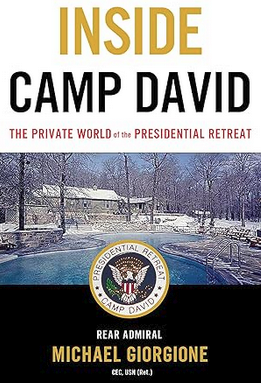
President Herbert Hoover found himself homesick during his term in office in D.C, and decided to buy some land with his own money to develop as a mountain retreat. While security concerns did add some infrastructure, like telephone lines, the creation of Camp Rapidan was solely a personal project — though one Hoover intended to gift to presidents who followed him. Roosevelt, who did follow him, found Rapidan too rough for his own needs, but liked the idea. So was born a new camp in a more attractive location, some two hours from D.C. and largely isolated. Thus Shangri-La was born, and ever since then it has been — despite a name change — a retreat for presidents and an attractive locale to host world leaders. Inside Camp David is written by a former commander of the camp, who served during the tail end of the Clinton years and the beginning of the George W. years, and folds in stories about presidents at the camp inside Giorgione’s own personal memoirs. While formal history has been made at Camp David, this is chiefly of interest to those curious about the camp itself, and the parts of the presidents that were revealed in this more casual, rustic setting. Who would ever guess that Bill Clinton liked being a choirboy on Sunday mornings?
This was not a topic I had a huge interest in, but one day while taking lunch at work I realized I didn’t have a book to read: fortunately, I work in a library, so I grabbed something off the shelf that lent itself well to cozy lunch reading. I do have a fascination for the presidency that other libertarians probably find suspicious, so I was fairly quickly pulled in. I was surprised to learn that the camp is operated by the US Navy, and this owes in part to the odd way that the idea of a retreat was formed. Franklin D. Roosevelt liked the idea of a camp, but he much preferred relaxing on the presidential yacht, the USS Potomac. The outbreak of World War 2 forced him to claim a Works Progress Administration park, newly built, and christen it “Shangri-La”, transferring crew from the Potomac to serve as its staff. To this day, the camp has a naval officer in charge of operations, and the entire staff — from servers to groundskeepers — are bonafide members of the Navy, many of them Seabees who are doing work like planting flowers that they’re absurdly overqualified for. Although the camp has witnessed history itself — being used by Roosevelt to conduct the war, even hosting Churchill, and later being the setting of the Camp David Accords — more interesting for me was how the men themselves and their families used the place.
Like their employment of vice presidents, presidents have varied widely on how they use Camp David. Ronald Reagan loved the place, visiting most weekends he was in office: it probably helped that it gave the equestrian a place to ride regularly. Reagan’s use of Camp David is also notable in that he preferred coming alone, without the large family and friends entourages that marked other presidents who visited less, like the Clintons. For virtually every president who visits, it’s a place of relaxation — a place where their days are unscripted and they can ride, shoot, or bike at their pleasure. (One notable exception is LBJ, who viewed it as just another workspace.) The isolation allows for presidents to get away with things they couldn’t otherwise do, like drive themselves, or teach their kids to drive. Giorgione remarks that the lessening of pressure allows for presidents and first families to let their hair down — making jokes with the staff or even forgetting the eyes on them. (Gerald Ford introduced himself to camp staff as “Gerry”.) While White House memoirs I’ve read consistently mention that Hillary Clinton was a …pill, let’s say, she is evidently more pleasant company at Camp David or the commander didn’t see fit to comment. As close as he comes is noting that LBJ was demanding about his showers, and that George W. frequently wore staff out with his love of biking, running, etc. Dick Cheney also appears in a mis-step: he arrived at Camp David during 9/11 and said that the president had said for him to be put up in Aspen Cabin, the presidential suite. When Bush returned to Washington, he was not pleased that Cheney had taken over his bedroom.
This was a fun look into a place I knew literally nothing about before. I enjoy books that allow me to see the presidents more as people than politicians, especially given that there are some politicians I have strong opinions about and don’t particularly like disliking as much as I do.The book is good about showing that human side for most everyone covered here, and the camp itself is such an odd operation there’s intrinsic interest in learning about it. There were bits of trivia I found fascinating, like the number of foreign dignitaries who have an interest in seeing nearby Gettysburg Battlefield when they visit, and the absurd degrees that the White House goes to appease foreign visitors. Reagan allowed the Russians to replace the phone system at Camp David with their own during peace talks, and the women in the camp staff, as well as their children, were asked not to go outside wearing shorts, swimsuits, or anything too revealing as a way of showing their respect to Clinton’s Palestinian guests. Said guests returned the favor by going commando under their open robes and driving golf carts all over the flower gardens, paved paths made for the purpose apparently being marks of western decadence. Honestly, what’s the point of being the global superpower if you’re going to let terrorists destroy the tulips?

 Reading Freely