
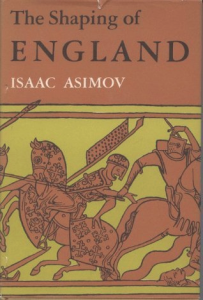
The Shaping of England is an older (1960s) Asimov history written about early England, beginning with speculation about the Beaker people and moving through the Celts, Romans, Anglo-Saxons etc to wrap up with the establishment of the Magna Carta. Like Asimov’s other histories, this is written for a general audience, with text accessible enough for a literate middle schooler but with facts and wit enough to please an adult reader. While I assume older parts of it are dated at this point (archaeology has presumably had much more to say on the Beaker, Celtic, and Anglo-Saxon periods), it’s a lovely narrative with Asimov’s usual charm and critical eye. I’m generally familiar with the subject matter and largely read this to enjoy the dear doctor’s writing again — he dominated the early years of this blog until I ran out of books by him to read — and found few discrepancies but a few surprises. His treatment of the Roman invasion of Britain, for instance, attributes Caesar and Claudius’ attentions there to Britain simply existing: seizing it meant overcoming the dangerous mystery of Oceanus, and thus driving Rome not simply past a geographic limit but past limit in general — imperium sine fine! All modern scholarship I’m familiar with stresses the connections between Celtic Britons and Celtic Gauls, and how Rome’s aims towards consolidating power in Gaul meant ending the outside interference.
I was wholly surprised by the assertion that the Scilly islands were visited by the Phoenicians. This is something I’ve never heard of, and after digging around I think it was just speculation that was common in the 1960s which is now wholly ignored. The earliest reference I can find for it (1924) comes from an article that also mentions Aryans and the Sumerian origins of English. Asimov doesn’t pursue a single-track narrative: he often follows powers and personalities who intersect with Britain and then England proper’s story. While this can appear distracting at times (why am I reading about the Norse in Vinland?), it helps maintain some flavor of the period we are in — and sometimes, to better appreciate the actual subjects by direct comparison. Robert Guiscard and William the Bastard are compared together, for instance, as forgers of stable Norman empires from far more chaotic source material. This narrative was my first time really getting into the civil war between King Stephen and Matilda, despite the fact that my name should give me an obvious interest. (Amusingly, King Stephen managed to both win and lose the civil war with Matilda: he ruled during his lifetime, but allowed her son Henry II to assume the throne and begin plantagenting all over Europe. The Angevin empire and its drama are a large part of this book’s final third, and proved interesting given that Asimov is not impressed by the lionization of Richard or the demonization of King John. Sure, Asimov writes, he wasn’t great — but Richard wasn’t exactly the bee’s knees from a character perspective. One of the men Richard arrogantly dismissed during the Third Crusade wound up getting the last laugh, being instrumental to the capture of the Lionheart in Europe and creating all manner of trouble for Europe as John was pressed to raise a literal king’s ransom.
This is dated, but fun: doubtless it’s surpassed by modern scholarship (I’m thinking of following this up with Dan Jones’ work on the Magna Carta itself), but given my longstanding affection for all things Asimov I got a kick simply from ‘hearing’ his voice again.

 Reading Freely
The Greeks DEFINITELY visited Cornwall mostly to trade in Tin (to make Bronze). There are records (or at least tales) of Phoenicians leaving the confines of the Mediterranean to move out into Atlantic waters including visiting – indeed circumnavigating – the British Isles. No doubt they popped into a few places including the Isles of Scilly and Cornwall. It wouldn’t surprise me at all if they traded for Tin there too. I *think* I’ve definitely read about that somewhere…. [muses] There is a real possibility that the Phoenicians reached as far as the Shetlands and maybe even Iceland. Those guys got around a bit.
The “Tin Islands” thing is why it makes its way into Asimov’s narrative. I’m sure I have a book on British archaeology somewhere in my ebook collection — that’s one problem with ebooks, searching is limited to keywords and I can’t easily “see” what I have considering how much is in my collection!
I understand that Cornish Tin was traded all over the Med & that Cornwall was considered an important trading port of call for a goodly chunk of Ancient times.
Your review reminded me to check my library for any Asimov books. They have I, Robot and Foundation, so I guess I’ll start there!
Sweet! I, Robot is a collection of largely unrelated short stories, and Foundation is a series of 5 stories that are meant to part of one greater story together. I’m guessing the reason your library still has it is because they were both mal-adapted into modern movies/series..
I thought the ‘I, Robot’ movie did manage to capture *some* of the essential elements of Asimov’s 3 Laws quite well (I know I’m being rather charitable here!) but that its portrayal of Susan Calvin was laughingly awful!
Susan was a difficult character, as I remember…..Asimov’s first attempt at creating a woman (posssibly before he ever married and realized they were people, too XD), if I remember correctly.
I do remember her being a *cold* fish! I still liked her though…