
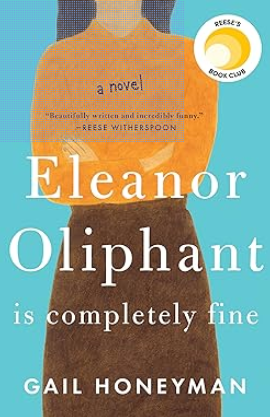
Eleanor Oliphant has worked at the same firm every year since she graduated college, and she has an unvarying routine of going home and watching tv while eating packaged meals. On weekends, she drinks vodka by the liter, staying pleasantly drunk until she wakes up Monday morning for another week at the firm. She keeps to herself and finds her coworkers as strange as she suspects they find her. One day, though, an old man crumples to the ground while she’s walking outside, and when she’s called over to help by one of her coworkers, she unwittingly sets on a course that will begin recalling her to life from her prison of routine and isolation. So begins a novel with a fascinating lead character who the reader will quickly realize is hiding some serious trauma — from herself and from those around her. Ultimately it’s a story of a woman facing her demons with a little help from her friends.
Because of my fondness for odd characters like Ove and Arthur Entwhistle, this book has become highly recommended to me. There are some faint similarities, in that this is partially a story of a socially withdrawn and introverted personality being drawn out of herself and into the world again. This struck me from the beginning as a more serious read than any of my previous curmudgeon/Sheldon-esque characters, however — in part because Eleanor is very obviously an alcoholic, and she maintains ties with an emotionally abusive mother, with hints of a very bad history between them. The humor is here in abundance, of course; Eleanor not grasping basic social cues, and being so disconnected from ordinary society that she finds it strange and acts as an alien observer. Both this and A Man Called Ove have mentally troubled characters with tragedy weighing on them, but in Eleanor Oliphant the tragedy weighed heavier on me because the character has closed herself off to everything but a few bad habits. Ove at least had his memories of his wife to dwell in.
This was an interesting novel: I didn’t take it to it as enthusiastically as I have others in this ‘genre’, if it can be called a genre; I think part of that was that I hadn’t expected the trauma along with the weird and whimsy.
Quotations:
If [Jane Eyre] has one failing, it’s that there’s insufficient mention of Pilot. You simply can’t have enough dog in a book.
“Can I get you drink?” the man yelled over the top of the next song. […]
“No thank you,” I said. “I don’t want to accept a drink from you, because then I would be obliged to purchase one for you in return, and I’m simply not interested in spending two drinks’ worth of time with you.”
A semi-human bath sponge with protruding front teeth! On sale as if it were something completely unremarkable. For my entire life, people have said I’m strange, but really, when I see things like this, I realize I’m actually relatively normal.
Related:
Rachel’s Holiday. Substance abuse & unreliable narrator.
The Rosie Project. Presumably-on-the-spectrum character begins a project to find a girlfriend.

 Reading Freely
Sometimes I wonder if people write and read books like this to make themselves feel better about themselves.
Because books like this are seriously messed up. I’m pretty tired at the moment, so I know my judgement is compromised, but if books like this are what people are choosing to read, I say they deserve everything they get as a result. And that’s why I’m not God 😉
I can only speak for myself, but I’m aware of my own tendency to live in my head too much, or to withdraw because of social overload. Men like Ove and Ebenezer Scrooge serve as a reminder of the consequences of that — at least, before their redemptive arcs. The curmudgeon-recalled-to-life is a favorite trope of mine for a reason.. 😉
👍