
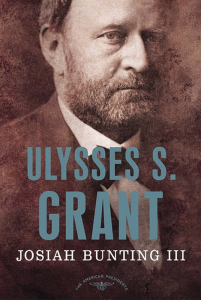
Ulysses Grant opens with Josiah Bunting III’s rueful observation that Grant is almost always thought of “General Grant”, never president — despite being the only man between Lincoln and Wilson to serve two consecutive terms. Bunting attributes this to both Grant’s military successes, his modest upbringing and demeanor, and the issues that flecked his presidency. By way of repair, Bunting’s own biography focuses the majority of its attention on Grant’s presidency: the Civil War is over and done before the reader has even gotten halfway through. Grant is an easy president to read about, largely because of his modest stillness and humility: his virtues were ordinary and plain, not dramatic. He did not have the charisma and zeal of a Jackson — with their attendant problems — and does not appear to have been a psychologically complex figure like Nixon. He simply was, “Sam Grant”: son of a tanner, a good soldier, a hard worker, and a dedicated servant of his country. As with a few others in this series, Bunting writes with no neutral pen: he plainly admires Grant and refers to him as truly noble.
I have read the memoirs of Grant before, so I was largely familiar with the tracks of Grant’s life. He was a son of the Midwest, growing up along the Ohio. Only a generation before, this area had been the frontier, and even now it was still being developed. Grant shared the spirit of industriousness the age demanded, launching a livery service even as a young lad. Per his father’s wishes, he entered into West Point and proved himself a superb horseman, but despite this was shunted into the infantry. He did well for himself in Mexico, but found serving as a quartermaster in peace interminably dull. After some head-butting with his superiors, Grant resigned to work his and his wife’s farm in a cabin they built together, but struggled and was effectively rescued by the outbreak of war. Grant had a good mind for logistics and a willingness to attack — two factors that served him well. He rose rapidly as the war developed, and by the time General Lee surrendered, had managed to achieve admiration on both sides. After the acrimony of the Johnson presidency, in which the president and Congress sparred over who had authority to conduct Reconstruction and how it should be achieved — Grant was seen as a unifying force. Despite the scandals that men in high office got up to, Bunting views Grant as a man of unimpeachable character, wholly admirable — especially given his commitment to safeguard the rights of freedmen and to enact better policies in regards to Native Americans. This drew fire from the blackguard Sherman, who regarded his old boss as having gone soft. Nothing is said of more prickly issues in Grant’s history, like his order evicting all Jews from Kentucky. (The order, composed to help squelch supplies flowing to the Confederacy through Kentucky merchants, was later countermanded by Lincoln.) Still, it’s hard not to sympathize with a man who did so much, and yet suffered with cancer in his terminal years and still worked through his constant pain in hopes of providing for his family even as poor investments left him nearly penniless.
Bunting is an interesting author who delights in allusions and quotations — World War 2, Korea, and Vietnam are all mentioned — and clearly delights in writing, sometimes striking Fosses into florid territory. As much as I enjoyed reading this, though, it’s hagiographic in tone and I can see myself looking for something more balanced and substantial, like Chernow’s beefy treatment.
Grant had an amused contempt for book learning in soldiers; such people, he said, “always knew what Frederick the Great did at one place, and Napoleon at another. Unfortunately for their plans, the rebels were always thinking of something else.

 Reading Freely