
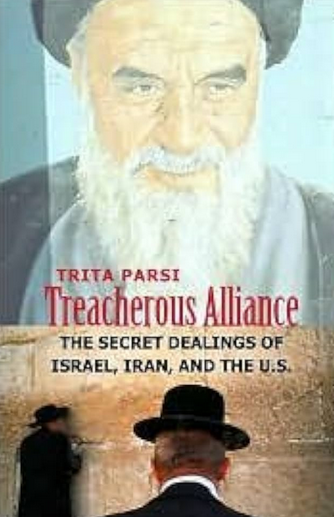
Trita Parsi’s Treacherous Alliance is a history of relations between the United States, Israel, and Iran from 1947 on. It principally argues that Iran and Israel’s relationship has become poisoned not because of Iranian ideology — specifically, that of the Muslim clerics who control Iran — but through each power pursuing geopolitical interests that sometimes included one another, but increasingly did not. Specifically, Parsi argues that the Israeli-Iranian animosity that exists at present owes to Israel changing its priorities: rather than court Iran as an ally against the Arab nations that surrounded it, in the 1990s Israel began courting its Arab neighbors and using Iran as a common enemy. This was partially entangled with DC’s decision to abandon its mission of balancing Iraq and Iran against one another, and instead settling on the more ambitious and imperial cause of “dual containment”, a cause enabled by the sudden folding of the Soviet Union and the fleeting establishment of the unipolar world. Treacherous Alliance is dense but informative, covering every step of the constant dance between Israel, Iran, and DC — a dance that has more than a few surprises.
A key point in Treacherous Alliance is that Iran and Israel both view themselves as regional outsiders: Israel is a quasi-western and Jewish outpost planted in a largely Arab world, and the Iranians have both ethnic and religious differences with their own Arab neighbors. These are not insignificant differences, but Iran has tried to overcome them from time to time — positioning itself as a regional leader through different means, first its connections with the west and then its status as an Islamist state. Parsi’s deep history shows how Iran has tried different tacks at different times — depending on how the geopolitical winds were blowing — but how realpolitik and not ideological fixation has always been the ultimate driver for Iran. The Shah, who was far more open to working with Israel than the bigbeards who followed him, still kept them at a bit of a distance: they were largely useful as a means of connecting more readily with the west, and as an ally against Arab (principally Iraqi) or Soviet aggression.
Events like the Iraq War or the collapse of the Soviet Union would change the dynamics — and the respective party’s priorities. Realpolitik is king: even when DC was inveighing against Iran, and Iran against Israel, in back rooms deals were cut to allow information and war material to flow as each state pursued its respective interests. (The Iran-Contra affair comes readily to mind.) While the mullahs might harangue Israel rather than offer terse depreciation of them the way the Shah did, both regimes were still willing to deal. In the 1990s, though, Highlander politics started to dominate each nation’s rulers’ more: in terms of regional hegemony, There Can Only Be One. Both Israel and Iran had the potential to dominate the area’s politics, but only if they could marginalize the other. This was especially true when Israel began making traction with the PLO, and Iran — which had made support of the PLO one of its planks for authority in the region — felt further isolated. DC was frequently complicit in this, think tanks declaring Iran a chief sponsor of terrorism even as the house of Saud funded wahhabist schools who would give us virtually all of the 9/11 hijackers. DC’s dismissal of the Iranians was partially fueled by lobbying groups like AIPAC, which also pushed the Clinton admin to ending trade between America and Iran.
But lest readers think “Ah, okay, now we’re at more or less present relations” — oh, no. At this point Netanyahu was a voice for moderation, pushing to preserve the relationship between Tel Aviv and Tehran. He viewed the PLO as a far more pressing threat. Another fly in the soup, though, is that Israel and Iran both viewed the United States in the context of their own struggle for power; neither power wanted the other to draw too close to DC for fear of being isolated. So, when DC and Tehran had golden opportunities to work together destroying the Taliban regime — foes of both governments — the Israeli lobby in DC kicked into overdrive, helped by Israel’s discovery of a ship full of weapons manufactured in Iran enroute to Arafat. Plans that were developing for DC and Tehran to stabilize Afghanistan together — complete with a jointly-trained army — disappeared, and the conduit for talks closed when Bush declared Iran to be part of the ‘axis of evil’. Clinton and Bush’s previous progress with the PLO was also undermined, as Bush’s team wrote Arafat off as untrustworthy. Ultimately, Tel Aviv appears to have been far better at navigating the particular tug-of-war, as our present circumstances (the 2026 – ? Iran War) prove.
The last section of the book, “Looking Ahead”, is now sadly moot. I appear to have a bad habit of reading Parsi books after Trump’s gunboat approach to Iranian diplomacy has rendered them somewhat irrelevant. Parsi comments that DC could benefit by leaning more on Iran as a potential ally, cultivating it as a guardian against Chinese encroachments into the region: instead, Bush, Obama, and Trump’s continued aggression against Iran (including funding al-queda in Syria to undermine Iran’s ally Assad) have pushed the regime deep into partnership with China and Russia, and the present war may have the perverse effect of rallying Iranians around the flag in addition to deep-sixing the global economy. Still, as far as understanding what’s gone before, this is an extremely detailed and generally fair-minded approach.
Okay, this is the actual cover:

 Reading Freely
I’ve been reading about Israel etc.. recently too for some reason…. Review on Thursday… It was looking (mostly) at events post-Oct 7th 2023 with some deeper background. Its future gazing is also rather moot at this point!
I wonder if in the future we’ll remember this time like the beginning of an epochable event, or if Trump and whoever’s still alive will manage to find an off-ramp. From what I’ve read the Shiia subscribe to similar persecution/apocalyptic complexes that the Branch David group did…..so that ‘persecution’ to them amplified the desire to fight, because they were entering into the endtimes and enabling the rise of the messiah/mahdi.
I think there are several fundamental problems here:
The fact that Israel & the US have different objectives. The fact that the US has never had an overall strategy for the war. The fact that they assumed that a simple decapitation strategy would topple the regime. The fact that they grossly underestimated Iranian military (missile) capability. The fact that the Iranians were more that willing to attack/destroy installations across the Gulf region. The fact that the US in particular thought that the Straights of Hormuz would be or could be kept open. SO many mistakes or mistaken assumptions!
As far as I can tell there are two main ways this war ends. Either the present Iranian regime is completely destroyed (which will mean a ground offensive & mass casualties all round) or the US walks away with a proud ‘Mission Accomplished’ which the rest of the world will see, rightly, as complete BS. The thing most people seem to forget is that Iran has a vote too. Imagine the price of oil if the Straights don’t open for 6 months… Imagine the price of fertilizer?
I doubt VERY much if the war is going to be over any time soon. It’ll definitely last months rather than weeks & might even last YEARS. There’s a *very* real possibility that Israel might run out of defence missiles which means that a LOT more Iranian attacks will get through. What happens when 50% (or more!) of Iran’s ballistic missiles hit their targets in Tel Aviv? Will Israel go nuclear and take out Tehran? That’s not a 0% probability. THEN what happens?
Overall its a COMPLETE mess. Israel is responsible & Trump added fuel to the fire. Unfortunately the rest of the world is going to pay the price for the hubris & stupidity we’ve seen so far. The only thing I’m confident of is that its going to get worse before it gets better.
Trump has already had his Mission Accomplished banner moment when he said the war was ‘pretty much over’. Unfortunately, I don’t think many people in DC factor in the OTHER ways oil fuels the modern world — fertilizer, like you said, plastics. The decapitation strikes were impressive in an abstract way, especially if — as humor has it — DC was manipulating Tucker Carlson into providing his Iranian contacts false information so that everyone was out and about and prime for getting bombed. I have NO IDEA how true that rumor is — right now I’d label it pure speculation, especially since who c can tell anything about Tucker Carlson these days? He wasn’t even on my radar until he interviewed Putin and the Iranian president, but evidently ‘where you stand on Tucker’ is a big thing in conservative circles these days given the growing rift between the pro-Israel crowd and the America First crowd.
Iran having a voice is a common theme in this book — DC keeps focusing on Israel and the Arabs, and Iran causes problems to force DC to recognize that yeah, we have a stake in this as well.
Tucker has been saying some weirdly rational things lately (for a change), but then I remember that even a stopped clock is right *twice* a day….
Did you see the Lyndsey Graham comment about comparing Kharg island with Iwo Jima…? Because THAT battle went SO well….. [shakes head in disbelief] Just imaging how well 7K dead and 20K wounded would go down with the American public!
I doubt most any American could tell you how many people died in 20 years of Afghanistan, and nearly ten in Iraq. That’s how effective the corporate media is here. Unless Americans come from a serving family — and there are a lot of those in the Mississippi, ALabama, Georgia neck of the woods — they’re oblivious.
As far as Tucker, I don’t know. He had a talk with Cenk Uygher of the Young Turks which was fascinating, but then he’s talking to Candace Owens who is going on about being harassed by the French because she’s accused Macron’s wife of being a dude.
I caught wind of the Graham comment. Not surprised. Trump’s cozying up with LG and other neocons, while at the same time treating principled men like Massie like pariahs, has lost him a LOT of goodwill among people who didn’t support him in 2016/20, but were willing to roll the dice in 2024. I am NOT surprised Vance is increasingly distancing himself: he and Gabbard were supposedly left in the dark about some of these MIGA antics, and both have been sharp critics of interventionism in the last few years. However, Dems being Dems, they’ll probably come up with something to enflame Trump’s base again. It’s an old story and I think it’s told on both sides: we don’t like our side, but we HATE the other guy. That’s the nice thing about listening to mostly libertarian circles….we get the dirt on both and are so jaded that anything good politicians manage always comes as a surprise.
Oh: and one mystery to me, and perhaps to DC as well, is why the popular agitation of a month or so ago is completely absent. Perhaps it was ginned up by the CIA in the first place, or perhaps — and this is my fear — the war has caused a rally ’round the flag effect, as happened when Iraq invaded in the eighties.
I guess we won’t know until….it’s over. At some point….