
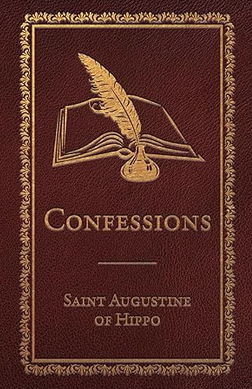
Fifteen years ago, I read The Confessions; I am not sure what prompted me to do so, other than perhaps a desire to read The Classics, and my belief that St. Augustine was like Cicero, a brother in avid pursuit of philosophy. My past self was not particularly impressed by the book, finding “Gloomy Gus’s” penchant for self-abasement depressing, and his particular focus on philosophy far too academic for my tastes. Then as now, when I read philosophy it is with an eye toward practical living – which why I like the Stoics. I was amused to learn later on that the translation I read, by Mr. Pine-Coffin, is “aptly named, for it is a dead translation”. When I decided to re-read The Confessions, now fourteen years a Christian in a very liturgical tradition, I chose to read Anthony Esolen’s translation. Not only do I enjoy Esolen as a writer and speaker in general, but it was his translations that took me through Hell, Purgatory, and finally Paradise. On having finished this a second time, I found it somewhat more enjoyable than my first go-round, especially once I realized that Augustine’s work was not merely woolgathering, but one volley fired in a battle of ideas — in this case, Christianity vs Manicheanism.
Confessions is frequently hailed as the first autobiography, but this is not an attempt by Augustine to give himself the Plutarch treatment. It is a spiritual biography, and Augustine’s growth as a man — from a selfish boy to a selfish youth to a young adult caught between the agonies of desire and the thirst for meaning — develops in tandem with his growth as a spiritual being. I noticed immediately there were elements from my original reading that I found far more compelling this round: when Augustine agonizes over stealing a fruit as a child, he is not being a self-flagellating puritan. However scrupulous he might have been, the moment is more than beating himself up: it’s a questioning of why we delight in transgressive behavior. He stole the fruit not because he was hungry or because he didn’t have the means to buy food, or even to spite the fruit-owner: he did it for the thrill of the steal. The older I get the more aware I am of that transgression for transgression’s sake and how pervasive it is in modern western society — from alt-right personalities embracing Hitler to activists defacing art with slogans. It strikes me, candidly, as Satanic — the spiteful decision to attack the good in creation in an attempt to frustrate the Creator.
The early sections can be compelling or boring depending on the topic at hand: Augustine’s greatest temptation appears to have been sexual appetite, not surprising for a young man, and his earnestness was such that he sent his mistress of many years packing away to Africa…only to relapse and find himself sleeping with both a new girl and his self-loathing. I could hear him echoing Paul — “the good I would do, I do not; and the evil which I would not do, I do.” These come along with discussions of Plotinus and neo-Platonic thought and there frankly my eyes would glaze over. These are not merely academic, though: just as Stoic praxis is grounded in Stoic cosmology, so too was Augustine’s perception of sin guided by his philosophical background. Critically, he regarded sin as originating not from inherently corrupt flesh, as the Manicheans and Gnostics did, but from a disordered soul. A disordered soul could be mended, but not through sheer force of will, as Augustine found out with his libido: grace was also needed, and there we move from philosophy to theology. For Augustine, grace breaking through was especially salient when he heard a voice urging him to “Take! Read!”, and then opened his Bible to a verse that cut his heart to the quick and made it clear that it was time for him to make a decision.
It’s fascinating to read this and then my old review, because past-me was very hostile toward the bishop. Although I became obsessed with philosophy, religion, and meaning in the late 2000s, I suspect parts of Confessions touched on parts of my being that were very sensitive — specifically, the memory of constant fear and self-loathing of my Pentecostal youth. When Augustine expressed humility, I reacted from the memory of constant condemnation — of myself, of the world, for every petty thing. Twenty years removed from Pentecostalism now, I can read Augustine as he is, and not some distorted version of him. There were some parts of my original review that indicate how poorly I understood what I was reading. I condemned Augustine for endorsing the ‘hateful split’ between the world of the body and spirit simply because he writes honestly on his problems with the passions. In fact, Augustine defends the body by arguing that it is the spirit that is disordered; the body itself is what God declared it to be in the first chapters of Genesis: ‘very good’. Gnosticism, Manicheanism, and many iterations of Protestant thinking are guilty of my condemnation, but not Augustine. At this point I’m also far more theologically aligned with Augustine on certain points that I would maintain even on secular grounds — particularly the notion of being curved in on ourselves, and of that being a source of much of our own inner poverty and social disorder. Although this is theologically dense, I enjoyed Augustine’s prayerful reflection on his life for the most part. It’s not a devotional text per se, but chronicles an important era of late-classical era thinking, and despite its age still speaks — though not necessarily on topics moderns dwell on today outside of college philosophy classes. This is a dense read — both of my priests looked askance at me when I said I was reading it — and some parts are just as opaque to me as they were in 2011. Now, though, I appreciate Augustine’s spirit more.
A note on the translation: Esolen as ever has expository footnotes, the text reads very cleanly, and some of the phrases chosen (“made myself a kingdom of want”) will echo in my head long after I’ve put this book back on the shelf. Given that all translation is interpretation, I have to wonder how much of my appreciation of this owed to Esolen’s translation. Who can read “Drunkenness is far from me; you will have mercy on me, so that it may never draw near. But feasting, well, that has sometimes crept up on your servant.” and not laugh?
Quotations
“[…]for you have made us for yourself, and our heart is restless until it rests in you.”
The house of my soul is too cramped for you to enter: make it more spacious. It is falling to ruin; repair it. Much inside it offends your sight; I know it and I confess it.
But I, I slipped away in the days of my youth, and wandered from you, my God, far afield from your steadfastness. And I made of my own self a kingdom of want.
Begone from my soul, then, those who say to it, “It all depends on what you take joy in. That beggar took joy in being drunk, but you, in glory.” What glory, O Lord? As his was no true joy, so mine was no true glory. No, it turned my mind to consider things more closely. That night, he would digest his drunkenness, but I had fallen asleep with mine and had risen in the morning with it, as I was going to do again—and look how many days!
For he wanted nuptials with death, and he who loves peril shall fall into it.
Drunkenness is far from me; you will have mercy on me, so that it may never draw near. But feasting, well, that has sometimes crept up on your servant.

 Reading Freely
I thought we’d have *very* different ‘takes on this. [grin] My review is up (about 20 minutes after yours I think which is pretty good synchronisation considering the time differences).
I wasn’t sure if we were waiting on one another or nor — I checked this AM when I woke up and then decided to just post it once I was at work. Your and 2011 me’s views were pretty similar. I’m SO amused that you and past-me read the Pine-Coffin translation. Esolen is more enjoyable, I think. If it wasn’t for Milton I would go to Lucretius to get Esolen’s treatment of him..
I didn’t have any problems with the translation – not knowing what I might be comparing it with. It seemed ‘OK’ as far as it went. I did find large chunks to be rather tedious though. If he’d cut back on the praising it would have been a much shorter & much faster read.
My biggest problem with Augustine himself was his apparent lack of drive to understand things despite his supposed motivation. I was SO frustrated when he had DIRECT access to Saint Ambrose… but didn’t want to ‘bother’ him….! That’s like being a novice mathematician and working next to Einstein in the Patent office but not wanting to talk math over lunchbreak!
Well, in his defense he probably didn’t realize Jerome and Ambrose were going to BE Jerome and Ambrose. That was a jarring moment for me — realizing Augustine is talking to the guy who translated the Biblical texts into a Latin version “everyone” could read.
so glad you enjoyed your reread. I loved it, read it many years ago, and some passages are really brilliant.
Though now I appreciate less his general pessimism about human nature.
I go back and forth on that myself…
Oh, I think that we have *every* reason to be pessimistic about Humanity… and not just because of current events. Honestly, we are dumb as rocks……
I think we CAN be brilliant, but we’ve been undermining ourselves for a few generations at least. In the US we have kids arriving in schools whose development has been completely warped by a ‘lifetime’ of screen time; teenagers who talk to themselves and narrate everything because they’ve grown up watching streamers; high school graduates and college who can’t write complete sentences. I think we are descending rapidly into a new dark age that we’re blind to because our INSTITUTIONS retain knowledge on our behalves, and even allow for technological progress….but that’s because people whose minds have NOT been destroyed by tech-dependence are still in charge.
Individuals can be brilliant, cultures or civilisations are rarely so. I certainly recognise what you mean about technology warping things but I’m not just talking about the last 20 – 30 years. We, as in humans, have been doing incredibly stupid things for the whole of recorded history. We’ve certainly been doing our very best to wipe each other out for that long. It beggars belief the sheer amount of time, energy & money we’ve spent making our weapons more lethal. So far we’ve been lucky. That luck won’t hold forever.
As cultures we’re incredibly short-sighted, greedy and selfish. When something new comes ‘online’ the two biggest questions that arise are ‘how can we make money from this?’ and ‘how can we use this to kill our enemies?’ – DUMB. We haven’t changed that in the last thousand years and I doubt we’ll be changing it any time soon. My bet is that we won’t have a thousand years to improve things. Personally I wouldn’t put a substantial bet on a hundred.