
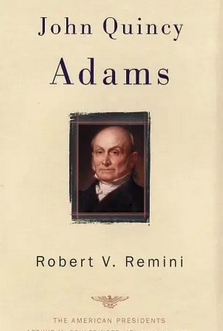
In his biography of Abraham Lincoln, Jon Meacham referred to John Quincy Adams — hereafter referred to as Quincy, following John Adams’ practice — as “the personification of the nation’s story”. That’s a hell of a epithet, one so striking I had to scribble it down. I am somewhat familiar with the Adams clan, beginning from John himself all the way to Henry Adams, and tend to like them, especially John and Quincy, who were bookish, moralistic, and prone to irritating people. After reading a series of books on John and Abigail Adams years ago, I’ve always intended to tackle their eldest son — and am glad this history project is giving me additional drive to do it. I’m beginning with a shorter one in The American Presidents series (they’re all about 200 pages), but can readily imagine follow-ups and circle-backs.
Bless John Quincy Adams: he had ‘tiger parents’ who rode him incessantly and insisted he had to be the very best. John Adams himself came from humble circumstances and made himself a notable through hard work and an invictus-like attitude; he expected more from his son, who grew in more privileged soil. His mother Abigail was equally demanding, and little Quincy was pressed into public service at the tender age of 14, assisting America’s diplomatic mission to Russia. Diplomacy would mark his early political life; even after he returned to America and graduated from Harvard, he would achieve early distinction serving Presidents Madison and Monroe, in the latter case helping to formulate the Monroe Doctrine that declared the Americas closed to future colonization. Remini’s book puts this doctrine into context: as the peoples of South America began rebelling against their Spanish overlords, the Republican administrations of Madison and Monroe saw a new chapter beginning in American life. The rule of the Old World’s monarchies in the New was over; now it was time for American republics to shine. This was not an example of early American ‘imperialism’; it was Republican idealism, and an idealism that Adams’ own presidency would exhibit when he tried to send ambassadors to a pan-American conference to discuss matters of mutual importance. President Quincy would be so hindered by the already-sectional Congress that by the time his ambassador arrived (one died en route) the Conference was already over.
Quincy is a fascinating president to study; despite his diplomatic accomplishments before, and his storied career in Congress after the office, he was not an effective president. He was marred from the beginning: he ran against a man who he’d actually defended, Andrew Jackson, but despite Jackson winning the popular vote the electoral college was undecided with no majority: Henry Clay cast the decisive vote to give Adams the presidency, and when Clay was awarded with a Cabinet position the opposition cried foul and accused Adams of conducting a corrupt bargain. Never mind that Clay hated Jackson and would have never voted contrary; the circumstances were such to give energy to the accusation. Quincy also dealt with difficult issues in office, from diplomatic affairs to the apparent willingness of Georgia to declare war on the Creek nation on its own if the federal government wouldn’t get around to evicting them. Adams had a strong sympathy for the plight of the Creeks, especially given that one treaty signing over land was created by such a brigand than the Creeks killed the man upon learning what he’d done to them, and acted in a way that annoyed everyone. To make matters worse, he signed off on the ‘Tariff of Abomination’ which would lead to a sectional crisis during Jackson’s administration when South Carolina threatened to secede over tariffs that transparently made the South pay premiums to protect the North and Northwest’s emerging industries.
What makes this interesting, though, is that Quincy’s commitment to integrity made his job worse: he retained people in office who hated him and actively campaigned against him or undermined his policies because they were effective in their posts: he would not remove people for purely political reasons, and his inherited postmaster general was so devoutly Jacksonian in bias that Jackson made the man a Supreme Court justice after Old Hickory hisself was in office. Adams also retained the Founding-era contempt for politicking, and refused to do things like appear at the 50th anniversary of Bunker Hill, or the opening of a canal. He was a man of intelligence and integrity who refused to court public opinion — and lost the next election rather handily. Despite suffering the losses of his father and two sons in this period, Adams was nonetheless courted to become a legislator, and there he achieved lasting glory as a stalwart against the expansion of slavery. It is his actions there that he is largely remembered.
Several volumes in this series have been fascinating, but this one was especially so for me because I was familiar with Quincy already. I didn’t know how much family tragedy he encountered: Remini remarks that alcoholism was a family curse, claiming one of Quincy’s brothers and two of Quincy’s sons. (His son Charles Frances famously overcame his namesake uncle’s predilection for the bottle and became an accomplished diplomat himself, though Southerners may wish contrariwise.) While one is reluctant to start fossicking around in psychology, the intense social pressure the Adams clan put on one another is no doubt part of the problem. Quincy was told by his father that he had no barriers to success beyond his own moral degradation, and he himself administered that same moral whip to his sons. Remini, while sympathetic to Quincy, regards him as a failure as a father and husband for failing to see his sons than anything other than scions of an accomplished house who were obligated to live up to their reputation. The man told his sons not to come home for Christmas when he saw their Harvard report cart and viewed it unsatisfactory. All the same, Remini regards Quincy as a man of unparalleled integrity whose adamant stance against the expansion of slavery redeemed his reputation for the ages.
This is the first book on JQA I’ve read, but I doubt it will be the last. The man is both difficult and interesting, a combination ripe for future reading.

 Reading Freely
When you commit to a theme…. you COMMIT don’t you! [lol]
I’m planning on taking a break after Polk, since I’ll have the first 16 presidents. Believe it or not, I am getting a LITTLE tired of the 19th century. XD
I’m hoping to read up about a few 20th century Presidents this year.. Probably Nixon and maybe something general about the Kennedy Whitehouse…. [muses]
Both are fun, but for different reasons — Nixon’s paranoia and Jack’s philandering.
Its interesting just how physically *ILL* Kennedy was. Also interested in his dad in London during the early part of WW2 as US ambassador. Universally hated apparently!
Jimmy Hoffa dismissed Joseph Kennedy and co as “a buncha rum-runners”. The story is they came from ‘disreputable’ roots, got rich, and then Kennedy wanted to be as respectable as you could get — and pushed his boys into politics. And yes, as I understand it JFK suffered much from war wounds, especially in his back, and had an entire medical regimen.