
I thought it would be amusing to do a history short round after realizing I’d read two books in which Jon Meacham focuses on Kentucky-born presidents who became icons and who dealt with secession crises. First up, Andy Jackson!
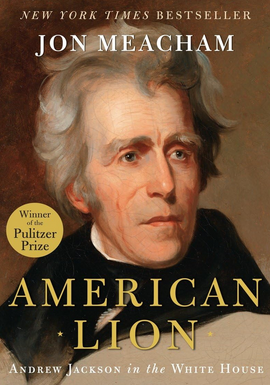
Andrew Jackson is a singularly American figure; no other nation could have produced him. Just over two hundred and eleven years ago, he won a flabbergastingly improbable victory over the British at New Orleans, making a war that had already ended in a grudging truce into an roaring victory in American memory. Jackson – who had led men on his own through the wilds of the ‘old southwest’, bearing the pain of duels past as they trudged toward New Orleans – became a folk hero and went on to transform national politics and become the President. Although today he’s only associated with Indian removal, Meacham points out that his policies there were perfectly in line with other politicians of the period, like William Henry Harrison. Jackson is a tough old bird, resilient both physically and emotionally. Raised practically an orphan, he nevertheless forged a path for himself in the military and law. Raised in the southern honor culture, he had a tendency to get into duels and would carry the debris of several with him. He wasn’t just a violent hillbilly, though — he could conduct himself with grace that surprised his opponents in Washington. He had many, too, because he viewed the Washington elite as just that, an elite who were unresponsive to the needs of the people. In an age of increasing suffrage, the people had louder voices — and Jackson not only heard them, he marshalled their energy. Interestingly, although Jacksonianism was avowedly opposed to elitism and centralism in government — one of the reasons Jackson constantly attacked the National Bank, seeing it as a tool of eastern bankers to keep the country in hoc to them — Jackson in office was not a protolibertarian icon. He was heavy-handed, both with the bank and with South Carolina after the palmetto state threatened secession if the tariff of abominations — which sheltered northern industry at the expense of southern consumers — was not scotched. In this Jackson is not an exception: many who criticize the use of power find it strangely intoxicating when the One Ring is on their own finger. This was an engaging and fair take on one of early America’s more complex and fascinating figures.
Next up, Abraham Lincoln.
Lincoln is usually rated alongside George Washington in terms of ‘great American presidents’; and perhaps that’s fitting in one way. Just as Washington was first to preside over the Union created by the Constitution – a new approach to Republic from the previous Articles of Confederation Republic — so did Lincoln effectively create a new Union in his attempt to save Washington’s from sectionalism and dismemberment. And Then There Was Light takes a fairly obvious tack towards Lincoln, hailing him not only as the man who kept the Union together, but in the process recognized that this was the moment to finally destroy the noxious institution of slavery, and labored to do so. It’s fairly hagiographic, at least as much as a modern writer can admit that anyone who died before us can have a shred of virtue. Meacham’s attitude is that while Lincoln was not the saint moderns might wish him to have been, he was all the saint it was possible to be in his time and circumstances. As such, the even-handedness from the Jackson biography is absent here: any opponent of Lincoln’s is a nogoodnik. Even the anti-war northern democrats, who protested the war in general and especially war measures like conscription and the like, are simply dismissed as allied with his enemies, and when listing the states that seceded Meacham does not bother to point out that the second wave, which would include many of the men who would frustrate the Union for years, did not happen until Lincoln called for troops to suppress the rebellion. (In the text they come off as being summoned to defend the Capital, surrounded as it was by hostile Maryland and Virginia.)
Fortunately for Meacham, his subject is inherently interesting: a poor Kentuckian turned Illinois rail-splitter was struck by ambition to be not only known, but unforgettable. Lincoln had a gift of gab — a quick wit and a sense of humor that made him both a good lawyer and an excellent political booster. According to Meacham, it was Stephen Douglas’ Kansas-Nebraska act that lured Lincoln fully into politics: he was so opposed to the potential for slavery’s expansion that he felt compelled to enter the arena. Although my libertarian politics do not allow me to give many laurels to Lincoln — he is one of the principle figures of the the Republic’s transition into the Dominion of DC — I cannot help but sympathize with him. I admire any man who shoots up from nothingness into national prominence through dogged hard work and ambition, and Lincoln served under the most dismal of circumstances. Not only did he inherit a country at war, but he was struggling with his own inner demons and would lose children in the process — and, when he’d finally neared the dawn of potential peace, a bitter actor shot him. Lincoln is a marvelously complex fellow, and I will not settle for just one book on him.
Do not be surprised to see Mr. Meacham again; I fully expect to read his biography of George H.W. Bush, which will be interesting since Bush Sr was my “childhood” president, and his face is the first that comes to mind when I think of The President — just as Queen II is always The Queen and John Paul II is always The Pope.
COMING UP: John Grisham’s The Widow and a radio adaptation of The Hobbit, if its obnoxious renderings of goblins and other monsters do not drive me to stop listening to it.

 Reading Freely
I own both of these, but haven’t read them yet. Thanks for sharing. They need to move up on my list.
Pingback: The Real Lincoln | Reading Freely
Pingback: January 2026 in Review | Reading Freely