
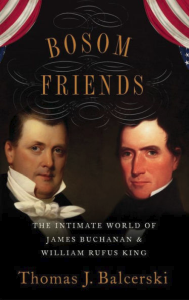
James Buchanan remains the United States’ only bachelor president – he was technically joined in this feat by Cleveland for one term, but by the time 22 had returned as 24, he had found his better half. Buchanan, though, despite numerous flirtations and one possible engagement, never fully tied the knot. In this chronic bachelorhood he was joined for a time by William Rufus King, the son of a prominent Carolina family who with his brother took early parts in the development of Alabama: King, in fact, founded the town of Selma, though he remained more interested in national rather than city politics. Buchanan and King served in Congress together, and lived together. This has sometimes given speculators in the 21st century cause to wonder if the two weren’t an item together, and exploring that possibility is the ostensible purpose of this book. Readers eager to dive into the romance lives of old men wearing frock coats, however, will be disappointed – just as I was relieved. Instead of being a work of historical gossip, the author instead uses the close friendship and political alliance between Buchanan and King to explore the role of “messes” and personal alliance in the early-mid 19th century.
When this book first came out, I gave it a wary look: since William Rufus King is our town founder we should have anything and everything possible on him, but this one struck me at first sight as gossipy and salacious. My recent Buchanan dive, however, made me look at this one a little more closely, and I found it far more substantive than expected. Knowing his reader’s expectations, however – having partially set them – Thomas Balcerski opens the book by looking at the rumors of King and Buchanan’s alleged pairing. He points out first that the fact that they lived together is absolutely meaningless: in early Washington, Congressmen often shared boarding houses together, generally in politically-related clumps called “messes”. This owed in part to the lack of housing in Washington City in general: it was a city still very much being formed. King and Buchanan’s arrangement was slightly different, as theirs was the self-consciously styled “Bachelor’s Mess”: they were joined by numerous other men through the decade or so that the mess was intact, but the other bachelors had a habit of running off and getting married. Balcerski also looks at the language used by these men in their letters together, and the dismissive way other men dismissed them as effeminate. It was not uncommon for politicians to attack one another by accusing them of being effeminate or ladylike; Buchanan, in fact, would dismiss John Quincy Adams in adjacent language, calling him a “witch”. The language used in the letters is rather intimate by our reckoning, Balcerski writes, but not unusual in the context of its times . While there’s certainly room to read between the lines, ultimately Balcerski maintains there’s no real evidence one way or another. King swore that he’d fallen in love with the princess of Russia and could not find room in his heart for anyone else, and Buchanan flirted with women throughout his life and was even engaged for a time, though something went sideways and he was not even permitted to follow her funeral train when she died. Both men would devote themselves to their nieces and nephews, and rely on their oldest nieces as personal assistants of a sort: it was Harriet Lane and Catherine Margaret Ellis who retained their uncles’ letters and allow us any insight at all into their 19th century wheeling and dealing.
The majority of the book follows Buchanan and King’s lives in Washington as they made common cause together, at least for the most part. Both would eventually be affiliated with the Democratic party, working for national unity despite sectional rivalries. I truly did not understand the angst around the Union’s health that pervaded the early 19th century: between New England threatening to secede in the 1810s, South Carolina threatening and very nearly doing so in the 1820s, and so on, there’s a salient sense that this experiment in unitive democracy might and very well could fail. While balances and deals were struck – sometimes involving these men’s input – the Mexican war sorely unstabled things by adding enormous swathes of land to the United States’ potential for settlement. King, the conservative southerner, was conservative more in a Kirk sense than we appreciate. He knew full well that adding all those lands would create drama that might disrupt the tentative peace the South now enjoyed: his northern bestie Buchanan, however, was an eager expansionist, eager to drive the Stars and Stripes westward to the Pacific. The ‘mess’ system allowed for political work to be done even outside of Congress, and Buchanan and King would both be rising stars: eventually Buchanan would be tempted by a Supreme Court seat, and be elected president, and King would be elected vice president. His career was tragically cut short by tuberculosis: he died a month into office, and makes me wonder what someone of his even temper would have done during the ‘secession winter’ of 1860 had he lived.
I found a few irritating bits early on, mostly in connection to my local history interests: Balcerski mentions that King settled near “the new town” of Selma and does this several times before getting around to the fact that King in fact founded said town, choosing its name from the Songs of Ossian. On the whole, though, I enjoyed this: it helps to be in a particular mood for this topic at present, and to be able to read claims made here in the context of other books as I struggle to get a bead on who Buchanan was. This was an altogether different look at 19th century dealmaking and political alliances, and I think the author makes fair use of his contacts without drifting into speculation.
Quotations
The petty squabble altered Buchanan’s previously rosy view of the nature of mankind. His father consoled him with a truism that shaped the outlook of the future politician: “The more you know of mankind the more you will distrust them.”
In one memorable anecdote, Buchanan happened upon Jackson in his private quarters at the White House while the latter was dressed only in shirtsleeves. Young Buck reminded Old Hickory that he was scheduled to receive a visit from a lady and encouraged the president to change into more suitable clothes. After a second such reminder, Jackson supposedly replied, “Mr. Buchanan, I once knew a man in Tennessee who made a large fortune—by minding his own business.”
President Buchanan sent his fourth annual message to Congress on December 3, 1860. At times, the document assumed an almost apocalyptic tone. He meditated at length about the constitutional crisis precipitated by South Carolina’s proposed ordinance of secession and concluded that neither the president nor the Congress possessed the power to enforce the preservation of the Union. “The fact is, that our Union rests upon public opinion,” he declared, “and can never be cemented by the blood of its citizens shed in civil war.”

 Reading Freely