
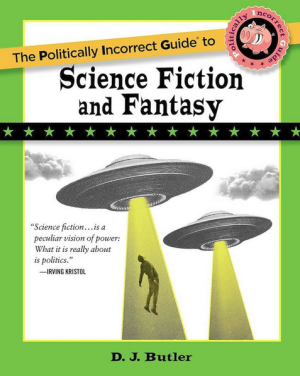
I was surprised to spot this on the shelves, and intrigued enough to give it a go — especially since this is SF month, after all. It’s not that science fiction is not political: politics is arguably inseparable from SF to some degree, and many SF works are explicility political. George Orwell, Bob Heinlein, and Ray Bradbury come to mind, of course, as do cyberpunk and solarpunk as entire genres. It’s just that the Politically Incorrect Guide series is generally aimed at a conservative audience, and I rarely encounter conservative literary analysis of SF. Brad Birzer is a notable exception: he has a lecture series on SF from a libertarian perspective, enjoys discussing the works of Heinlein and Bradbury on podcasts, and has written a book (Mythic Realms) that includes reflections on SF&F. That could very well be me just not having encountered those perspectives, though. At any rate, this book proved to be unlike any other PiG in that it’s a straightforward introduction to SF&F, with the series’ normal edge nearly completely sheathed.
Butler begins from the first signs we have of the human power of wonder — strange cave paintings of human hybrids, and the stories of the Constellations themselves — and moves forward through European recorded fantasy. As we hit the industrial age, science fiction is incorporated as well, and the two are thereafter tracked separately under categories like Cyberpunk, etc. The PiG books are all on the slim side, 200 page or so, so most authors only get a paragraph or two. High-profile authors like Tolkien, Lewis, Heinlein, and le Guin get more attention, of course, but even here Butler has to be spare. The Space Trilogy, which was intended as SF, is ignored to chat about Narnia, instead. As he continues to move through to the present, there are frequent sidebars to discuss related topics: the rise and role of conventions and fan fiction, for instance, or the growth of tropes and character types like antiheroes. The author strives for comprehensiveness and includes authors he doesn’t like, and his attitude is largely neutral except on some occasions where he waspishly strikes at adult Harry Potter fans. (I should note that I can only vet the SF category’s range: my fantasy holdings take up less room than Twiggy standing sideways.)
As mentioned, this title is anomalous in the Politically Incorrect series in that it doesn’t have the aggressive edge of those books. They’re generally written to be provocative, some authors can be downright acerbic, which is why I have read so few of them. Aside from a few pointed remarks about cancel culture, though, Butler generally ignores politics. As the caption quote above says, this is largely Butler providing an introduction to books and authors, from the view of someone who is a published author himself. (Of……Mormon steampunk?) Around the 65-75% mark, Butler switches from introducing the reader to authors and concepts with SF&F and begins writing about current issues within the craft. He is concerned about the rise of “Hard magic”, for instance, magic with defined rules and quantifiable elements, and argues that it removes the mystery, and thus part of the attraction, from magic. Here, some politics does come up, but it’s not that pointed and is heavily mixed in a grab-bag of SF&F related thoughts, like how many authors have lapsed series these days, or trends in publishing.
This was a decidedly odd read: enjoyable enough, and there’s no shortage of new-to-me authors and books to learn about from here. The issue for me in recommending this, though, is that that’s all there is. Granted, there’s value in that: if I’d read this back in say, 2010 when I became more broadly interested in SF outside of Star Trek and Isaac Asimov, it would have given me a lot of ideas. As it is, though, it was a pleasant way to spend a few hours.
The desire to indict Tolkien also makes the choice between philosophies clear. Tolkien fought in the Great War. His boyhood friends died in the mud in France. He writes about the need for sacrifice and the urgency that the men of the west band together and stand against the mechanized evil of Mordor. Martin, on the other hand, claimed conscience objector status to avoid going to Vietnam and then made a career in Hollywood. He wants us to believe that there are no heroes, that everyone is a potential murderer, out for himself. I know which world I believe in, and which man I’d rather be.

 Reading Freely
This sounds oddly interesting. It’s not at all something I would be drawn to picking up, but it sounds like it has some good points to ponder. I quite liked that quote at the end – there’s a lot there.
Also, I have to agree with “hard” magic “systems”.
He attributes them as an odd side effect of DnD-type games where (for the sake of the game working) hard rules and quantification HAD to exist.
I’m pretty conservative and I tend to avoid books like this because of that “edge” you mention. So the fact that it is missing makes this a good candidate to add to my non-fiction list 😀
I am concerned however that he seems to include Fantasy instead of just sticking to straight sf. It really sounds like he delved into SFF or even “speculative fiction”.
and I just “looked” at the book’s title instead of your title and realized the truth. Well, that takes care of that then 😀
Mm….yes. He did mention speculative fiction as an all-inclusive category. The two were pretty muddled together in the beginning of the 20th century, though. John Carter is basically “fantasy but on another planet”, and Star Was is essentially fantasy wearing an SF hat.
I think if he just wrote about SF in the 1970’s he’d be about as politically incorrect as you can get. They were ROUGH times…. [lol]
Although I’m not a *huge* fan of Fantasy I do like my Magic System to make sense. Things have to be consistent within the overall context. You can’t just “make stuff up” just because its *magic*…. We see FAR too much of that it SF movies and TV with the excuse of “but its not REAL”…. [grinds teeth].
Well, I think there’s a difference between consistency and….mmm, transparency that spoils any sense of fun. With Star Trek, for instance, warp speed is somewhat oriented toward the Speed of Plot: it can take weeks to go from one place to another, or just a few hours. BUT — if we’re going to one place pretty frequently, then we need it to be CONSISTENTLY one speed or another. DS9 handled this OK, I think.
(And yes, I am up in the middle of the night. I fell asleep watching Wargames and will probably go in for a second sleep within the next hour or so…..)
Well, they do say that sleeping for 8(ish) hours straight through is a very modern invention…. LOVE Wargames. Great movie.
I’m trying to schedule in some Fantasy at some point. We’ll see how they manage their magic ‘system’…!
This will be my second or third time. I figured it SF adjacent.
Definitely SF – or close enough. Artificial Intelligence, Nuclear War, Hacking etc… So, close enough….
I appalled one of my movie buddies the other night when I told him I was watching Terminator 2……for the first time!
T2…. for the **FIRST** time….? LOL….. I’ve lost count of the number of times I’ve seen it. One of the GREAT movies of the age!
Yeaaaah…..I watched the first one years ago and just never got around to continuing. I think this was because the ones that came out when I was in high school looked pretty silly.
Most of them are at least watchable. I’ve enjoyed them all mostly – except for ‘Dark Fate’ which I thought was a total travesty. I’d still like to see a proper “Future War” movie with the Judgement Day survivors fighting Skynet. I had hopes for ‘Salvation’ which moved in that direction but then wobbled too much away from what I’d hoped it would be.