
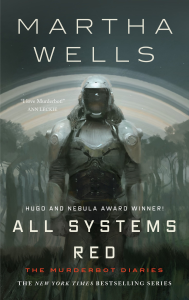
All Systems Red is a fun action-mystery thriller in a SF context. Our narrator, as the series title “Murderbot Diaries” might suggest, is not quite human. Murderbot is instead a robotic-organic construct that prefers humans see it, or him, as a robot: that way he’s left alone to watch recorded TV dramas in his head when not monitoring feeds and shooting bogies as need shooting. Unlike most constructs, though, Murderbot is rogue: at some point he hacked his “governor module”, the bit that forces him to respond to orders, and has been keeping this secret to avoid being disassembled for parts, or worse – “fixed”. Murderbot as he styles himself, is a security unit: his whole function is to crush, kill, and demolish. We find out through the text that Murderbot hacked himself not to give him leeway to get rowdy, but because sometimes conflicting orders diminished his ability to function. Although I enjoyed the story, Murderbot didn’t seem like an ‘other’ – unlike Shelli or Seven of Nine, whose cognition and verbal expression hint at their being different, and to a lesser degree R. Daneel Olivaw. (I say lesser because Olivaw was literally trying to pass as human for most of his lifespan and did fairly well at it.) I could see continuing in this series, as it made for fun reading.
I COULD HAVE BECOME a mass murderer after I hacked my governor module, but then I realized I could access the combined feed of entertainment channels carried on the company satellites. It had been well over 35,000 hours or so since then, with still not much murdering, but probably, I don’t know, a little under 35,000 hours of movies, serials, books, plays, and music consumed. As a heartless killing machine, I was a terrible failure.

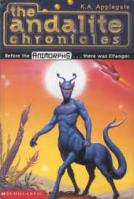
I saved this post for today (instead of yesterday or the day before, when I’d finished reading it) because of the prompt: “other life forms in SFF”. This is also why I was thinking of Murderbot and the lack of a sense of “other”. One of the enduring aspects of SF, I suppose, is the freedom it gives writers and readers to think about life and its expression. Sometimes this can take physical form: Andalites were extremely interesting to me in middle school because of their bodies, and the thought that K.A. Applegate had put into their world. Andalites were, of course, cool as hell: they almost look like centaurs but had powerful scorpion-like tails armed with a scythe, and then eyes on stalks that allowed them a broader perspective.
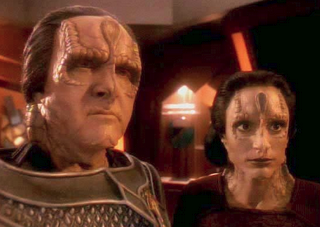
Often aliens are used to explore human culture. Star Trek did this a lot with some species transparently standing in for human civs (the TOS-era Klingons being Space Russians, something Trek leaned into when they had TNG Worf raised by a family in Minsk). My favorite Trek species, though, are the Cardassians. While they were originally conceived as villains with fairly elaborate makeup, Deep Space Nine really fleshed them out. It gave us Cardassians who were people, not merely antagonists: we saw Cardassian scientists, shopkeepers, poets, etc. What’s more, Cardassia itself had a history — a high-arts culture being stressed to the point of death by famine and environmental disruption, then replaced by a mire militant order. DS9 did wonderful things with the Cardassians, like exploring personal and national guilt: in one memorable episode, a man pretends to be the equivalent of Rudolf Hoess so that he can stand trial and force Cardassia to admit its sins. It’s machine intelligence, though, that I find the most interesting — especially when its sentience is debated. Daniel Suarez’s DAEMON did this incredibly well.
In SF-related news, I watched Dune, Part Two last night. This picks up with Paul and Lady Jessica in the desert with the Fremen, and struggling with their respective fates. I’m not going to do a “Reads to Reels” post because it’s been too long since I read Dune proper, but I was riveted by the movie. I’d only planned to watch half of it last night, but wound up staying up long past my bedtime to finish it off. Well, mostly: I may need to rewatch the last twenty minutes or so just in case. I’m pretty sure I fell asleep toward the end because when I woke up Amazon was playing some TV show that featured a man approaching John Wilkes Booth and offering him help. May have to look into that. To quote Leonardo DiCaprio, — “You had my curiosity, sir, but now you have my attention.”
Coming up in SF Month: I am reading Star Trek: The Entropy Effect and just picked up an Amazon first reads with a SF background, including a virtual world like that of The Oasis or Husk.

 Reading Freely
I have really enjoyed listening to the whole Murderbot series.
Hmm, maybe I should try Star Trek!!
I have a bunch of Audible credits because I keep forgetting to subscribe, so I should check one of them out to see how good the narrator is!
Pingback: #ScifiMonth Mission Log: one