
When checking Amazon for the Old Man’s War series, I noticed a new short story series created by Amazon. I’ve read their FORWARD and WARMER collections before and figured this might be fun. Unfortunately, this skewed more toward the level of WARMER than FORWARD, as I only enjoyed a few of the pieces and even one of those was confusing.
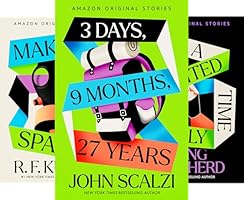
“3 Days, 9 Months, 27 Years”, John Scalzi
If you could be a tourist in the past, where would you go? Personally, I’d want to visit North America prior to the arrival of humans from the Bering Strait, so to witness the megafauna at the time. Pity it would probably eat me. “3 Days” takes us to a world where time travel is possible, but with limitations. Nothing we do in the past shapes our timeline, and there are only three opportunities to come back — windows that open three days, nine months, or twenty seven years from departure. When a tourist goes back into time, they are free to do whatever they like: kill Hitler, flirt with Napoleon, try to introduce a tank into the Punic Wars and see what happens. Some perish in the times they visit; others find out that if you kill a painter in 1920s Vienna, you’ll find yourself arrested for murder, not hailed as the savior of western civilization. “3 Days (etc)” at first seems like it’s just entertaining readers with the premise, but then delivers a twist.
For his sake, I hope he was indeed eaten by his preferred dinosaur. It would be terrible to plan one’s own death between the jaws of one of the most fearsome predators to live, only to trip up and be consumed by something less majestic.
Except for that one client who traveled to another reality expressly to walk up to the younger alternate version of themself and punch them square in the teeth. The client did not explain themself to their other version. They did not explain themself to the organization in the debrief afterward. But I never did see a client happier with their experience.
“Making Space”, R.F. Kuang
An infertile couple finds a child in the woods looking like he’s escaped captivity: what they don’t realize is that their frustrating, suburban world is Eden to a child who comes from a far less hospitable future. Aside from the main character’s compassion for the child, this wasn’t particularly compelling and I hated the way the story developed.
“For a Limited Time Only”, Peng Shephard
A salesman named Russ works for an ad and product placement company with a twist: it can send people small amounts back in time to manipulate markets and help its clients steal a march on the competition. Most of the story is about character drama, though — Russ witnessing two of his friends’ relationship fall apart, and experiencing ups and downs with his own daughter. Because of the nature of his work, though — constantly moving through time — sometimes his daughter is two, sometimes nine, etc. Sometimes one friend is dead, sometimes alive. Although the story wound up being compelling, the temporal ‘jumps’ are so chronic and often unannounced that I was often confused.
Oracle has two main departments: Past and Futures. Including Vik and me, there are probably fifty employees in Past, and I have no idea how many in Futures, other than Theresa. Most of them, we’ll never meet, because they haven’t even been hired yet.
“A Visit to the Husband Archive”, Kaliane Bradley.
Unique in these stories, “Visit” has a double premise: the media is thrown into a confusing world where many characters appear to be chronic amnesiacs, doing manual labor and living in a brief window of ‘now’ surrounded by mental fog. As the story progresses, we learn about an extraterrestrial element that also involves time.
“All Manner of Thing Shall Be”, Olivie Blake
I…I don’t even know how to start with this one. We have some eccentric personalities living in a house together who all transform into some kind of flesh-eating ghouls at sundown, and time is also involved. Not enjoyable, aside from this quote:
There was a trend going around on the latest app—ingenious, really, the way someone had built the algorithm to do the work of a million, perhaps even a billion psychic vampires; the way it could drain the life force from anyone and yet still continually feed, its prey returning willingly for more. In another life, Esther thought, or perhaps in a century or so, when she tired of her educational ventures, she might look into the neurology of it all, though presumably by then everyone would be permanently slumped over, comatose save for the dim blue light of their insatiable devices.
“Cronus”, P. Djèlí Clark
A short story set in an alternate history where segregation in the United States never ended, and people are comically hateful. There doesn’t appear to be one point of deviation: instead, several “switch” moment in history, like the Brown v Board of Education decision and Jackie Robinson signing on with Brooklyn, don’t activate. As the story develops, we realize that a time travel tourism company has been used to alter the past — but memories from the original timeline keep surfacing and causing problems. The main character, Annie, is contacted by a resistance group who want her to use her position as a clerk at the company to help.
All of these were 38 – 48 pages and readable in one sitting.


 Reading Freely
Hmmm, I suspect the Time Traveler’s Wife didn’t have one of these passports. Somebody should do something about that…
Pingback: #ScifiMonth Mission Log: one