
Rush Hour 2, 2001. I watched this a few times back in the day, but it’s been fifteen, twenty years I’d say. I remembered it for three things: one, a ridiculous fight scene in a massage parlor in which two men fight off a small army of Triad goons dressed in short bathrobes and towels; two, the female actresses, and three, a hysterical exchange between detectives Carter and Lee after they bump into one another after a long separation in which Lee believes Carter was killed during an explosion.
Carter: Who died, Lee?
Lee: You!
Carter: Detective Yu?
Lee: Not Yu, you!
Carter: Who?
Lee: You!
Carter: Who?
Lee: Do you understand the words that are coming out of my mouth?!
Carter: Don’t nobody understand the words that are comin’ out of your mouth!
It reminds me of a “Who’s on First” routine starring George W. Bush.
There are many plot oddities, like a Secret Service dude ordering an LAPD detective who is on vacation to go back to the States, and said SS dude telling a Hong Kong special inspector that he’s off the case. Also, there’s the fact that Ricky Tan, who is supposedly the former partner of Lee’s father (also an inspector) looks a decade or so younger than Lee. On the bright side, it was nice to see pre 9/11 airports. Jeremy Piven has a minor but very memorable role as a Versace salesman: he was later a major supporting member of Chasing Liberty. I also appreciated that the Netflix version includes outtakes and bloopers, like “Daaaaaamn! He ain’t gonna be in Rush Hour 3!”
Chasing Liberty, 2004. Mandy Moore plays the American president’s daughter, who feels smothered by her SS detail and decides to ditch them while in Prague; she flees with the assistance of Matthew Goode, who unbeknownst to her is a plainclothes SS man. Believe it or not, this is a rewatch for me, and a rewatch many times over back when I was younger. As someone still in his teens but moving quickly toward young adulthood, I loved the idea of going on this spontaneous adventure across Europe – seeing beauty, meeting interesting people, finding what was real. There were a lot of perks in the movie, too: I greatly enjoyed the actors who played the principal SS men, especially Jeremy Piven, and Mark Harmon features as the president. This film was also my introduction to Matthew Goode, who I later enjoyed in Imagine Me and You – and then much later, Match Point, The Imitation Game, &c. There are some great minor characters in this like Scotty MacGruff, who makes a habit of slapping Six Million Dollar Man stickers on things. We can rebuild him! We have the technology! The story is fairly absorbing: Goode and Moore’s characters fall in love, which is a big problem for Goode given that he’s basically deceived her and he’s in love with his boss’s daughter.
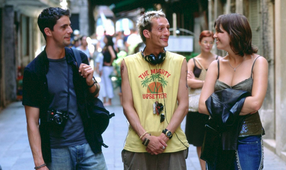
McGruff: Hey, chilly-willy, Squabblers, take a few of these on your solo travels then.
Ben: What are these? Six-Million-Dollar Man stickers?
McGruff: These stickers are my contribution to the global community. Everyone I meet gets a handful. Your job: post them up! Pound one on a door, slap one on a kiosk, place one on a postbox, wherever your life may lead you.
Anna: And then what?
McGruff: Then, nothing. You forget about the sticker, you move on. One day, maybe you’re a little down in the dregs, and all of a sudden, there it is! The corner of a window, the door of a subway, the side of a telephone booth, one of the stickers. And it puts a smile of your face because you know you are not alone in the world; we’re all connected.
Ben: Wanker.Morales: No, no, no, let me ask you something, Weiss. Do you actually get women like this? I was really curious if there were actually women out there in the world who walk by the construction lunch break which is your very personality and say: “Oh, yeah, please. Baby, give it to me. Give me some of that hard hat, right here, right now.” There are actually women like that?
Weiss: A couple.
36 Hours, 1964. A rewatch for me, though it’s been over a decade since my late friend Al Benn first introduced me to it back in 2011 or so. In this movie, a senior American military officer wakes up in what seems to be a U.S. Army hospital in 1950 after supposedly spending several years in a coma. The medical staff fuss over him and soon begin asking curious questions about what he remembers. Specifically: D-Day. Where did the troops land? How many were there, bitte?
…Bitte?
Ach, du lieber!
Where Eagles Dare, 1969. Broadsword calling Danny Boy! This is a crazy-fun WW2 spy thriller in which Clint Eastwood and Richard Burton blow the hell out of a bunch of Nasties amid twist after twist. (Quote Clint Eastwoood: “Major, you’ve got me as confused as I ever hope to be.”) It’s also probably the WW2 movie I’ve watched the most times: I had a VHS in high school and loved it. Mind, at the same time I was also playing Commandos and Medal of Honor….
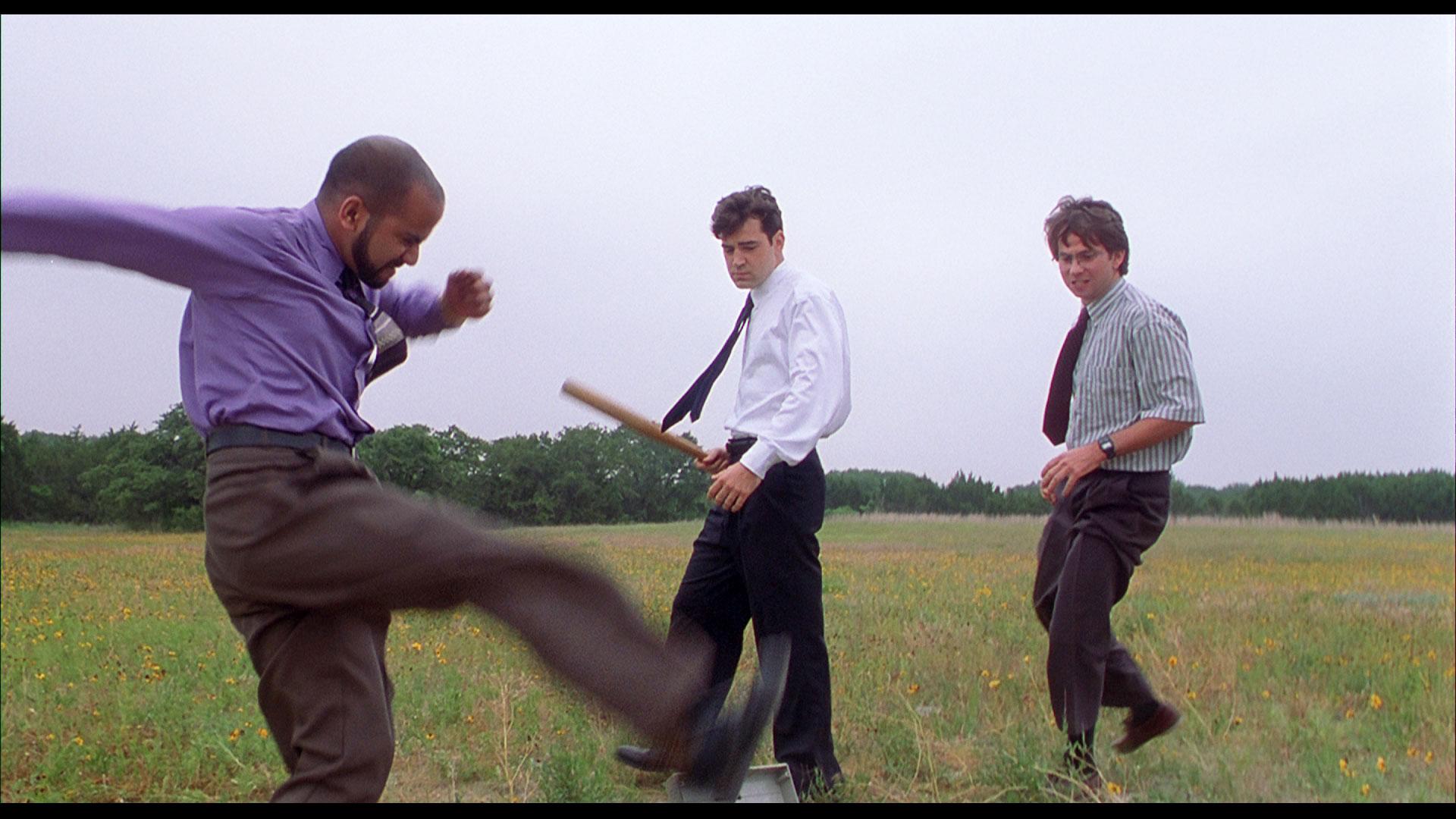
Office Space, 1999. A many-times rewatch: I’ve been watching this film on and off for ….20 years. It’s a black comedy about the inhumanity of office work, I suppose? Lawrence remains my favorite character. (“Hell, you don’t need a million dollars to do nothin’, man. Look at my cousin. He’s broke and he don’t do ____!”)
Elephant, 2003. A psychological drama based heavily on the Columbine massacre, a failed bombing turned shooting that has become the …iconic? …school shooting. The film is unusual in that it’s not a straight movie; this isn’t a 9/11 movie or a Pearl Harbor movie where we’re seeing characters Do Things and Change the Plot. Instead, we’re observers, with the majority of the film being tracking shots. These shots are often from behind the character, like we’re following them, and the intent is to…”experience” a Columbine-like event not as a movie, but as if it were happening to us. Accordingly, most of the film is watching characters do routine stuff: one guy is walking around campus taking photos for his film project, a guy has come to school late because his dad was drunk and he had to make arrangements, etc. And then….what happens, happens, and it’s an abrupt change.
The film creates ambiguity by moving the setting to autumn Oregon (instead of spring Colorado), and having its characters not be named after the two RL cretins, and there are ups and downs. I was glad it included the failed-bombing aspects (the IRL guys planned to blow up the school, then use their guns to sweep survivors coming out of the doors), but it did play to the contemporary narrative that the perps were poor widdle socially abwused loners who lashed out. In reality, one of them was a popular sociopath and the other was played like a fiddle by the sociopath, but given how quickly this movie came out that’s forgivable. I watched it for the director and the interesting perspective shift, buuuut I was also a middle schooler when Columbine happened and part of me was interested in seeing how they portrayed….that time as far as fashion and such. I know that’s weird, but I also rewatch Scream for nostalgia, so there you are. (…I watched Scream around this same time. Don’t tell my parents, they’ll never let me go over to Tim’s house again.) My only complaint is that the school was weirdly dark: some corridors look like they have no lights on at all. I don’t know if that was an artistic choice or not, but a lot of the dark areas did wind up being shooting galleries.
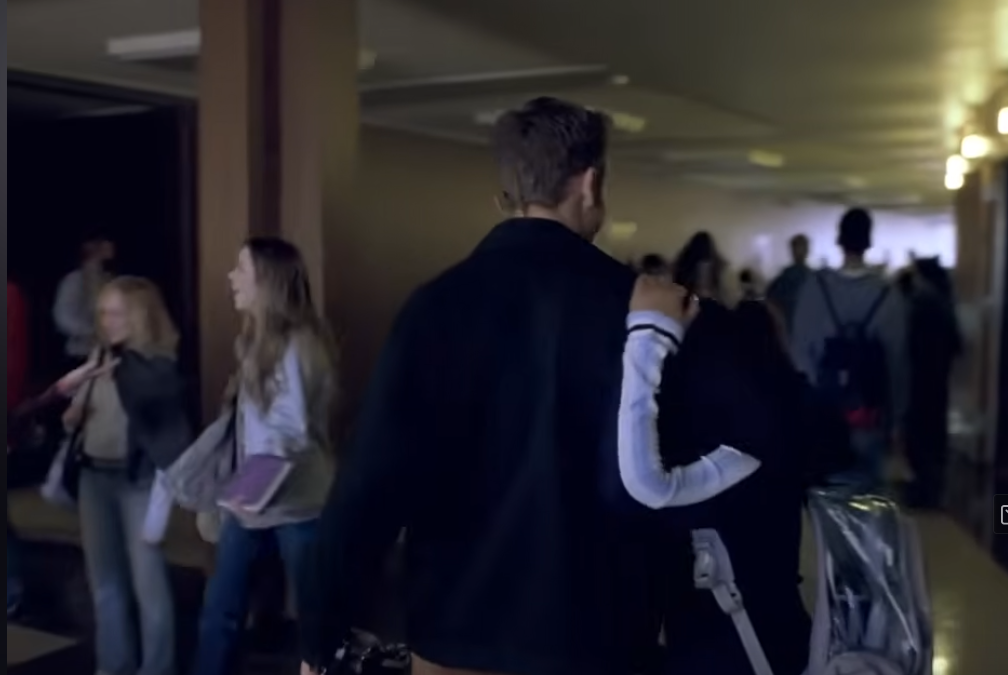
(fun fact: the dialogue at this moment was “Oh, I’m going to the dark room to develop some shots.”)
Killing them Softly, 2012. A crime drama set during the financial crisis that preceded the Great Recession, but dealing with underworld financial issues instead. Ray Liotta’s high-stakes poker game has just been hit, and since he hit it himself a few years back, he’s the chief suspect. Who really did it was John Sacrimoni, who hires two losers (including Ben Mendelsohn as a bizarrely convincing dopehead) to do the dirty work for him. Brad Pitt and James Gandolfini are called in to find the guys and knock them off. This will be made slightly easier by the dopehead running his mouth. I watched this largely for Gandfolini, but if I had any doubts the presence of Liotta would have sold it. It’s a strangely paced movie: with 30 minutes left and little accomplished, Pitt and Gandolfini are sitting around drinking Scotch and talking about old girlfriends. It culminates in Obama giving his victory speech in 2008, which has a couple of levels of interest that I won’t get into because of spoilers.
Scream, 1996. Do you like scary movies? This is the kind of gory film I’d never watch today, but because I watched it in middle school (at a friend’s house, illicitly), it now has this strange nostalgia power that overrides everything. This film, for whatever reason, prompted me to try writing for the first time, and in middle school I had an entire three-ring binder filled with “horror” stories, with antagonists like ghosts and mutant spiders. One was about the wreck of a luxury train called The Titan (no points for guessing the inspiration given the context of the late 1990s) and I distinctly remember using a new vocabulary word, “gregarious”, to describe a character. Anyhoo, if you’ve been living under a rock for thirty years, this is a parody of slasher films that is “meta” in its delivery: characters are aware of slasher film tropes, including the killer who enjoys taunting their victims with them It’s dated and I love it for that: “Let me ask you this: what are you doin’ with a cellular phone, son?” I also love Matthew Lillard’s character acting in this: he was both charming and psychotic. It’s worth noting that this parody of horror films was the first time I’d ever seen a horror film – soon followed by I Know What You Did Last Summer.
“It’s the Millenium. Motives are incidental.”
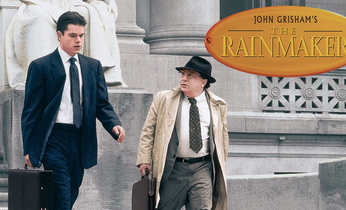
The Rainmaker (1997). In 2000 or 2001, in creative writing class, this movie was my introduction to the works of John Grisham. It was also my first time seeing Matt Damon and Jon Voight, and it had a great soundtrack. (It wasn’t my introduction to Danny DeVito — I’d already seen Matilda.) Damon and Voight both pull off believable Southern accents. “Sworn in by a fool, and vouched for by a scoundrel. I’m a lawyer at last.” I’m amused by how much of the dialogue I still have memorized. This remains a wonderful movie: LegalEagle rated it an A+ for legal accuracy, and it’s completely compelling from a viewer’s perspective — the characters, the drama, and the writing all hold up. Directed by Francis Ford Coppola, it’s the one Grisham adaptation that really sticks in memory, while others — A Time to Kill, Runaway Jury — have mostly faded, aside from odd details like learning the word indigent from The Client. I’d rate this as possibly my favorite legal movie: not as funny as My Cousin Vinny, but a genuine David vs. Goliath story that helped shape my reflexive mistrust of corporations. It also stands out for showing the trial from soup to nuts — something no other Grisham story or adaptation quite managed.
Truth and Treason, 2025. A group of teenage German boys is inspired to begin creating circulars against Hitler in the early 1940s. The author of them is exposed when another document he’s written bears the same tell-tale typewriter defect as all of the circulars have. Although the leader is forced, under torture, to expose his colleagues, in the end he makes a brave decision that saves his soul if not his body. The movie is based on the true story of Helmuth Huebener.
The Firm, 1993. Probably my first Tom Cruise film and quite possibly my first Gene Hackman. Think I watched it in the very early 2000s. Not a great adaptation of the novel, but I enjoyed revisiting it. The Firm was my first JG book, but as mentioned Rainmaker was my first JG movie. A young lawyer (Mitch McDeere aka Tom Cruise) receives an unbelievable offer from some boutique firm down South – only to realize that whoopsie doodle, this is a mob firm. Gene Hackman is prominent, as is Ed Harris – I’d forgotten Ed. He plays a real jerk, an aggressive FBI agent whose treatment of Mitch is no less bullying than the Mob’s. Amusingly, Paul Sorvino – who played Paulie in Goodfellas – appears here as a mobster. Whaddya wanna guess the wiseguy’s name is Paulie? (IDMB suggests his name was Tommy, like he was funny. Funny how, like he’s a clown, like he amuses you? Like he makes you laugh, like he’s here to amuse you?)

The Chamber, 1996. Christopher O’Donnell plays a young lawyer (Adam) who is trying to get an aged man (Gene Hackman) adjudicated guilty for bombing a Jewish law firm and killing two children off the death penalty. The twist? Said old man, Sam Cahill, is his granddaddy. Accordingly, he’s dealing with not only his soul-haunting questions, but the fact that his father killed himself and that his aunt who has tried to escape family history deep in the bottle. The book version of this was one of the single-most thought provoking books I ever read in high school. I’d never thought about the death penalty then, as a teenager, and Grisham really made me start pondering it. Decades later, my inner jury is still not settled: I appreciate both libertarian and Catholic arguments against it, but I also have a pretty firm conviction that human predators ought to be addressed accordingly. One thing that leapt out to me immediately is a historical error: Sam claims to be a fourth-generation Klansmen, which is nonsense on stilts juggling three balls of flaming lunacy given that the first Klan was gone by the 1870s, the second Klan didn’t begin until the 1920s where it was formally “revived”, and after it imploded groups calling themselves the KKK didn’t revive until the 1950s or so. There are a few other quirks (historical, gun mechanics, the most ludicrous attempt at portraying a ‘klan rally’ since O Brother Where Art Thou), but that’s moseying into digression. As a moral drama, it still succeeds wonderfully: Adam having to learn who his grandfather was and wrestle between his desire to know Sam and his repugnance at Sam’s racial bitterness and bigotry – and the growing third factor, the very real premise that Sam wasn’t the man who planted the bomb. Rewatching this – I think this is only my second time? – made me appreciate the late Hackman’s acting chops all the more.
“Why would the FBI want to hide information from a case that’s thirty years old?”
“You in Mississippi, now. The land of secrets.”
The Client, 1994. TOMMY LEE JONES! …also there’s a plot about a kid seeing something he shouldn’t have and being harassed by the state because the Mob was involved. All I remember is that Sarandon’s character is a fan of Led Zeppelin and that “indigent” means “poor”. Not sure when I watched this for the first time, but it was probably the early 2000s. The kid, Mark, becomes a pawn between the Mob and the State because he witnessed a lawyer with Mafia ties killing himself. The bad guys here are evil-league-of-evil evil, and I found myself wondering if they’re this bad in the book. (It’s been a long time since I read it.) On the bright side, there’s the aforementioned Tommy Lee Jones, and “Ruth” from Fried Green Tomatoes, otherwise known as Mary Louise Parker. Tig from Sons of Anarchy plays a minor mook here.
The Pelican Brief, 1993. This film had Julia Roberts, and that is the most I can say. The movie is basically a prolonged chase scene that was an enormous downgrade from the character-centric JG movies preceding it. This may be the first time a Denzel Washington movie has bored me to sleep multiple time. Stanley Tucci was also present, but he had hair and that was disturbing. My first Grisham movie that’s NOT a rewatch!
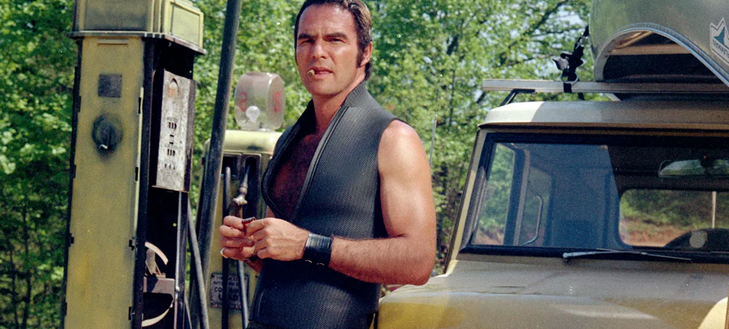
Deliverance, 1972. Burt Reynolds looks weird without his mustache. While I’ve watched the “Dueling Banjos” scene many a time (let’s ignore the fact that it involves one banjo and one geetar), I’ve never seen the movie. The night before Halloween, though, seemed appropriate for a ….murder-thriller set in some Appalachian backwoods? Anyway, a buncha soft-handed city boys decide to take a canoe trip down a river ‘for it’s dammed up and lost, and in their high-handed approach manage to annoy the locals who commence to murderin’ them, because what’s the difference between an insurance salesman and a Yankee at the end of the day, right? One interesting scene for me was the song played at the end of the Atlantans’ first day: while some of the lyrics are shared with the traditional song “Rye Whisky”, the tune is very different – much more melancholy – and the lyrics as a whole diverge. Features a disturbingly un-moostached Burt Reynolds and a sadly moostached Jon Voight. There’s a disturbing scene when Jon Voight was trying to take a young buck who was barely a button-head in velvet. Talk about disrespect for nature. (Deer season doesn’t start until bucks have developed their antlers more fully and have shed their velvet.) Anyway, this gets disturbing. I do appreciate the wailing cicadas, though it confused me as to the seasons when combined with a late spring/early summer buck. Another small appreciation is the power of the river, and its role in the movie. There’s an interesting overall theme in this movie on civilization and savagery….and on how quick our primal instincts overturn one for the other.
“You can’t judge people by the way they look, Chubby.”
“It’s true what you said, Lewis. There’s something in the woods and the water that we have lost in the city.”
“We didn’t lose it. We sold it.”
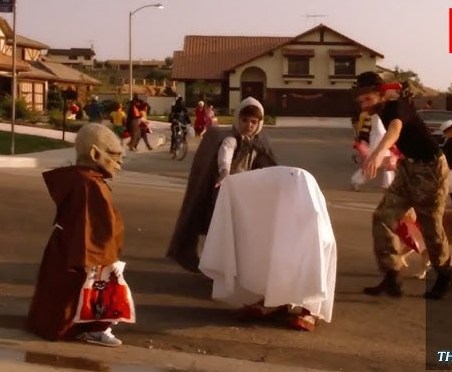
E.T., 1982. A small boy discovers a marooned alien in his back yard and befriends it…only to have to rescue it from G-men. This is very possibly the first non-cartoon movie I watched as a kid, around age five or six or so on VHS. I’ve watched it maybe once since, and I figured since it has a Halloween scene, why not watch it on Halloween? If Die Hard can be a Christmas movie, E.T. can be a Halloween movie! Watching this as an adult, I’m impressed by the practical effects and sound design: seeing E.T. get left behind and managing to understand its desperation and pain works. Some parts have….aged: Elliot’s brother wants to go to Halloween dressed as a terrorist, making me wonder what the stereotypical conception of a terrorist was back then. The arrival of the G.Men in hygiene suits is still intimidating, even if close up they look like astronauts doing Darth Vader breathing impressions.
Zero Day (2003). A Columbine-inspired found footage documentary, in which we witness two friends with violent fantasies collude and plan a school shooting. What makes Zero Day so utterly disturbing is the nature of the production itself, the “found footage” approach: the film is presented as a series of clips taken from consumer video recorders, some purposely filmed by the future shooters as a record for the future, some simply documenting their lives as-lived. We get a sense of the boys as people, with utterly normal social circles and lives, though they do have resentments toward certain parties at school. One such person is “Brad Huff”, a jerk jock whose house they pelt with rotten eggs after arriving at his home to find his SUV nowhere in sight. The found footage is eerily weird, with expect amounts of outtakes, muffed lines, and “teenagers mugging for the camera” that you’d expect. It avoids the poor widdle buwwied story completely: we see two teenagers with unhealthy interior lives and an uncanny awareness of how they’d be perceived afterwards ratcheting each other into a course of destruction, where they will escape a world and a school they hate by turning it into a bloody mess. Zero Day is far more unsettling than Elephant for its approach, though I will admit to being partial toward found footage.(See my affection for The Blair Witch Project, which continues to disappoint my film buddies.) The acting is uncanny across the board.

 Reading Freely
That’s a lot of movies in one month!
Quite the change from last month, yeah, where I only had 4. May be a stress thing: this month has been wild at work because of the shut down (a lot of people are coming to the library to get paperwork SSA would have given them), and when I get home I’m not in a reading/reflecting/writing state of mind, more of a “lay on the couch and enjoy my stories” kind of mind.
That’s quite the list!
‘Elephant’ was definitely a *strange* movie. Quire effecting. There’s always a strangeness, and otherworldliness, to American High School movies though…..
‘Where Eagles…’ LOL. I SO, SO love that movie. I must have watched it 50 times. The books good too. A very close adaptation.
‘ET’ had its moments but I do find it increasingly mawkish the older I get. There’s SO much sentimentality that I can feel my blood sugar rising as I watch it.
Presently watching the 9th film on my list of 10 (The Blues Brothers), so I should be posting my latest list later in the month.
I imagine they’re run rather differently than British schools, “public”, “private” or otherwise. Somehow the meanings reverse mid-Atlantic. A lot of American high school movies have young adults playing the parts: I think Elephant is a notable exception to that. But please know that our high schools are usually quite well lit.. :p
My cinema buddy is 65 and haaaaaaaaaaaaaaaaaaaaaaates E.T. We usually tell each other what we’ve been watching on weekends, but I’m not going to set him off on another “kiddie movie” rant. The CPR scenes are unintentionally funny.
In my High School (or Secondary school as we called it) we wore uniforms at least until 6th Form (16-18). The campus had two schools – both State Comprehensive which meant that they took *anyone* – AKA non-selective. They were OK as things went. Comps from working class areas didn’t really expect much so it was easy to cruise by. There was some level of internal selection (called sets) so that the brighter kids got the better teachers & more attention and having an internal 6th Form (shared between the 2 schools because otherwise it’d be practically empty) for those thinking of going on to University. Its a *very* different world to the American version! I do need to read up about our Education system @ some point… [muses]
ET is, I think, *very* overrated.
The German education system has that “Abitur” that controls whether kids go to university or trades, doesn’t it? Of course, when I learned about that it was 15-20 years ago.
We used to have (and I think *some* places still do) the 11-Plus which determined if you went to either Grammar, Secondary Modern or Technical schools. They got rid of that (mostly) with the Comprehensive system which was supposed to be fairer.
Access to Uni is through passing exams – called A (as in Advanced) levels. The Uni’s themselves decide on what A-levels you need to get in (and what grade) and then its up to the student/school to get them. It took me 3 tries, but I got there in the end!
Ah, like the O-levels in Harry Potter….
(grins and runs)
I have SIX O-levels…. [grin]
Chasing Liberty!!! Oh man, I’d almost forgotten about that movie … so so good. I love the way they played the secret SS agent-turned-relationship better than First Daughter (which was a fabulous watch initially, but has never been rewatched).
Agreed! I watched First Daughter and don’t remember a THING about it. I also saw My Date with the President’s Daughter, which was a made-for-TV Disney movie. Would love to re-watch that one….it had Ben Friedel from Boy Meets World, I think.
Oooh, I missed that one! It’s such a fascinating concept – I remember reading Meg Cabot’s All-American Girl along the same vein as well.
I think it helped that we’d had back to back presidents with teenage daughters, and the Bush twins were a bit rebellious!