
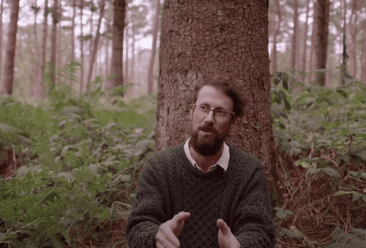
But while I learned this early, it was much later that I learned something else, dimly and slowly, through my study of history, mythology and, well, people: that every culture, whether it knows it or not, is built around a sacred order. This does not, of course, need to be a Christian order. It could be Islamic, Hindu or Daoist. It could be based around the veneration of ancestors or the worship of Odin. But there is a throne at the heart of every culture, and whoever sits on it will be the force you take your instruction from. […]
The dethroning of the sovereign—Christ—who sat at the heart of the Western sacred order has not led to universal equality and justice. It has led, via a bloody shortcut through Robespierre, Stalin and Hitler, to the complete triumph of the power of money, which has splintered our culture and our souls into a million angry shards.
Cut loose in a post-modern present, with no centre, no truth and no direction, we have not become independent-minded, responsible, democratic citizens in a human republic. We have become slaves to the power of money, and worshippers of the self.
The quest for perfection is a quest for homogeneity and control, and it leads to the gulag and the guillotine, the death camp and the holy war. Even if we could agree on what perfection amounted to, we would none of us be equipped to build it.
Even if you are living where your forefathers have lived for generations, you can bet that the smartphone you gave your child will unmoor them more effectively than any bulldozer could. The majority of humanity is now living in megacities, cut off from non-human nature, plugged into the Machine, controlled by it, reduced to it.
This, then, is the Machine. It is not simply the sum total of various individual technologies we have cleverly managed to rustle up—cars, laptops, robot mowers and the rest. In fact, such ‘technics’, as Mumford calls them, are the product of the Machine, not its essence. The Machine is, rather, a tendency within us, made concrete by power and circumstance, which coalesces in a huge agglomeration of power, control and ambition. The Machine manifests today as an intersection of money power, state power and increasingly coercive and manipulative technologies, which constitute an ongoing war against roots and against limits. Its momentum is always forward, and it will not stop until it has conquered and transformed the world.
Many people have simply forgotten what it feels like not to be pulled and pushed and tugged and directed every hour of the day by the demands of the glowing screen. Many people are not paying attention.
Rebellion is necessary, if we are to remain human at all.
Looked at this way, it’s not hard to see that progressive leftism and the Machine, far from being antagonistic, are a usefully snug fit. Both are totalising, utopian projects. Both are suspicious of the past, impatient with borders and boundaries, and hostile to religion, ‘superstition’ and the limits on the human individual imposed by nature or culture. Both are in pursuit of a global utopia where, in the dreams of both Lenin and Lennon, the world will live as one. […] Today’s left is no threat to technique; on the contrary, it is its vanguard. If you have ever asked yourself what kind of ‘revolution’ would be sponsored by Nike, promoted by BP, propagandised for by Hollywood and Netflix and policed by Facebook and YouTube, then the answer is here. Progressive leftism and corporate capitalism have not so much merged as been exposed for what they always were: variants of the same modern ideal, built around the pursuit of boundless self-creation in a post-natural world. The Canadian ‘Red Tory’ philosopher George Grant once observed that ‘the directors of General Motors and the followers of Professor [Herbert] Marcuse sail down the same river in different boats.’ These days, they have abandoned their separate vessels and are sailing downstream in a superyacht together, while the rest of us gawp or throw rocks from the banks.
The West is my home—but the West has also eaten my home. Should I stand up to save it from itself? How would that happen? What would I be fighting for?
The right kind of warrior takes on his own internal demons before he sails out to take on those of others. He takes his stand, and stands his ground, without giving in to to the nihil of the age. He cleaves to what he believes in without falling into the traps laid by partisanship, anger and self-righteousness. Most of all, he works to clear out his own inner junkyard so that he can go searching for truth—and recognise it when he finds it. His war is against the worst of himself and for the best of the world, and what he is fighting for is the love he so often fails at. His most effective weapon is sacrifice. This is easier written than practiced, of course. But I think it might be the way through.
The Machine exists to create dependency. It is essentially a mechanism of colonisation.
My point is not that women should get back into the kitchen: it is that we all should, and into the other rooms of the home too. Machine modernity prised the men away from the home first, as the Industrial Revolution broke their cottage industries and swept them into the factories and mines, where their brute strength could be useful to the Machine. Later the women, who had been mostly left to tend the home single-handedly, were subject to the same ‘liberation’, which was sold to them as a blow struck against inequality. Perhaps it was, but it was also a blow struck against the home, for both sexes.
Make an idol of your nation, and you will end up sacrificing human lives to it.
If people, place, prayer and the past are the ground upon which real culture is built, many of us today would have to look at our own countries and conclude that they have no real connection to any of these. Blame the immigrants if you like—it’s always the easy option—but they didn’t strip the soul out of the nations of the West. We did. Do you think you can build your country around nothing but money and then complain when people want to come in and earn some of it themselves?
Religion in the West is effectively dead, and yet our inherent human sense of the sacred is not. In this reign of quantity, we are assured that there is nothing beyond this life, and therefore nothing that we should not try to bend into our preferred shape here and now. But at the same time, we cannot abolish our hunger for the transcendent. We are no longer interested in God, and yet God is still interested in us.
The crisis of the modern world is not a crisis of technology or politics or greenhouse gases. It is a spiritual war. What the Machine represents is our ultimate rebellion against nature: against reality itself.
This, then, is my idea of an anti-Machine politics. A reactionary radicalism, its face set against Progress Theology, which aims to defend or build a moral economy at the human scale, which rejects the atomised individualism of the liberal era and understands that materialism as a worldview has failed us. A politics which embraces family and home and place, loving the particular without excluding the outsider, and which looks on all great agglomerations of power with suspicion. The rejection of abstract ideologies in favour of real-world responses, and an understanding that material progress always comes with a hidden price tag. A politics which aims to limit rather than multiply our needs, which strategically opposes any technology which threatens the moral economy and which, finally, seeks a moral order to society which is based on love of neighbour rather than competition with everyone.
It was the pandemic—or rather, the response to it—that finally ripped up that contract for me. I had not prepared myself for enforced medication on pain of job loss, blatant media narrative control, scientists being censored for asking the wrong kind of scientific question, or ordinary members of the public being locked out of society while politicians and journalists called them conspiracy theorists and far-right agitators. I wasn’t prepared to see in my country a merger of corporate power, state power and media power in the service of constructing a favoured narrative, of the kind which had previously only characterised totalitarian regimes. When I did see it, it shook me hard, and it changed me.
The momentum of a state is always towards the centre; always towards the agglomeration of more power. No ‘conspiracy theory’ is necessary for any of this to be true, and neither do the people running the state need to be evil or ill-intentioned. It is simply the logic of the thing. A state is like a vortex or a black hole: at a certain point, it begins to suck in everything around it. As it grows, it will tell stories that justify its existence.
I don’t hate many things in this world—hate is an emotion I can’t sustain for long—but I hate screens, and I hate the digital anticulture that has made them so ubiquitous. I hate what that anticulture has done to my world and to me personally. When I see a small child placed in front of a tablet by a parent on a smartphone, I want to cry; either that or smash the things and then deliver a lecture. When I see people taking selfies on mountaintops, I want to push them off. I won’t have a smartphone in the house. I despise what comes through them and takes control of us. Takes control of me, when I let it.

 Reading Freely
Well…. I can see why you liked it……
Paul manages to hate phones even more than I do!
I think they’re only ‘bad’ because people use them badly. Looked at correctly they’re a simply brilliant piece of technology. In your hand you have access to the entirety of human knowledge…. and the ability to contact anyone anywhere at any time… and what do we DO with it…? [shakes head sadly]
I think that’s a bit like saying cocaine is only bad because we abuse it. XD When cellphones were dumb, circa 1990s/early 2000s, they could still be ANNOYING because people took them everywhere, but minutes were restricted so people didn’t yap all the same. This could be the equivalent of Amazonians chewing coca leaves — they get a buzz, but it’s relatively harmless. Refine it, though? Put a screen and a wifi connection and all the notifications and such? It’s a drug. I come back from lunch some days and every.single.one of my coworkers is staring down. I wonder if it’s too late to go into whatever branch of surgery does neck pain…it’s going to be a growth industry!
Yes, cellphones are used like drugs. They are designed to be addictive (or at least they’re designed to function that way) and people respond accordingly. But the device itself is not inherently bad. We have just allowed (indeed encouraged) companies to pervert them into the attention vampires they have become. As Neo rightly said, its all about choice.