
In the distance, singing to itself
Of money. Its song was the web
They were caught in, men and women
Together. The villages were as flies
To be sucked empty.
God secreted
A tear. Enough, enough,
He commanded, but the machine
Looked at him and went on singing.
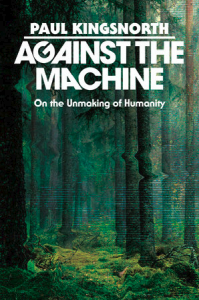
At some point during college, I tried to work out what an ideal human society might look like. This was back when I still strongly identified with the left, but my dreams were not of a world state and a carefully-managed economy. Instead, I imagined something on the order of a small town, one in which the shops were owned by locals, and surrounded by farms that were also locally owned and operated. This was a small-scale vision, a humane one, and it made me realize I might not be much of a leftist after all. The vision was in fact nostalgic, a look at a world that agri-industrialization and globalization have since destroyed. I found kindred spirits and dreams in Chesterton and Wendell Berry, and now, in Paul Kingsnorth but his Against the Machine goes deeper than dreams. Against the Machine is a critique of how we came to be here, speculation that we have become victims of our own devices, increasingly captive creatures in the hands of a lustful and hungry god – the Machine. Kingsnorth draws on an impressive variety of authors – Marx, Berry, Mumford, others whom I’ve never heard of but will assuredly be looking into.
Against the Machine is fundamentally a critique of what might be called modernity, but it’s a deeper and yet more personal critique than one might expect. Kingsnorth opens the title on that personal level describing his love of Nature even as a child and his yearning for a deeper relationship with it. Relationship is a fundamental part of this book: our relationship with the Earth, with our tools, and with our Creator. Although this is not a “religious” book in the sense that it’s written for an audience of believers on a topic that’s “within” religion, it is religious in the sense that Kingsnorth has an ‘enchanted’ view of the cosmos. It was a view that led him to be an early environmental activist, and then become despairing when he witnessed the take over of environmentalism by beancounters and other apologists for the global consumer-machine. His reaction upon arriving at Mount Athos – a Greek Orthodox island-mount monastery so strict that women are not allowed – turned from reverence to dismay when he witnessed the brothers constantly pulling out phones from their robes and staring at them. “Even here?”
What is the machine? It is something inescapable. It is the industrial-consumer-financial order that owns the entire planet, except for pockets of jungle or some caves in Afghanistan. Its material form is The Grid, the vast mesh of powerlines, data centers, and smothering blankets of oil-soaked tarmac that now cover so much of the globe – and the factories and financial centers and big box stores that urge ever more getting and spending. It’s a fusion of powers – financial, corporate, culture – that lusts for more power. This is not, however, just a critique of the effects of industrialism on society, or the unintended side effects of consumer capitalism on communities and human culture. Kingsnorth’s critique goes deeper than that, though, because fundamentally he sees our dilemma as a theological and spiritual problem: the modernist worldview is simply a return to the Serpent’s original promise to Eve in the Garden: ye shall be as gods. Indeed, Yuval Harari unselfconsciously titled his book on the promises of the future as Homo Deus. The Future, however, the dream of Progress, has no attraction for Paul Kingsnorth. Nor does nostalgia, strictly: he realizes that the moving finger has writ and cannot be pushed back to cancel a line. He emphasizes, though, that it is importance to realize what has happened to us so that we may best figure out how to respond.
At the beginning of the book, Kingsnorth addresses the collapse of transcendent order in the West, its replacement by the control-and-consume ethos, and the great challenge the Machine poses to human flourishing. We need rootedness and meaning, Kingsnorth argues, and modernity offers us nothing even as it directly attacks those sources of happiness. – indeed, often the opposite case is true. Human culture has been savaged by modernity in more ways than we can even begin to appreciate. Homes full of amateur musicians entertaining one another in the long hours have turned to boxes of disconnected people staring at their respective devices, their heads filled not of folklore and the songs of their nation but the latest commercial jingle and pop/rap dopamine dance. Notions of particularity and tradition are replaced by meaningless dreams of cosmopolis and globalism; our places and people mean nothing to us, and we leave them without a thought to chase mammon elsewhere. Breathes there the man so dead? Yes, by the multitudes.
There is so much to take in these four hundred pages that I doubt I can write a review that can do it justice. Kingsnorth writes at the beginning that he feels as though he’s been writing around this issue all his life, and that this is his best effort to see the problem in full. I greatly sympathize with Paul on this point, because the concerns he muses over here are those I’ve had since I have been an adult, from the moment I realized on a factory floor that a life working just for money, or worse getting money just to spend it on DVD sets and clothes, was not for me. Those criticisms developed philosophical and political layers as I moved to college, but Kingsnorth goes beyond. The conception of the Machine a something with a life of its own, with a desire to expand itself, to use us to achieve its ends, is darkly fascinating. And yet when one reads about AI scientists feeling some strange compulsion to make the Golem they are making bigger and better even though they don’t like what it’s doing now and they don’t even understand how it’s doing it, something in the mind itches, and I am reminded of Rod Dreher’s opening line in Living in Wonder: “The world is not what you think it is.”
I have been looking forward to this book for months, and I read it slow, both for the complexity of its ideas, the deliciousness of spending time with someone who had the same concerns as I but had found words to address it, and the means to begin resisting it in his own life. Some of its arguments, especially when they get more theological as King compares the Machine to the spirit of Antichrist, will a little much for strictly secular readers. There is a great deal written here, though, that has broad appeal. I could see my college self or my later early -young adult self devouring this title – but it was that same self who, despite being an agnostic, found inexplicable interest in the company of priests and preachers, because they remained more interested in the inner yearning of humanity than merely our material comfort. The Machine offers comfort and ease, but at the cost of all else that matters.
In short: book of the year, no question. I have over a hundred highlights of this on Kindle and will try to post a best-of tomorrow or Wednesday.
Related:
Living in Wonder, Rod Dreher
Crunchy Conservatives, Rod Dreher
Anything by Wendell Berry, but especially The Unsettling of America
Out of the Ashes, Anthony Esolen.
The Plain Reader, ed. Scott Savage

 Reading Freely
Book of the year for you eh? That’s pretty serious….
Well, its only competition would be PROVOKED, and that’s just military-political history. This has NOT been a year for five star reads. I’ve only managed 4 NF ones to this year. Kingsnorth, though, is someone whose substack I’ve been following for a while, and someone who I like enough that I’ll travel out of town to listen to him talk.
Do you usually get a lot of 5star reads in a year? I don’t, so I’m always surprised when others do…
(and kind of jealous too)
I’ve usually gotten enough that I have just a SLIGHT bit of trouble narrowing it down to 10 for a top ten list. I had 13 last year, for instance, and 16 in 2023.
Sounds like a wide ranging critique of Capitalism (both the material and philosophical version) as well as the commodification of *everything* (which I despise with a PASSION).
But, you can certainly see where ideas for ‘The Matrix’ come from………
Yes and no — I think he’d probably say that capitalism is a daughter of modernity rather than the big cheese itself.
I’d probably see them as two sides of the same heavily tarnished coin…….