
Can you imagine the Russians marching through Berlin? And the Americans and the British in the Ruhr? It would be the end of everything.” “It almost seems as though you can see the future,” she said. “Do you think you can change it?”
On a visit to the airport, Heinrich Schloss has inexplicably found himself there in 1941, watching an airplane plow into the tarmac. Its passenger, Adolf Hitler, is now dead – and history will change. Schloss has no idea why he has transported back in time forty years, and he’s dumbfounded to find himself as the Parteileider, a position that in his memory was held by Martin Bormann. Evidently his alter-ego, this other Heinrich Schloss, shot Bormann and assumed his position. Schloss, who grew up in a West Berlin dominated by the threat of Soviet violence, knows two things: one, he needs to exploit his inexplicable arrival in this time and in this seat of power to prevent the Russians from invading Germany – and two, he needs to stop the Final Solution. Although the premise is a bit sketchy (we get a prologue in which scientists five centuries ahead of us do something and then go “…oh, that’s going to do some weird stuff in the multiverse”), the execution is surprisingly good.
Although Schloss has no idea how he got here, and he’s equally mystified and creeped out by the fact that the man he replaced was some instance of himself – same voice, face, handwriting – but has two advantages in using the position to pursue his primary goal of saving Germany from a hubristic attack on Russia. One, he was a teacher of German history with a specialty in World War 2, presumably in the area of vergangenheitsbewältigung, or reckoning with Germany’s Nazi past. Two, he’s good at parsing personalities and manipulating people, and he takes some pleasure in the act of doing so. When he’s suddenly made part of a small group of men who are responsible for navigating the Reich through these waters, those two skills combine nicely. He quickly emerges as one of the two power players at the table, and even as the fuhrer-council navigates through 1941 – considering Barbarossa, the air war against the Englanders, and keeping the Amis from wading further into the war – Schloss and Himmler are slowly maneuvering for the big seat. This is Highlander politics, though: in the end, there can only be one.
Character-wise, this novel is all kinds of interesting, in large part because Schloss is not the moralist readers are expecting, Yes, he does want to avoid the Final Solution, but his first priority is keeping Germany from HItler’s midwar mistakes that saw the Fatherland broken up and occupied by foreign powers. He is a German patriot, someone who wants to magnify its power even while scaling back the things that made Nazi Germany a reprehensible polity like mass murder and the police state. He wants Germany, not Russia, to dominate the continent, and he’s willing to take risks like annoying Himmler to do it. There’s a subtle complication, too: the “alter-Schloss”, the counterpart he appears to have replaced, is seemingly present within Schloss himself. He has the man’s ease with a Walther PPK, for instance, and some places and people seem familiar in a way he can’t explain. And then there’s the ambition, ambition that led alter-Schloss to murder Boremann and accuse the man of treachery. Are Schloss’s own desires to lead Germany into a greater future for itself his own – or are they alter-Schloss’s, now being moderated through Schloss’s own morality?
Connectedly, Wagher succeeds in creating a character-driven novel wherein most of the supporting characters are the Nasties themselves! We spend a lot of time seeing Schloss talk and argue with Goering, Himmler, Hess, Ribbontrop, and (to a much lesser degree) Goebbels. This extensive characterization muddies things for the reader. Not for a moment do we forget that they’re Nazis, of course, but when seen through Schloss’s eyes – as he evaluates their usability and their weaknesses– we see them as human villains rather than just the baddies. They are human not in the sense that Wagher is redeeming them, but in the sense that we’re getting a clearer view of their foibles and their interior drama. (The exception is Himmler, who is consistently antagonistic and often leaves meetings in a Huff.) Goering, for instance, is all kinds of awful – a thief, a glutton, and a morphine addict– but he becomes a key ally for Schloss. Hess, too, despite being somewhat erratic, proves to be excellent at giving speeches and spends most of the book being the figurehead for the council in a way that reminded me of Malenkov in The Death of Stalin.
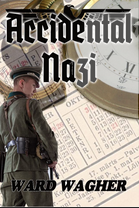
As alt-history goes, this was really fun. Things are getting quite different but in believable ways, and the more they drift from our history’s course, the harder it is for Schloss to predict what to do: by the end he’s more dependent on his own instincts as a leader and his history with these men. The geopolitical situation gets lively, too, and I’ve already started the second novel where Herr Schloss is steaming into the complete unknown. There are other elements I appreciated, like a good sprinkling of German expressions for flavor, and for Schloss’s dark, sarcastic humor – what Phillip Kerr called the Berliner Schnauze. I was not expecting this to be as good as it was, given the self-published nature of the cover.

 Reading Freely
Different…..!
And evidently a HUGE series, though not addictive like CJ Box.. 😉
10 books…… I wonder if he can keep things interesting over that many pages?
Well, the Japs just blew up the Panama Canal to make it a lot harder for the US to send ships to the Pacific — and they need them there, because the entire Pacific fleet was blown up at Pearl Harbor, the carriers included. 😦
It does amuse me just how far authors will go to bend history so that the Axis Powers won….
Plus, there are OTHER turning points in History that would make a good/great story. What-Ifs are *everywhere*.
Well, in this timeline….I don’t think that’s the case. Spoilers follow, but Schloss convinces the rest of the Fuhrercouncil to let Barbarossa sleep, knowing that a postponed plan will turn into a dead plan; he changes Germany’s air strategy to re-focus on the RAF rather than committing outrages against civilians, thinking that will make the war less salient for voters and eventually they’re sue for peace and live Germany to control Mitteleuropa; he strives to keep the Americans from getting closer and tells the Japs he will NOT support any offense against the US; and he begins deporting Jews to former Judea/Palestine instead of killing them, which lowers the temperature. So right now Japan is at war with the US (China is never mentioned, oddly), but Germany is in a….thing with the UK. They’re at war, yes, but it’s entirely an air war, and neither side is being very aggressive. It’s more a “Ach, you silly Englishmen, you blew up my airport. Now I blow up your airport! How do you like THEM apfels?” I’m interested to see where it goes.
Oh, and the epilogue of the first book would make a great series of its own: it repeats the first chapter ALMOST VERBATIM, but at the end Hitler & co land….in Ilinois….in 1927…..and everyone is confused.
This sounds…. Different! I love alternate history but then I get real history confused so I avoid it 😅
There’s a reason the majority of my alt-history is in areas I’m VERY familiar with! In other areas someone could be telling a story right out of the Simarillion, I’d have no idea.