
~ St Augustine
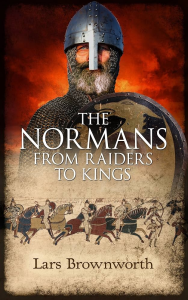
I can still remember being scandalized in seventh grade when I opened the next chapter in our western civ text to discover we would be studying THE CONQUEST OF ENGLAND. England, conquered? At that age, for whatever reason, I had a notion of England as an impregnable island fortress: from that time on I regarded the Normans with enmity. Recently, though, I found myself in possession of a generous gift card and a desire to find out just what those Normans got up to outside of England. As a regular reader of medieval European history, I’m always stumbling upon them getting up to mischief, and figured a survey would be helpful. Given Lars Brownworth’s adjacent research into the Byzantines, Rome, and the Crusades, From Raiders to Kings is not only a very readable survey, but one that brings in useful context without getting long-winded.
The story of the Normans begins, of course, with the story of the Vikings — aggressive Norse and Danish raiders who savaged Britain, France, and other parts of Europe while also vigorously exploring across the Atlantic and into what we now call Russia. Viking predations caused the coasts of France to depopulate themselves, as people moved away from areas of easy access to the raiders; when the Franks decided to bribe the Norsemen with land, sea-facing Normandie around Rouen seemed an obvious place. There the Northmen in Frankland — the Normans — slowly began slipping into respectability. After first following the French Normans and their eventual attack on Britain — where other Vikings had also been attacking, leading to poor Harold Godwinson having to fight attacks back to back in different areas of the country — Brownsworth moves to the arguably more interesting Sicilian Normans. The Norman arrival in Sicily was amusingly mercenary; they were at first hired to fight one side, then switched the other when geld proved shiner and more numerous there; eventually they began a conquest of Sicily. The Med was…..complicated back then, and most of the book focuses on the constant political wrangling that goes on between the Norman powers, the Eastern Empire, saracens of various sorts, the Papal States, and other European powers. Because of the focus on the Sicilian Normans, my animosity toward the conquerors of Anglo-Saxon Britain was quickly put aside in the very entertaining history of the Normans in the Med. One chapter is called “William the Bad”, followed by “William the Worse”: What’s more, even while the Normans frequently shifted allegiances over the years — especially where the Eastern Empire was concerned, since Constantinople could be both patron and arch-rival — they also fought against misplaced enemies like Anglo-Saxons in the Varangian guard. Englander displaced by the arrival of zis people with outrageous accents were delighted to be able to seek vengeance against the Normans, even if they weren’t quite the same Normans.
The Normans, in short, was an unexpected ball of fun. It added enormously to my appreciation of the medieval Mediterranean world, even if I don’t quite buy Brownsworth’s hypothesis that the sheer amount of energy the Normans added to Europe transformed its history and helped propel it into global dominance, at least for a few centuries. What is obvious is the Normans’ gift for adaptability: they always took what they had and grafted it on to the existing culture to create systems that not only worked, but flourished. This led to some institutional strength that persisted even if a strong man perished and was succeeded by someone with an inferior skillset. Alas, I think I’m almost done reading Brownsworth unless I can find a copy of his Macedonian book. Perhaps I’ll put a word in with his uncle the indie bookstore shop owner….
The alliance with the Lombards was short lived. Even with Norman arms stiffening their forces, they were crushed by Byzantine forces in the first real clash. The battle was enough to prove the worth of Norman swords to the Byzantines, however, and they immediately hired them to quash the troublesome insurgents. Abandoning the cause of Lombard freedom as easily as they had picked it up, the Normans cheerfully set to work
enforcing the imperial will.Under the brilliant Macedonian dynasty of Byzantium, the empire had turned the tide against the caliphate and was engaged in a great push to clear the eastern Mediterranean of Muslim pirates. The Macedonian line had ended with the death of Basil the Bulgar-Slayer in 1025, but although the emperors who followed him were weak, the army Basil had created was still formidable and won a string of victories in Syria and along the Anatolian and North African coast.
Charismatic, headstrong, and larger than life in nearly every respect, Maniaces had a reputation as imposing as his physique. Even the usually unflappable members of the imperial court seemed stunned in his presence. After reporting that the general was ten feet tall and had a roar that could frighten whole armies, the imperial historian Michael Psellus concluded by saying that “those who saw him for the first time discovered that every description was an understatement”.
Maniaces gave every sign of panic, assuring the Saracens that at first light he would appear in their camp with every bit of treasure the city possessed. As a gesture of his good intentions, he sent along a large amount of food and drink for the victors to enjoy. The wine in particular had the intended effect as the Saracens were parched and in the mood to celebrate. Before long they were hopelessly drunk and Maniaces’ soldiers slipped into their camp and butchered every last man.
The Crusades are usually thought of as single armies, or single waves of armies, launching themselves in a certain year. However, they were more like continuous movements; not armies so much as armed men moving in ebbs and flows to the East. There was no single route they chose to travel, and no single recognized leader, just a vague agreement of the leading princes to gather at Constantinople.
Andronicus was a curious figure, possessing all of the brilliance of his family with none of its restrain. In 1182 he was already in his sixties but looked two decades younger, and his exploits, both on the battlefield and in the bedroom, were legendary. By the time he marched on Constantinople he had already seduced three cousins, been banished twice, and had acquired a reputation as an innovative — if slightly eccentric — general.
It would have been difficult to pick a more unsuitable group of people to run a government. The three advisers, a eunuch named Peter, a notary named Matthew, and the English archbishop Richard Palmer, spent most of their time trying to assassinate each other.”

 Reading Freely
I still love the idea that we have HUNDREDS of castles from that period going forward because we were SO hard to control… and that they had to bring in special laws because SO many of their soldiers ended up dead in ditches after visiting the local pub….. [lol]
Yeaaaah. that happened a bit in France, too. When the big man was weak the lesser lords would start throwing their authoriteh around.
This does sound like an excellent overview! I’ll have to keep it in mind for Mr’s Christmas 🙂
He has an interest in medieval history? Lars has been a solid author in that vein. I’m told Dan Jones is superb, too, but I haven’t dived into him just yet.
He does, and history in general. Dan Jones is great, and very accessible as well – Mr has read his book on the Templars, and I’ve watched his documentary on castles + listening slowly to the podcast.
That’s how I found Lars! He had a podcast called “Twelve Byzantine Rulers” that I stumbled into, and then in one of those weird coincidences I found out that my local indie bookstore owner is….his uncle! My copy of the Normans was a personalized copy which I’m returning this weekend. (He didn’t realize he’d sold me his nephew’s signed copy!)
That’s wild! 🙂