
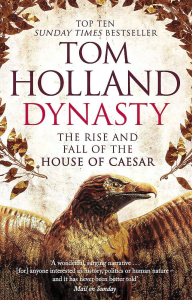
The names Caesar and Augustus have been known to me for as long as I can remember, from the Bible’s Christmas story to early world history texts with colorful illustrations of the Forum. Despite the long history of Rome, the Augustan family still retains its most colorful characters like Caligula and Nero: only relatively few emperors since them, like Marcus Aurelius and Constantine, have any name recognition at all for the general public. Dynasty is a history of this most colorful lineup of men: Caesar, his nephew Octavian (Augustus); Tiberius, Caligula, Claudius, and Nero. Through them we see a slide from the rule of law and moral authority (supposed or otherwise) into military junta and rank decadence. No stranger to Tom Holland’s pen, I found Dynasty compelling and informative reading.
Instead of presenting the familiar narrative of a slow, steady erosion from Republic to Empire, Holland lets the men’s lives speak for themselves. We see that the transformation was not gradual at all, but began to lurch dramatically in the last days of Tiberius. Caesar and Augustus both saw themselves as saviors of the old order, which had in fact already partially collapsed during the days of the civil wars between Marius and Sulla, and the unorthodox triumvirate. Tiberius’ reign appears to mark a crucial point: he was a creature of duty, almost slavishly so. He divorced when told to divorce, he married when Augustus told him to marry, and he looked after several sets of heirs who might one day replace Augustus at the expense of his own happiness and glory. He was an aristocrat in both the best and worst senses of the word: he shared Marcus Aurelius’s later sense of noblesse oblige, but not his Stoic cosmopolitanism — that regard for all men as fellow creatures. Instead, Tiberius viewed the plebes in a more patronizing way: he would take care of them, but they were unwashed masses who merited no say in government. Despite his attempts to favor the senatorial class and the senate himself, Tiberius was dismayed and angered that the nobles were more than happy to let him carry the full burden of Empire. Hating Rome and its people, he withdrew like Achilles into his tent, slipping into his own private decadence and allowing Rome to be led – after his death – by a “viper”. Caligula and Nero these days are bywords for cruelty and decadence, and they are bridged by an old man who came to power at the tip of a gladius – not his own, but the praetorian guard. The guard would become far more active in the political life of Rome after the last subject of this book is dispatched at their hands, leading to the year of four emperors.
The House of Caesar was an extremely dangerous family to be born into, given the pitilessness of Roman politics. Children were hardly safe, either from intrigue or outright murder. They didn’t need to be remotely suspected of being involved in a ruler’s either, either: Caligula’s daughter was murdered immediately after his own assassination purely to get wipe out his family line, and not in a nice way. Brutality is endemic here, even in peacetime with good rulers. Holland does not spare the reader’s sensibilities by shying away from graphic details like the normalization of rape and brutal violence: this is especially apparent with Caligula and Nero, who appeared to worship transgression for its own sake. It gets a bit lurid at times, but made me more appreciative how revolutionary Christianity would be once it swept the Empire — condemning the easy and abusive divorces of the Romans, declaring the humanity of slaves, and asserting a new moral order. Away from the salacious detail, I greatly enjoyed Holland’s writing in general. He appears to have written another work, Pax, that makes this and Rubicon into a trilogy: don’t be surprised to see it in the future, though not immediately.
Quotes
‘Nature produced [Caligula], in my opinion, to demonstrate just how far unlimited vice can go when combined with unlimited power.’
‘These are the objects of my prayers. A plot of land – not so very large. A garden, a spring beside the house, its water ever-flowing, and a small wood on a slope.’as the obituary delivered on him by Seneca, a philosopher who had known him well.
Whether cheering on boxers in back streets, sporting a battered sunhat or roaring with laughter at the sight of a hunchback, Imperator Caesar Augustus retained just a hint of the provincial. None of which did him any harm among the mass of the Roman people. It gratified them to think of the Princeps as a man without airs and graces. Intimate personal details, carefully leaked, helped to cast him as a citizen of honest, simple tastes.
A man as promiscuous as Augustus was reputed to be seemed to many citizens to lack the self-control that was properly the mark of a Roman. Unchecked sexual appetites, while only to be expected in a woman – or, of course, a Greek – were hardly appropriate to a citizen steeled in the noblest traditions of the city. Energies devoted to sleeping around were better suited to serving the glory of the Roman people.
Scolded for not emulating her father’s ostentatious frugality, she only laughed. ‘While he may forget that he is Caesar, I never forget that I am Caesar’s daughter.’
The kingdom of Armenia, a land of icy mountains, thick forests and notoriously effective poisons, lay sandwiched uncomfortably between the rival empires: too indigestible to be swallowed, too tasty to be left alone.
What they adored most of all, however, was the sheer blaze of his glamour. He might be prematurely balding, and possessed of large feet and his father’s spindly legs, yet Caligula knew how to thrill a crowd. The Roman people were bored of grim old men. Now at last they had an emperor who seemed to glory in living the dream. That summer, opening a new temple to Augustus, Caligula rode to the inauguration in a gilded triumphal chariot. Six horses pulled him. ‘This,’ so it was noted, ‘was something wholly cutting edge.’
For decades, secure within its chrysalis, protected by the cunningly crafted hypocrisies of Augustus and the superseded traditions so valued by Tiberius, a monarchy had been pupating; now, with the return of Caligula from war, it was ready to emerge at last, to unfurl its wings, to dazzle the world with its glory. No longer was there to be any place for the pretensions of the Senate – only for the bond between Princeps and people.
As for Caligula himself, he remained on the pontoon; and when he had eaten and drunk enough, he amused himself by treating some of his companions much as he had done his uncle, and pushing them into the sea. Finally, determined that the celebrations not end in anticlimax, he ordered that some of the vessels where his men lay feasting be rammed. And as he watched the action, ‘so his mood was all elation’.
Seneca, when he imagined Roman ships powering their way to as yet undiscovered continents, did not necessarily approve. As a philosopher, he saw nothing to celebrate in perpetual motion. The prosperity that was the mark of a great empire was, in his opinion, a treacherous and soul-destroying thing, characterised by perpetual restlessness, and destined only to torment itself.
‘What an artist perishes with me.’ So Nero, with his customary lack of modesty, had declared as he steeled himself to commit suicide. He had not exaggerated. He had indeed been an artist – he and his predecessors too. Augustus and Tiberius, Caligula and Claudius: each, in his own way, had succeeded in fashioning out of his rule of the world a legend that would for ever afterwards mark the House of Caesar as something eerie and more than mortal. Painted in blood and gold, its record would never cease to haunt the Roman people as a thing of mingled wonder and horror. If not necessarily divine, then it had at any rate become immortal.

 Reading Freely
I keep *trying* to resist the pull of Rome….. But its just SO bloody fascinating…! [lol]
Yeaaah! I’ve got a huge biography of Caesar but after wading through this need a change. About to knock out a history of the Crusades and then perhaps a short history of the Normans — both by Lars Brownworth. Found a gift card while cleaning and decided to put it to use this Saturday.
Typically I’m being pulling in ALL directions. I expect to be starting a stack of 10 modern history books soon running from 1914-1983 but after THAT? Who knows where my book muse will take me?