
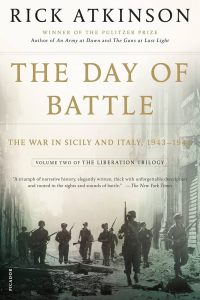
Although I’ve been reading about World War 2 for most of my life at this point, beginning in middle school, the scope of my reading has never broached the Italian campaign. This is probably due to the huge role D-Day plays in the imaginations of Americans thinking about the war in Europe: it was a deadly drama like no other. Or…was it? Turns out, Operation Shingle and the resulting battles of Anzio and Rapido also featured surprise landings and a brutal reception, with intensive fighting over the course of months. I suppose it’s a tribute to how much death and spectacle there was in World War 2 that something like Anzio gets short-shifted. The Day of Battle is a well-written and grimly detailed account of the Allies’ push into Sicily and Italy, suffering only from a want of more maps when appropriate.
One surprising aspect of Day of Battle is how uncertain the Allies were about moving this direction to begin with. Neither Sicily nor Italy were attractive landscapes for offensives, riven as they were with hills and mountains, and the Alps themselves were a formidable barrier between Italy and the tank country of western Europe. Mussolini was removed from office during the capture of Sicily, and surely a bombing campaign could remove Italy from the war. Problem was…there were Germans in Italy, too, and they weren’t going to march home singing of Erika and Lore and their little Marlene. They were going to stand and fight, and delay any attempt at a push toward Germany in their front. Delay they did, too: Allied forces had been pushing up from Salerno but ran into stubborn resistance well south of Rome. Operation Shingle deposited three divisions of troops behind the lines in the hopes of using that in conjunction with an attack on the Rapido River to force an advance. Instead, the troops on the Rapido were cut down like some grim mini-reenactment of the Battle of the Somme, and the divisions who landed near Anzio were bottled up for four months, this time recreating something like Gallipoli. Although General John Lucas was initially castigated for not being more aggressive about spreading away from the beaches, Atkinson remarks that other military minds — then and now — regard Lucas’ action as prudent.
Regardless, both he and his fellow commanders were in for months of hell, shelling, and mutual slaughter: while the men at Anzio fought desperately to maintain their foothold in Italy, the bulk of Allied forces were crashing against the Gustav Line, anchored at Monte Cassino, across four distinct battles. Men on both sides were pushed to the limits of endurance — physical and otherwise. Because fronts were stationary, carnage mounted — literally, with some soldiers being shaken by stacks of corpses and bags of dismembered bodyparts. Supplies ran low: when breakthrough happened later on, Allied soldiers discovered that the German wounded were being treated with paper, bandages having been exhausted.The Gustav Line front moved at such a sluggish pace to remind its generals of the Great War, and the Germans used it for propaganda — producing a poster that suggested that based on the Allies’ rate of movement from September ’43 to February ’44, that they should arrive in Berlin in spring 1952. (German radio also referred to the Anzio beachhead as the largest prisoner-of-war-camp in history, something the grunts who defended their stake for months on end might not have argued with.) This continued until May 1944, when a massive offensive kicked off that would eventually result in the capture of Rome only two days before another massive invasion of Europe happened — a one-two punch like nothing since Vickburg fell and Lee’s army faltered at the Angle in Gettysburg.
This was quite the read. It helped, of course, that I had virtually no idea of what the Italian front was like, so that everything came as a surprise. Even if I had been familiar with the broad outlines of the campaign, though, I think I would have still been surprised by the role played by Polish and Indian troops, and the meatgrinding aspects of the bloody scrum. While I figured moving through mountains was no picnic, I didn’t realize how effective and costly the German defense was, and Atkinson heaps on the details to drive the butcher’s bill home in a visceral fashion. I cannot recommend that readers read this at lunch, which was my practice. The book well drives home the adage that no plan survives contact with the enemy, or that everyone has a plan until they get punched in the face: despite all the preparation on other side, not until battle was engaged and forces set loose that could not be suddenly recalled did either party start seeing what was going to happen. I’d also never heard of the outrages committed by African colonial troops against Italian populace — with so many deliberate rapes that American troops confessed they’d rather shoot the Goumiers than the Germans. One sixteen year old girl was raped four times by France’s colonials. Interestingly, although Hitler later wanted Paris burned rather than ceded to the Allies, Atkinson records here that the Bavarian insisted that there be no “battle of Rome”: he valued its architecture too much. I also enjoyed the section in the epilogue that weighed military criticisms of the value of the Italian campaign against one another — comparing the men and material lost against the bombing advantages and greater sea & air control gained. (The German general Kesselring also weighs in, stating that the Allies’ invasion of Normandy showed clear knowledge gained at great cost on the beaches at Anzio.)
I will most likely finish this trilogy, though having been marching through Italy for nearly three weeks now, I need a breather.
All documents that disclosed the invasion destination were stamped with the classified code word Bigot, and sentries at the Husky planning headquarters in Algiers determined whether visitors held appropriate security clearances by asking if they were ‘bigoted.’ (‘I was frequently partisan,’ one puzzled naval officer replied, ‘but had never considered my mind closed.’)
By any reckoning, two U.S. infantry regiments had been gutted in one of the worst drubbings of the war; the losses were comparable to those suffered six months later at Omaha Beach, except that that storied assault succeeded. “I had 184 men,” a company commander in the 143rd Infantry said. “Forty-eight hours later I had 17. If that’s not mass murder, I don’t know what is.”
“I will do what I am ordered to do, but these Battles of the Little Big Horn aren’t much fun.”
Each yard, whether won or lost, pared away American strength. In a two-acre field diced by German artillery, survivors counted ninety bodies. Six new lieutenants arrived in the 2nd Battalion of the 135th Infantry; a day later just two remained standing.”
“Sir,” a major said, “I guess you will relieve me for losing my battalion?” Darby smiled. “Cheer up, son,” he replied. “I just lost three of them, but the war must go on.”
A Forceman whose leg was blown off rode to the aid station atop a tank. “Hey, doc,” he yelled to the battalion surgeon, “you got an extra foot around this place?”
“Are we beasts? Are we taking this too far?” Churchill wondered aloud. Later the prime minister, who had ardently pressed for some of the most ruinous raids, would voice regret “that the human race ever learned to fly.”
Only one in four Eighth Air Force bomber crews flying in early 1944 could expect to complete the minimum quota of twenty-five missions required for reassignment to the United States; those not dead or missing would be undone by accidents, fatigue, or other misadventures. Bomber Command casualties were comparable to those of British infantrymen in World War I. Here was a pretty irony: airpower, which was supposed to preserve Allied ground forces from another Western Front abattoir, simply supplemented the butchery.
Crewmen sang a parody of the theme song from Casablanca: “You must remember this / The flak can’t always miss / Somebody’s gotta die.”
For every boxcar destroyed, ten replaced it: the Germans owned two million in Europe. Extravagant camouflage, such as the threading of new bridge spans across the Po River through the wreckage of the old, made targets harder to find.
A study of four infantry divisions in Italy found that a soldier typically no longer wondered “whether he will be hit, but when and how bad.” The Army surgeon general concluded that “practically all men in rifle battalions who were not otherwise disabled ultimately became psychiatric casualties,” typically after 200 to 240 cumulative days in combat. “There aren’t any iron men,” wrote Brigadier General William C. Menninger, a prominent psychiatrist. “The strongest personality, subjected to sufficient stress a
sufficient length of time, is going to disintegrate.”“A corporal came and stood among the wounded…. Through his torn tunic I saw a wound the size of two hands, the shoulder-bone bared.” The corporal told him, “I shan’t let you evacuate me until I’ve thrown all my grenades.”
“Mark Clark has laid 4–1 against our crossing the Rapido,” Leese wrote. “As they say at a private school, ‘Sucks to be him.’”
After contributing so much to Allied success in DIADEM, some colonial troops now disgraced themselves, their army, and France. Hundreds of atrocities—allegedly committed mostly by African soldiers—stained the Italian countryside in the last two weeks of May, including murders and gang rapes. “All day long our men observed them scouring the area for women,” an American chaplain wrote Clark on May “Our men are sick at heart, and are commenting that they would rather shoot the Moroccan Goums than the Germans…. They say we have lost that for which we fight if this is allowed to continue.”
“We suffered more during the 24 hours of contact with the Moroccans than in the eight months under the Germans,” one Italian complained.
A message to the Combined Chiefs in Washington and London formally announced, “The Allies are in Rome.” How long it had taken to proclaim those five words; how much heartbreak had been required to make it so.
Related:
The White War, on the Italo-Austrian war during WW1.

 Reading Freely
It is a MUCH under-read and almost forgotten campaign overshadowed (as you said) by D-Day & going forward from that. I do (inevitably) have a few books on the subject – typically unread ATM!
Evidently the Brits and Americans were competing over who was first in Rome, too! Just saw an interesting book about Anglo-American rivalry in WW2 but forget the title…
Oh, yes! The Race to Rome was definitely a ‘thing’…. [lol]