
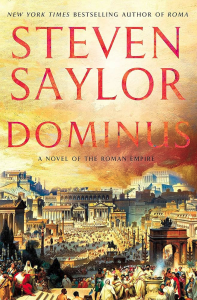
Di immortales, it’s been a while since I read any Steven Saylor! For those who don’t know the name, Saylor is an author of Roman historical fiction; I found him in college, and devoured a long series starring “Gordianus the Finder”. These were essentially detective stories, the plots of which introduced readers to various characters in the late Republic, and coincided with the rise of one Gaius Julius Caesar. Saylor has also written a couple of short story collections that tell the tale of Rome from its ancient beginnings through to the Empire: Roma and Imperium were both fun. Dominus continues the latter trilogy, staying rooted in the same family we’ve followed for centuries. This time, though, a new lord is in town: Jesus Christ is slowly replacing Julius Caesar as the JC of choice.
We open in the reign of Marcus Aurelius, who we saw a teenager in the last collection. Here the thoughtful young man has been saddled with the responsibilities of empire, and the first story sees our first antagonist Lucius Pindarii approaching his old friend with a hot tip about a new physician in town, some chap named Galen. Unfortunately, for the Emperor and posterity, Galen is too late to save the life of the Emperor’s son Titus, so we’ll get saddled with Commodus instead. Saylor continues using a family heirloom, a necklace with an ancient fascinus totem, to keep track of our heir — though in one story, it assumes an active role. Marcus Aurelius, noting that the Pindarii appear exempt from the plague, asks his friend Lucius if young Commodus can wear it for protection until the Pindarii heir comes of age. Commodus, being Commodus, insists on retaining it. Because the Pindarii have a friendship with the royal family and in fact produce statuary for it, readers bear witness through them to Rome’s tumultuous opening centuries in the Christian millennium — from the high watermark of Marcus Aurelius, through the post-Commodus chaos to the return of order (and familiar names) with Constantine. Historical events take on personal importance, as we experience through the characters the almost supernatural dread after seeing a temple’s holiest of holies exposed to the public by fire, or experience the total loss of familial possessions after enduring one of Rome’s many fires. The bizarre turns that Roman politics take are also in full view of us: how strange to witness the devolution of Rome from inspiring warrior-kings like Tiberius and Marcus Aurelius to mental cases like the “False Antonius“, a vain teenage boy with serious theological and sexual issues.
Being in a Roman mood, I enjoyed this well enough: it was nice to return to Saylor after so long a departure, and I notice he’s written a few other things in the interim — including a new Gordianus the Finder novel! As a fan of Marcus Aurelius, I enjoyed his prominent place in the beginning of the novel, though I didn’t quite buy his rendering as the philosopher-king. He was a complex personality, though, so I won’t dwell on that….and he’s far better than any other emperor we see! Much of the book is marked with decadence, depravity, and chaos, both political and moral. As gross as I found False Antonius, for instance, his death scene was even worse. This is not a book for people who want to avoid sex or violence, I will say. It’s not explicitly shown, but it’s often talked about. Not surprisingly, Saylor has also penned a series of “erotic fiction” titles. Vae!
I enjoyed Dominus well enough, but its structure as a series of stories in which Roman history is being observed restrains it a bit. The Pinarii are largely spectators to what’s happening, only twice being pulled directly into stories themselves. There’s not a plot, just the passage of time, and the only unifying thread is the slow increase of Christianity. At the beginning, it’s regarded as anathema to the Romans — unpious atheism — but by the end, one Pinarii is a practicing Christian, and the Emperor Constantine removes all previous restrictions, penalties, etc for practicing it. If you’re a fan of Rome, though, the lack of a driving plot may pose no obstacle to enjoying it. I especially liked experiencing trends that require more of a long view, like Rome’s slow decline as a city within the Empire, or the theological debate continually drifting in a way that made Roman Christianity possible. Sometimes characters’ political and theological observations are worth reading in themselves: I especially liked the view of history as a palimpsest, a slate continually rewritten but always bearing lingering marks of that which was inscribed before. Town names often carry multiple heritages, for instance, and the western weekly and annual calendars are a riot of influences — all the way back to the Babylonians and their seven-day calendar! Another interesting element of this book and the series as a whole is the role of myth: we see events in earlier stories become very different versions of themselves decades later, now married to meaning. I did find the characterization of Marcus Aurelius and Constantine suspect, though. Though not a tight ‘novel’, Dominus is a solid return to Rome, rewarding for readers who love living history vicariously; a plot point touching on real artifacts then recently discovered was a fun bonus.

 Reading Freely
I will, *one day*, get back into ancient historical reading. None planned for a while though!
Not even some Ben Kane?
No… [grin] I *do* have a ‘free’ 10 book set coming up later in the year. I know the non-fiction I’ll be reading (20th century 1914-1983) but I’m leaving the fiction inserts ‘free’. I’ll see about dropping an ancient history novel (or two?) in there, but I’m mostly looking at location (for my ‘World Tour’) rather than historical period.