
352 pages
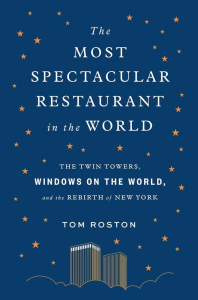
I’ve been collecting WTC photos since high school, haunted by watching the Towers burn and fall on live tv. Some of the most interesting I’ve seen have been inside Windows of the World, a restaurant that occupied two of the top stories on the North Tower. It was due to celebrate its 25th anniversary a month before the obscene assault that was 9/11, having made itself New York’s premiere dining experience. The Most Spectacular Restaurant in the World is a history of not only the restaurant, but of New York City’s postwar rise, its struggle in the 1970s, and the role of the Trade Towers in revitalizing it — and of Windows in broadcasting it. As I’ve never read a formal history of how the Trade Towers came to be, that was fascinating in its own right — but the focus on Windows brought other subjects into consideration. I was astonished to learn, for instance, that most of the Towers’ food services were centrally owned and organized, and that food served by the Windows staff was prepped over a hundred stories below where food from other restaurants was also being made ready. It was an unexpected look into how the Towers actually functioned. There were also some astonishing stories, like the arrest of a robber at Windows while said robber’s wedding reception was kicking off: in the audience were interesting figures like Paul Castellano, Gambino crime family kingpin, and members of the Bonanno family.
The major figure of The Most Spectacular Restaurant is Joe Baum, a New York restaurateur who rose to fame through a series of themed restaurants like The Forum of the Caesars and the Four Seasons. He focused on making restaurant dining an experience, not just a time of eating well-prepared food in comfortable conditions. Baum was known for his high attention to detail, whether in perpetuating the aesthetics of the restaurant — the Roman restaurant served wine in iced buckets modeled after centurion helmets — or in customer service. “Every thing we do is marketing,” he said — everything a guest would see or touch or taste was a way to impress and sell the restaurant. Given that his establishments attracted major clientele like the Kennedys — Marilyn Monroe gave her infamous serenade to JFK in Baum’s restaurant — he was chosen to create a restaurant to headline the Trade Towers. The importance of the restaurants was deemed such that Baum’s need for wider windows forced a change that would ripple throughout both towers, not just the North tower where Windows would be. Amusingly, Baum also headed the design of a cafeteria that would serve construction workers during the Towers’ build-out: he incorporated wood and concrete into its aesthetics and called it “The Loading Zone”. Baum would be responsible for bringing Windows to life, and then — after a long removal from the restaurant — overseeing its redesign and reopening after the bombing of the towers. Although cost overruns were the norm with Baum (“the only man who can blow an unlimited budget”) his knack for anticipating what would bring in customers was such that after he left Windows, he was paid $250 million to advise on revamping the restaurant at Rockefeller Center. There are other figures, though, like Kevin Zraly — an intense oenophile who guided the creation of Windows’ approach to wine and taught a wine-appreciation class to members of the Club, an elite social group headquartered at Windows.
Most of the 1980s and early 1990s are passed over: the restaurant appears to have maintained overall fiscal success despite losing its luster over the years, finding itself outstripped by newer restaurants. After Baum leaves the scene, the book has a brief transition period before jumping into the 1993 bombing of the Trade Towers. While the parking lot bomb didn’t cause any direct damage to the restaurant itself, aside from smoke damage, the food-prep and mechanical utilities it relied on were so destroyed that it was forced to close. Baum returned to oversee a redesign of the interior, and nearly three years later Windows was officially reopened. (There’s an amusing article about the reopening called “Windows 96”, a play on Microsoft Windows 95’s staggering launch the prior year.) The redesign also affected the menu: while the original Windows was very French, the new Windows incorporated more food trends of the 1990s, like sushi and kabob, despite Baum’s resistance to “New American Cuisine”. He oversaw the launch, but would surrender to prostate cancer within two years — probably a great mercy given that it meant he wouldn’t see the destruction of what he’d poured so much of himself into across the course of decades.
The book ends, as the reader might expect, with the horror of 9/11: Windows was directly above the impact zone and its staff and morning guests were quickly overwhelmed by smoke. The morning manager called for help several times, but with both stairwells blocked, there was precious little the dispatcher could do. Close to eighty Windows employees lost their lives that day, and survivors — those not on shift, or who were seeing to business in other areas of the complex or the city — clung together, helping one another find work. Some even created their own restaurant together, one that reflected Windows’ increasingly cosmopolitan menu. This spoke volumes to me about the camaraderie that existed at the restaurant in its “city in the sky”
This was quite an interesting read; the author wrote it as a tribute to a restaurant that was a large part of his life, the site of many “occasion” dinners — birthdays, anniversaries, etc. It’s based on hundred of interviews and the research and records already created by Zraly and Baum. The sommelier Zraly had begun work on a book like this before, but found it too emotionally difficult to begin writing: he was able to connect Roston to many of the people whose memories are recorded here. The book also draws extensively on newspaper articles and the like. The under-the-hood restaurant workings might be tedious for some readers, but I enjoyed learning about restaurant operations — and the inner workings of the Towers — along with the story of the restaurant itself. Occasionally the author tries to connect the story to that of broader New York, but that angle makes marginal contact with the ball at best. The only exception for me was getting the “Windows” version of what happened the night New York’s five boroughs all lost power in 1977. Suddenly being at the top of a 110 story skyscraper in a sea of darkness — and later, violent looting — would be nightmarish. This was a history that proved to have multiple points of fascination, and was clearly written with affection.
Highlights:
“‘Windows is the most important thing in this complex. I don’t care if the place is burning down. If Windows has a problem, you fix it first,’” Bob DiChiara, then the top electrical operations supervisor for the building, recalls Tozzoli saying. “That was Guy’s mantra. Windows had to be successful. If it failed, he failed.”
Baum was also overseeing the essential task of creating a kitchen 109 floors below, on the B2 level of the World Trade Center, to streamline food production through an efficient system that took advantage of economies of scale. There were to be twenty or more different food services operations. On the 107th floor were the five restaurants and bars, plus catering, that fell under the Windows on the World rubric.
Windows on the World would do a greater share of its preparation work in its own kitchen, but the rule for the restaurants and food stations below the 107th floor was to have Central Services, which covered twenty-seven thousand square feet, provide almost all the initial preparation of raw materials. For instance, cabbage would be sliced and slaw dressing mixed, and then the food services employees in the separate sites could mix the two together. “The only difference between us and a high-school cafeteria is care,” Baum said to a journalist of his future food Shangri-La.
As if he didn’t have enough on his plate. He was chasing down porcelain Rosenthal ashtrays, importing Sambonet coffee thermoses from Italy, and getting the proper materials for a brass railing that would hold up a movable ladder used in the City Lights Bar. “Everything we do is marketing,” Baum would say, meaning every item that a guest would see or touch or taste was another way to sell the restaurant.
Criminality was part of the culture. You could barely walk a block without seeing a car with a pathetic NO RADIO or THE LAST GUY GOT EVERYTHING sign. The clamor of car alarms at night was the city’s sick spin on chirping crickets.
We love Joe, but he’s the only guy who can outspend an unlimited budget.
Joe Baum is buried in a cemetery in Westchester. His children had his gravestone fabricated from the same green granite that he’d chosen for his kitchen countertops. On it, they inscribed, No more changes . . . Yet.
Related:
Windows on the World article that mentions the restaurant being spotlit by New York magazine, as well as the “Windows 96” article.

 Reading Freely