
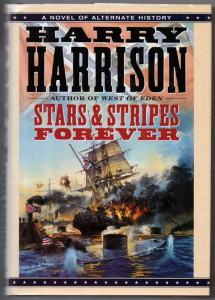
The War between the States is nearly a year old, but Abraham Lincoln now has a bigger problem. Last November, a Navy ship intercepted a British mail packet on suspicion that it was carrying Confederate diplomats bound for Europe; the two men were promptly imprisoned, but Her Majesty’s government is not pleased that a British ship was accosted and its passengers kidnapped by some uppity colonists. A terse letter is prepared – but whereas in our timeline the letter was modified to be more diplomatic by Prince Albert, here his illness puts him in bed and the potentially explosive communique is sent as-is. The result is a growing diplomatic crisis (an intensified Trent Affair) that adds to the gloom around the White House – gloom already thick from the death of Lincoln’s son and the ongoing war. The tension breaks into open war after Canadian militia in pursuit of honest moonshiners encounter American cavalry patrolling the border and shots are fired. While this sounds like the beginning of a “Confederate Victory” story, Stars and Stripes Forever is far more interesting than that. Light spoilers to follow.
For the most part, Stars and Stripes Forever is solid historical fiction: even when the reader hits the point of divergence, the nature of mid-19th century communications is such that it takes months for any effects to be witnessed. The battle of Shiloh happens months after the affair’s kickoff point, and in a way sets the stage for what happens. While 1861 was the first year of the war between the states, it was more of a time of preparation interrupted by numerous small skirmishes like First Manassas and Ball’s Bluff. Shiloh, though, was a taste of the horrors to come, destroying over twenty thousand lives across the span of two days. In our timeline it was soon surpassed by the charnal house of Sharpsburg/Antietam, and then later the three-day scrum that was Gettysburg. Here, though, it creates a somber mood that leds to opportunity after Hanlon’s Razor goes into effect. A British commander with his dander up misreads a map – and a flag – and tears into Biloxi, burning the town and raping its women. Astonishingly, this leads to a local armistice between the Union and Confederate generals who agree to focus on their now-mutual enemy – and things get even more interesting.
I enjoyed this novel thoroughly, especially for the one-two combo that Shiloh and the armistice create in the psyche of Generals Sherman and Beauregard – a sense of what are we doing fighting one another. The action and characterization are good on the American side: I suspect a British reader would find Victoria’s rendering here annoying, as she’s positively hysteric following the death of Albert and blames it on Washington given that stress over the situation supposedly aggravated his condition. That growing wrath for the North drives a lot of what follows. The British diplomatic response is the weakest part of the novel, largely because they do nothing in the wake of the wrong-flag affair. At this point, though, I was more fascinated by the interactions between Union and Confederate officials and politicians: Jefferson Davis, Abraham Lincoln, Sherman, and Lee frequently meet as their respective nations begin collaborating to meet an ever-increasing British challenge. While there’s a fair bit of implausibility here, it made for a gripping novel nonetheless.

As a point of historical trivia: the original and primary Confederate national flag, “The Stars and Bars”, was so easy to confuse with the Union flag (as a Brit did here) that the Confederate Congress changed it several times in the later half of the war. What most people think of as the “Confederate flag” or the “Rebel Flag” is the infantry battle standard, which was briefly incorporated into a very poorly conceived replacement national flag: the Battle Flag in one corner of a mostly-white banner. After everyone pointed out that a mostly-white-flag looks like a surrender flag, the design got even sillier by adding a red bar to the end. They probably would have been better off just flying the infantry standard!

 Reading Freely
I DNFd this after 70 pages back in 2014. My review is here:
https://cyberkittenspot.blogspot.com/2014/07/just-couldnt-finish-reading-stars-and.html
Hah! We both used ‘hysterical’ for Victoria. FWIW, the Union doesn’t prevail against the Confederacy, they just stop fighting — and then evidently in the next book they stop an invasion of Texas and…free Ireland?