
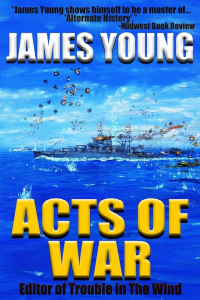
The King is dead. God save the Queen! When the RAF accidentally killed Hitler during a night-bombing and Himmler negotiated an armistice, many thought that was the war done. Tough luck for the Poles, but worse things happen at sea, you know. Speaking of — Himmler’s a bit of a pill and only negotiated the armistice so he could have more time to build air fleets, and now London’s being bombed into ashes and a general sea battle in the Atlantic has left the Germans smarting but HM George the Fifth rather…dead. Now his sixteen year old daughter Queen Elizabeth II is reigning in exile, and her uncle Edward, briefly King before he abdicated to chase skirts instead, has decided to call his former reign a mulligan. Welcome to Acts of War, a rather different alt-history novel in which things are….actually different. The Japs went to war with the Bolshies, for instance, Himmler has removed unworthies like Goering from the Nazi ranks, and he’s intent on being the potentate Hitler only dreamt of being. The Commonwealth is divided – which monarch to back, what war to fight? — and America’s sword still lies dead in her sheath, never wakened in the Sunday skies of Pearl Harbor. Although I’m still trying to understand the premise, Acts of War made for some fun naval 1940s naval fiction.
The Cobb family are the heart of Acts of War, as every single one of the brothers have joined some branch of the service or another, and several of them are stationed around Hawaii where their sister also lives. One of the brothers was so gung ho to fight Germans that he began as a volunteer in Spain, then moved to fight in the Battles of Britain alongside some Poles who had escaped. By the book’s midpoint, everyone gets involved in the scrapping, because Japan decides to attack the United States in 1942, and Himmler follows suit for whatever reason. As far as the action goes, it’s good: we are witness to two full-sized battle, the Battle of Regicide (where the German and British surface navies combat head to head) and the Battle of Hawaii, this universe’s version of the opening of the Pacific War. Both in terms of equipment and performance, the battle seemed believable, and while there’s a fair bit of gore it’s not center stage. Given how many Cobb brothers are involved in different outfits — one is a fighter, one aboard a submarine, etc — it seems inevitable that their mother will be getting some bad news.
One thing that puzzles me is the geopolitics of the war: this series is called the Usurper’s War, so presumably Edward VII is meant to play some central role, but US-Japan naval & air action dominated the book for me, and that has continued into the second book as far as I’ve gotten into it. What the consequences are for the UK having two contesting monarchs has not yet been delved into. The disposition of Japan, and the ambitions of Germany, are also a bit puzzling. We’re told that the Soviets attacked Japanese-held China and drove them out, so thoroughly destroying one battle group that Japan’s cabinet members all killed themselves in disgrace. There’s no obvious sign that Japan has been altered by this, though: her forces are evidently stronger than they were in 1941 of our own time, with more warplanes: but how many men were killed in the Russian war? How many men were freed from Chinese occupation by the failure? It’s all unclear, as are Himmler’s motives. Hitler, at least, had a cogent plan: he wanted to claim Eastern Europe for “living room”, destroy the Bolshies, and depopulate his new empire of those deemed enemies of the Reich. Himmler appears to be going for standard-issue villainy, and it’s hard to imagine an uncharismatic creep like him being able to command the party faithful after Hitler died. I’m intrigued but so far underwhelmed by the worldbuilding. I like the general change in premise, though, especially the dramatic potential of a divided Commonwealth, but I hope the Nasties and the Bolshies get to killing each other. I’m also hoping that Chinese resistance will be a lingering pox for Stalin, but we’ll see.
Aside from being a bit suspicious of the premise, I didn’t have any real qualms with this one: the action scenes are good, and there’s a nice mix of humor and tension.
Coming up….a book on homelessness in DC & Atlanta that was so dispiriting I stopped reading it and took a break with this alt-history instead. I’m almost done with it, though.
Highlights:
“I think, were I in your position, I would be ready to punch my captain out at the first opportunity. Given that you apparently have some experience with that, I would much prefer to clear the air before we have to work together.”
“Has anyone ever told you Southerners that the age of chivalry has long since passed?” “Just because you Yankee women don’t know how to demand proper behavior from your men doesn’t mean that we have to stop giving it,” David replied, looking out towards the harbor.
Well, this has been a rather…interesting day. I just wish someone would have told me I’d get shot down, see my squadron leader killed, and participate in a major sea battle when I got up at 0300 this morning.
“Zhukov was his name,” Adam said. “Looks like he studied blitzkrieg at the same school the Germans did.” “I don’t care if he learned it from Mars himself, he sure used it to kick the Japanese right out of China. My father told me just the other day that there was some rumor their entire cabinet committed suicide over the loss of face,” Overgaard replied.
A squirrel ran up one of the latter and chattered at him from one of the lower branches. Eric favored the animal with a glare. “You know, I can shoot you,” he said hotly. “I’ll even wear you like a hat as a warning to the others.” “Your mother would never forgive you,” his father said from behind him, causing Eric to jump and the elder Cobb to start laughing. “So what has you so distracted your old man was able to sneak up on you like a ghost while you were threatening your mother’s squirrels with haberdashery?” Samuel Cobb asked.

 Reading Freely
Alt-History *can* be fun – indeed its one of my favourite SF sub-genres – but I’m of the STRONG opinion that the world would have to be *very* different for the Axis to win it (or even look like winning it). I believe that the odds were heavily against them even before they made their fatal errors in 1941. I think an interesting Alt would be to see what might happen after the Blitzkrieg in France *failed*….
Oh, and I think it should be German “navy”….. [lol]
Depends at which point, I think — Germany would have had a much better shot had it not waste so much men and material in Africa, and (perhaps) if Hitler were not so myopically obsessed with Stalingrad. There was a “nonfiction” alt-history book called The Moscow Option that covered the latter. The main problem was over-commitment of scarce resources. If Hitler uses forces wasted in Africa and Greece to instead strengthen his Russian invasion, I could entertain some possibility of the war going a different way. Let’s say he knocks out Soviet Russia, which seems plausible enough given that most of its cities and production are in the “west” — how strong would the Allies’ resolve be?
The North Africa campaign certainly sucked up a lot of Axis resources that they really couldn’t afford to waste. But giving up North Africa early – even if it allowed for a bigger push into the Soviet Union – would have meant giving up the Med and opening up Italy for a much earlier attack. Germany was forced to try to hold Africa (even if it skimped on the forces used there) so as not to allow the opening of Winston’s ‘soft underbelly’ attack. But the Germans didn’t have the logistics to fight in both theatres.
Although Barbarossa was an impressive strategic move, the Germans VASTLY underestimated the Soviet ability to fight. Simple racism against the Slavs blinded them to the number of available troops and just how HUGE Russia is. They were expecting the Red Army to collapse almost immediately. Even with *millions* of men killed or captured the Russians actually got *stronger* as the Germans (slowly) advanced into their country. Even within a few weeks of the attack German High Command started seeing problems with their logistics and the (unexpected) amount of causalities they were taking. They just didn’t have either the manpower or industrial base to prosecute the war in the way they needed to.
Britain on its own out produced the Germans in *every* category or war material. Add the Russians and then the Americans and it was clearly impossible for the Germans – and even more so the Japanese – to win a long war. They both had to triumph QUICKLY and *everything* had to go right. As neither thing happened, as it was unlikely to do from the very start, the Germans were essential screwed from the moment they crossed the Polish border in September 1939 and the Japanese from the moment they decided to attack China. The idiotic attack on Pearl Harbor was just the final nail in Japan’s coffin.
I wonder about Italy being the soft underbelly — always seemed like a hard stand could be taken in the north, especially around the alps — but I’m just guessing as I’ve never really explored that bit of the war.
I think that Benito was ‘keen’ on the war – mostly to re-establish the Roman Empire, but I think that the Italian people were, at best, ambivalent. Once Sicily was taken and then the mainland invaded they capitulated pretty quickly. It was only really the Germans (yet AGAIN called in to pull the Italian fat out of the fire) that held up the Allies as they *slowly* ground north towards Germany… Of course this took even more troops away from the Russian Front where they were, by this time, sorely needed!
I’m aware of the basics of the Italian campaign, but need to read more about it. I know it was a LOT tougher than anyone expected – but I think that was mostly because of the constraints of the geography more than anything else. The Sicily landings were a VERY useful learning experience for D-Day though, so there’s that….