
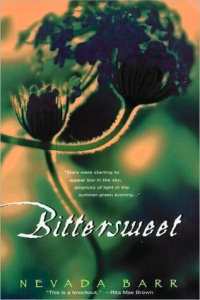
Recently I was looking for the author Nevada Barr, who has a series about a female park ranger who works across the United States. The library didn’t have the early ones in stock, so I grabbed this one without really looking into the plot: it was tagged historical fiction and would give me an idea of the author’s style, so why not? Such is how I came to read a prairie romance about two women, though it’s more of a drama with some romantic elements. While I don’t read romance, this kind of relationship in a historical context struck me as unusual enough to try. I was honestly curious as to how Barr would develop Imogene in the context of the 1870s and 1880s. As it turns out, it’s quite the story of resilience, opening with one woman having to leave town in a hurry, heading west, and ultimately scratching out a life for herself as the manager of a stage stop in the wilderness — learning to hunt, manage roughneck visitors, etc. As the title indicates, though, the women — Imogene and her partner Sarah — have a life of hardship ahead of them, with happiness squeezed from it at great effort. As historical fiction, this is wonderfully detailed, driving home the harshness of life in the old west: as a “love story”, it succeeds on the characters’ emotional bond and avoids becoming overly graphic, though there is an attempt at rape and the novel is fraught with violence.
Bittersweet opens with Imogene having to flee her Pennsylvania hometown after her relationship with another woman is discovered — the scandal being made more volatile by the fact that the woman was a former student of hers. Armed with a letter of recommendation from someone who either doesn’t know or care about that exposed relationship, Imogene heads west and is able to find another teaching position. Her new town is small and its schoolhouse in need of attentive care, which she provides; she also becomes closely invested in the future of Sarah, an intelligent but extremely shy girl about to graduate. After Sarah graduates, she and Imogene become closer still, as Sarah gets married to an older man who is well-regarded in the community but turns out to be rather sadistic at home. Over the course of a few years, Imogene becomes Sarah’s almost sole source of moral support, rising where her parents fall. Unfortunately for Imogene, her habit of letter-writing reveal her address to the wrong people, and they expose her to the town — and Sarah is caught up in the ensuing drama, as her already-abusive husband now suspects that Imogene has corrupted her. They’re forced to flee, and wind up in the middle of nowhere managing a stagecoach inn together, a la Ruth & Idgie. (Fun fact: Idgie’s real name is Imogene, only she couldn’t pronounce it as a kid so she became known as Idgie. ) Finally, a happy ending? Hah! More sorrow awaits, but that’s life in the wilderness.
As far as historical fiction goes, I was impressed by the level of details that Barr works in casually: there are no info-dumps, but we’re subtly reminded constantly of our setting and the hardness of life — both materially and socially, since Barr doesn’t shy away from characters being casually racist or hardened by suffering. The story feels believable for its historical context: some of the men who frequent the stagecoach are former Confederates who left the war-broken South, and over time the stage struggles as railroads continue their iron advance across the wilderness. She features the changing landscape quite a bit, and since the characters are constantly on the move, there’s a nice variety — prairies and mountains. The challenges of the west are extreme for Imogene and Sarah after they begin running the stagecoach, since they’re isolated: everything that needs doing, they need to do. Fortunately, Imogene has a mannish build, something that comes in handy when she needs to pretend to be a man to protect their lease on the inn, leading to some She’s the Man-esque humor amid people dying and coyotes harrowing the cattle. Interestingly, though this is described as a romance, it’s not particularly romantic: Imogene and Sarah have a strong personal bond that strengthens as they support one another through their shared adversities, but as written it’s more of an emotional intimacy than a physical one. The novel is at its most graphic when depicting attempts at rape, which I suspect most everyone thinks we could have done without.
In short, this was a surprise: when I realized it was romantic in nature I was tempted to put it back down, but Imogene’s resilience and Sarah’s journey from timid wallflower to confident young woman both impressed me. I have a couple of Barr’s park ranger books on hold and am hoping to see how her style matured, since this appears to have been her first book.

 Reading Freely
You DO like you’re LONG running series, don’t you?
Anna Pigeon Series…
aka Mountain of Bones
Enjoy! I imagine it’ll be a different read to the C J Box series….. [grin]
We’ll see! I don’t want my fiction running away again. I’ve just about got the balance restored…