
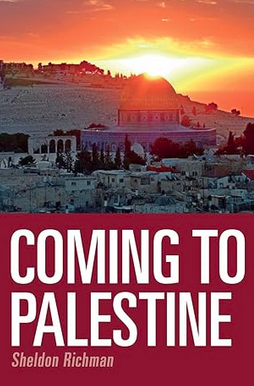
Given the current horrors going on in Gaza, and that Israel/Palestine is largely a blind spot for me, I figured this was worth a look, especially given that I haven’t read anything on the subject since Peace not Apartheid (2007!) and a lot of blood has flowed under the bridge since then. The book is published by the Libertarian Institute, many of whose books I’ve read, and Sheldon Richman is an author that Scott Horton frequently praises.
Coming to Palestine is largely a collection of essays with an Israel-Palestine connection: most were published at the Institute itself, but some are book reviews, and the book reviews can date back to the 1990s. All are sharply critical of Zionism and the State of Israel. As an atheist and an arch-libertarian, Richman has no regard for the idea of a Jewish community at all, let alone one with historic ties to the area and an especial tie to the city of Jerusalem. His critique (beyond detailing chronic human rights abuses) is moored entirely in individualism and property rights: individual Palestinians owned land, and individual Palestinians were wrongfully robbed of it. Although this makes the general scope of the work predictable — Israel is always the bad guy — the volume is not a dozen essays arguing the same thing. Some offer histories of Zionism and Israel’s expansions; some explore Israel’s bipartisan command of US policy, and so on. There are essays on how many conflicts in the Middle East owe to Great Britain and France’s arbitrary line-drawing after the Ottoman Empire fell, for instance, and an essay on how he came to his present beliefs, followed by another condemning the expansion of “anti-semitism” to mean “any critique of the State of Israel”.
I have never looked into the process why which Israel became a nation, so there was quite a bit to learn here, especially early (19th century) settlement and the hostile reaction of Reform rabbis to the idea of an Israel recreated by man rather than God. Richman argues that while settlers did “buy” land in what became Israel, they did so through absentee landlords who had no connection to the property beyond legal title, and who cared nothing for the farmers that the new owners would displace. (That it was legal title, though, would seem to undercut Richman’s pure-property-rights approach.) Other expansion has more the more straightforward pointy-stick approach.
This was an interesting if very partisan collection, one I’d rather evaluate with more knowledge of the subject matter. I did some fact-checking along the way, enough to realize Richman’s views were charged, let’s say. He announced that Israel, Britain, and France attacked Egypt, failing to mention the context of Nasser’s nationalization of the Suez Canal twelve years before the 99-year concession was due to expire, an act viewed by Britain and France as a direct violation of the treaty governing its custody. Unfortunately for Gazans, things have only gotten worse since this book’s publication, as the obscene evil of October 7 has led to an absolute orgy of violence since then, Israel appearing intent on creating a desert and calling it peace. One interesting oversight here was the lack of commentary on Netanyahu’s history of indirectly supporting Hamas for his own cynical reasons. Richman definitely doesn’t like Bibi, and I know Scott Horton is familiar with the topic, so it’s odd that that subject wasn’t addressed, this being a Libertarian Institute publication.
Coming to Palestine is quite partisan, but makes me want to learn more about the subject matter, if only to better evaluate this book. It’s informative, albeit biased, but I don’t think any level of bias can mitigate the fact that the state of Israel has acted horribly towards its neighbors, and has an adverse effect on DC’s foreign policy– whether that consists of enraging the Arabs against DC and America, or making it advocate things like “Erase Gaza and replace it with a resort managed by the president”.
Quotes:
Bush officials had demanded an election in Gaza, then regretted it when they saw the results. Indeed, Bush critic Sen. Hillary Clinton commented after the balloting, “I do not think we should have pushed for an election in the Palestinian territories. I think that was a big mistake. And if we were going to push for an election, then we should have made sure that we did something to determine who was going to win.” (Ooh, she said the quiet part out loud.)Some justify this unstinting and unique support [3 billion dollars per year in military aid] for Israel on grounds that Israel is an American “strategic asset,” and Israeli leaders cynically talk in those terms. But this makes no sense. For one thing, as many American political and military leaders have acknowledged since 9/11, rather than being an asset, Israel has been a liability. A big reason for the Muslim terrorism directed at Americans is precisely the unconditional U.S. military assistance to, not to mention the diplomatic support of, Israel.

 Reading Freely
I’ve read a *little* bit about the region – and intend to read more – but I’m always worried that whatever I pick up will be too partisan to be readable and, as I buy the majority of what I read, a waste of both my time & money. I do have a few I’m hoping to read this year. Hopefully they’ll be worth it!
Agreed that many of the issues in the Middle East originated in either Paris or London (LONG begore the US got involved). I always think that *any* map with straight lines on it is bound to be a conflict zone!
Glad to hear you weren’t hoodwinked by an Israeili hater. I won’t go “quite” so far as to say that people like this author support the death camps, but I’ll toe that line.
I’m going to stop before I say anything else.
I highly recommend A Day in the Life of Abed Salama for a balanced look at what has been going on for quite a while in that part of the world.
Well, it would be hard to find any book about Israel that isn’t partisan from one side or the other. They’ll all be biased, even my own opinions (hate Bibi, but I blame both him and Hamas for this horrid war), and I live in Israel. Strange that he said Reform rabbis wanted a Jewish homeland created by God, not man – that’s the much more Orthodox view. In fact, there is a sect of ultra-orthodox who live in Israel, but they essentially don’t recognize it as a sovereign state. I know one guy who left that sect in his mid-30s, and when the war broke out he decided to finally join up with the army (which is technically mandatory for Jewish citizens). Good thing, because he’s a Social Worker, and the PTSD both soldiers and civilians are suffering from right now is at an all-time high.
It was very likely a selective audience — Richman references them continually. He’s from a Jewish background, strangely enough, but more influenced by his secular grandfather than his parents.