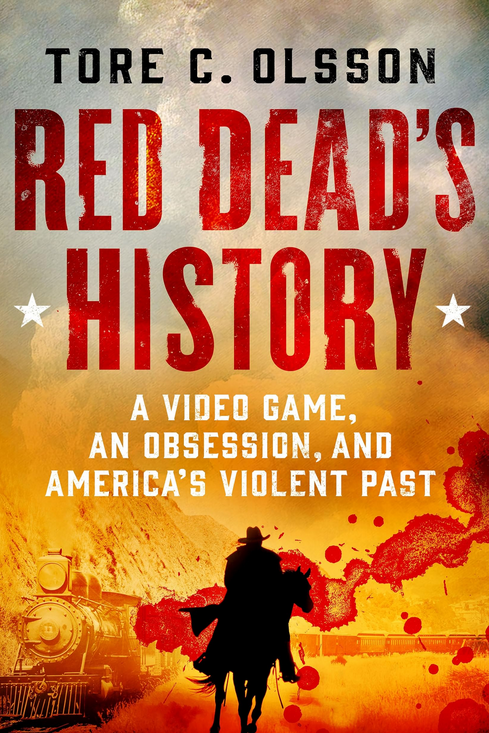
As a student of history who also plays a lot of video games which touch on history, I wonder sometimes what skewed version of history unread players take from it. Tore Olsson takes that same question and applies it to Red Dead Redemption 2, and finds the game surprisingly and refreshingly accurate, albeit with quite a few provisos. Red Dead’s History is a curious mix of pop culture and history wherein Olsson uses the game to explore different aspects of American – mostly southern – history in the 1890s. Although the book frequently leans more into the game’s context than the game itself, and often bristles with politics, I found it an enjoyable enough read – intriguing enough that I may check out his book on Southern and Mexican agrarian reform later on.
For the uninitiated, Red Dead Redemption 2 follows the slow disintegration of a gang of outlaws in the last days of the Wild West: following a botched ferry job, the gang is chased into the mountains during a brutal blizzard: with the way West blocked by both the law and bounty hunters, the van der Linde gang reluctantly descend eastward and are steadily pushed into an area that represents everything from Louisiana swamps to the Appalachians, where they become increasingly desperate and demoralized, plagued by both industrial-age law enforcement and their leader’s increasing mental instability. Along the way, they witness an America in transition, the rural and agricultural being replaced by the industrial and corporate powers. As Olsson follows the story, he comments on the American frontier, the treatment of native Americans, the role mass-bison murder played in their displacement, race and economy in the south, the dawn of women’s suffrage movements, and the treatment of “hillbillies” in the game. Although Olsson is generally complimentary of RDR2’s faithfulness to history, he notes that it’s more generally accurate to the 1870s, rather than the 1890s: the postwar Klan would’ve been gone, Confederate redemptionists would have been fighting in politics, not in paramilitary groups, and Native Americans wouldn’t have had a presence at this point. (The lack of Jim Crow laws in St. Denis/New Orleans is technically accurate for 1899, but would be highly off the mark by the game’s epilogue, at which point they’d become pervasive across the South.)
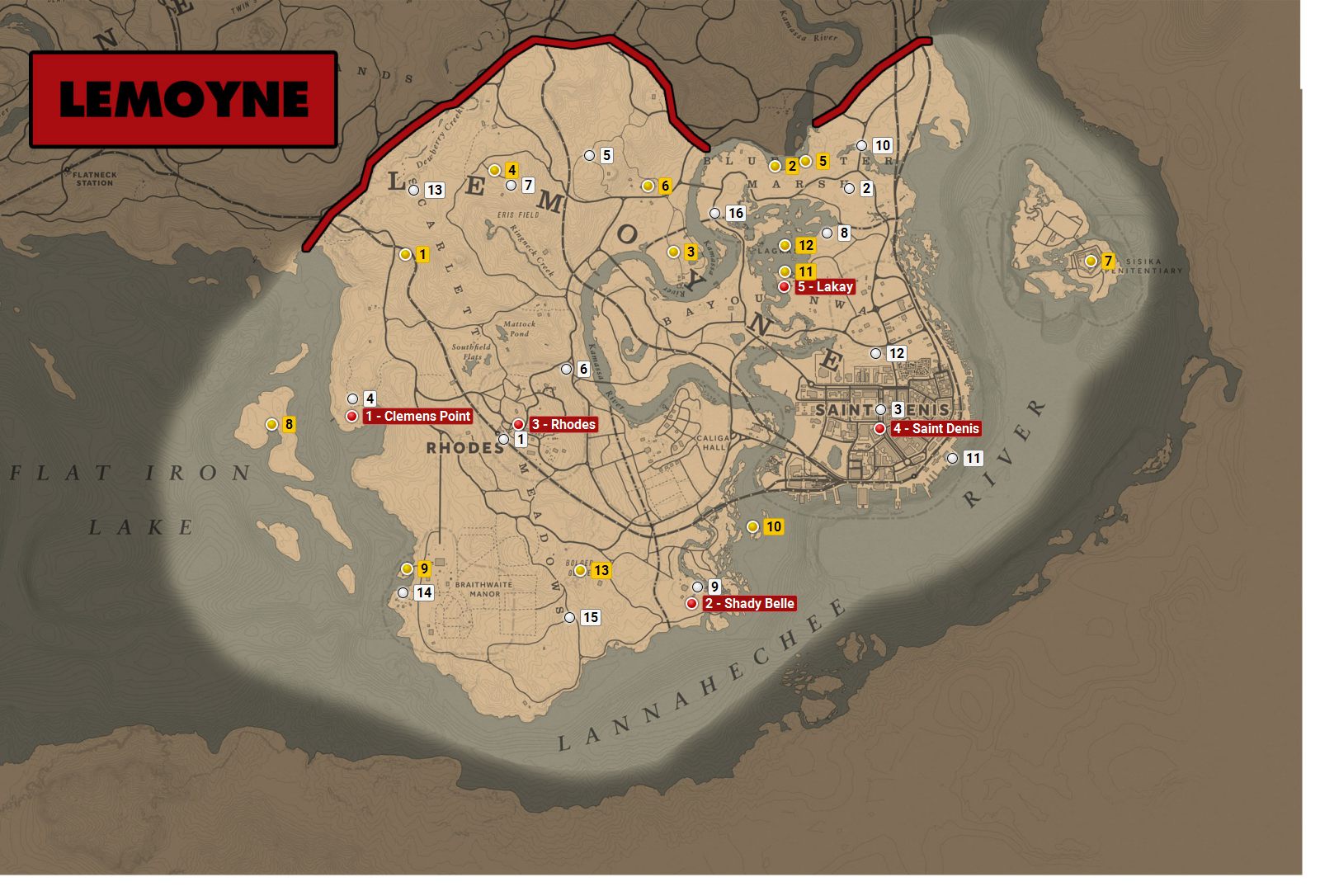
As far as history goes, this has moments both high and low: I was intrigued by his analysis of the Roanoke Ridge area as being a bad representation of southern Appalachia, replete with “hillbillies” who were a stereotype born of the 20th century desire to strip the Appalachians timber and mountains and shove the isolated and ignorant hillbillies out of the way. There were some interesting sections in here, like on the growth of enclosure and convict labor, which frankly only had a tangential connection to the game. Olsson uses the brief mission in which the gang raids an island prison to free one of their number from the fields as an example of how “central” convict labor was to the South, which fails on two fronts: first, it’s literally the only example of convict labor in the game, only appears to allow for an easy rescue of John Martson, and is connected to a federal pen with no role within the southern economy. The convicts there are presumably working for their keep. The “enclosure” section has an even weaker RDR2 connection: Olsson declares that when the gang moves into the South, camping sites are much harder to find in the wild. There are a lot more farms in Lemoyne than New Hannover or West Elizabeth, but as someone who’s played RDR2 pretty much every week since it released, I’ve never had a problem finding a place to camp there. Lemoyne is huge!
Another highlight for me was the fact that Olsson is aware that poor or middling whites existed: outsiders tend to think of the antebellum South as only containing black slaves and white Scarlett O’Haras, when in reality most southerners were white freeholders, most of whom (70%) didn’t own a single slave. Despite this, Olsson doesn’t bother probing into why they would have fought the Civil War: he spends no time discussing the prominent role States played in the antebellum constitution, ignores any sectional strife in the half-century leading up to the war, and dismisses any notion that southerners would have fought an armed invasion of their states simply for notions of honor or self-defense. I’d bet money he’s never read a single diary from a southern soldier, or entertained the wild idea that people might fight a war for reasons entirely unrelated to the war’s official causes. Did any British lad who was murdered by the state’s machines at the Battle of the Somme give a ha’pence about Serbian neutrality? Olsson has a dismal understanding of the Civil War, more clearly evidenced by his shock that Union generals who were so good on the Great Crusade to End Slavery were so cruel to the native Americans after the war. Perhaps, professor, the more plausible explanation is that the generals were merely agents of the DC state and pursued with equal vigor and mercilessness the Southerners fighting for independence during the War for the Union as they did the native Americans who were resisting their own conquest and subjugation by the state? (Again: I’d bet money he’s never read letters or diaries from Union soldiers, despite hailing from Massachusetts.)
Although I had more than a few gripes with the text, Roger Clark’s delivery was enjoyable to me as an RDR2 nut, especially when he repeats lines from the game in his Arthur Morgan voice. As shallow as I found the author’s take on some subjects, this was an interesting way to approach history.

 Reading Freely