
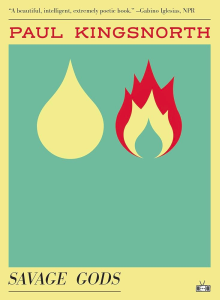
– Paul Kingsnorth, Mar 2026.
Savage Gods is a challenging book to review because of its nature: it is a meditation, or perhaps a rumination, by the author on his continuing search for meaning and the role of writing and the word in that search. Paul Kingsnorth fell in love with Nature from an early age and got into the green movement owing to his love of its beauty; in his twenties, he was a firebrand activist, writing for The Ecologist magazine and in the habit of chaining himself to things to stop their being bulldozed for parking lots and the like He traveled the world meeting people who were also fighting back against — what was it? Globalization, corporate rule, McWorld, industrialism? Something he could see but not yet define, though later he would call it The Machine. He realized in his long visits with traditional societies, though, that there was something missing in the West, some life had gone out of it completely: the West was desecrated, dehumanized, and so he decided to retreat to create a more human life for himself, his wife Jyoti, and their children. They found a rural cottage in Ireland and began trying to live a plainer life.
It is there that Paul writes these meditations, telling part of that backstory even as he ponders at length over the power words and writing have over him — how they demand he serve them even as he wonders if the abstract nature of the written word, of language, separates him to some degree from reality, even as it gives him the capacity to understand and think about it. There’s a lot of mysticism in this: Paul, despite being raised thoroughly secular, is God-haunted, and he conveys some of his interior arguments as dialogues between himself and the Norse gods Loki and Freya. I don’t know what I would make of this if I stumbled upon it by itself: as someone who knows Paul’s story, though, I found it incredibly interesting to view him in a transition point. I know that Paul’s journey will lead him further away from the material to the transcendent — from Buddha to Wicca to eventually to an Eastern Orthodox monastery in Ireland, where suddenly The Word will become all the more interesting as a concept. This is a strange book, the thoughts of an artist in anguish because he longs to write but finds he can’t quite catch the wind in his sails, the thoughts of an activist who is now turning trying to restore earth rather than “set the world on fire“, as the against me! song put it. As someone who is just a little younger than the age Paul was, but who has already gone through that transition from ideologue-warrior to someone seeking meaning through stewardship and creation instead of politics, I found it compelling despite its strangeness. This is a fascinating piece, but it’s not for everyone.
Highlights:
Money whips us around like a tornado, money and capital, greed and ambition and hunger and power, they uproot people and scatter them about and we all keep our heads down as the Machine passes through, drizzling us across the landscapes of the world, breaking the link between people and place and time, demanding our labor and our gratitude, hypnotizing us with its white light, transforming us into eaters, consumers of experience and consumers of place, players of games, servants.
I had a plan. The plan was to settle, to have some land, to root myself and my family. To escape from the city, to escape from the traps. To grow our own food, educate our own kids, draw our own water, plant our own fuel. To be closer to nature and further from the Machine. To be freer, to be more in control. To escape and, at the same time, to belong. To learn things I didn’t know anything about but wanted to, because I felt they’d make me a better, rounder adult person: planting trees, keeping hens, managing woodland, carpentry, wiring, building, all the small skills required to run a few acres of land and to be part of it. On top of that, to bring up our young children at home. And on top of that, to write books: truer books than I had ever written before. To write something great, something real, something so intense that nobody could read it without dimming the lights first.
Something I’d been writing about for years, in that book and elsewhere: human cultures come from places. They arise from them, curl out of them like smoke from hot ash. People do too. We’re not free actors. We can’t just skip from peak to peak, buzz from city to city with no consequences. I knew this, so why didn’t I know it?
The middle-class Europeans blockading summits and waffling about Negri and Fanon bored me to tears. They were rootless; they were as lost as me.They came in by plane or train from some other European city, they put on their black masks and Palestinian scarves, shouted at some fat cats, got tear gassed and then went home. Empty gestures, empty words, and I was empty too. But in the Baliem Valley in Papua or the Lacandon jungle in Mexico found something else; something older, deeper, calmer and very much more real. I found people who belonged to a place. I had never seen this before. Where I grew up, there was nothing like it. It had—it still has—more meaning to me than any other way of human living I had seen. I wanted to know: what would that be like? And could I have it?
I wanted to be a tree, but I am not a tree. I wanted to sing to the forest, but no one ever taught me the words, and I don’t suppose they ever will because there is no one in my world to teach me. Nobody here has known the words for centuries. I was born in those rootless suburbs and they have given me a rootless soul. I am not a tree. I am some kind of slinking animal in the hedgerow. I am a seed on the wind. I am water. I am coming to the rocks at the lip of the fall.
Take a story from a place and drop it into another place and it doesn’t necessarily make sense, at least not at first.Like people, stories don’t always travel well. Nothing belongs everywhere, and some things only belong somewhere. But some stories, when they travel, can spark strange new things in unmeasured hearts.
We stumble on alone, and our smartphone apps and robots that can order a curry for us from the Internet and toy drones for Christmas and regular doses of antidepressants and celebrity TV—all the great swirling ocean of bullshit we have surrounded ourselves with in lieu of life, in lieu of living—this is our civilization’s equivalent of a middle-aged executive buying a red sports car and sleeping with his secretary.
I feel that words are savage gods and that in the end, however well you serve them, they will eat you alive.
I thought I could make it all fit if I could just muster enough cleverness. But the world is not short of cleverness and not much is right. Now I know this is a god my words refuse to serve. No more cleverness. No more opinions. Opinions are easy to come by. Stillness is the really hard work. Not knowing is the hardest work of all.
‘In Western Civilization,’ says the poet Gary Snyder, ‘our elders are books.’ Books pass on our stories. Books carry the forbidden knowledge and the true. Books are weird things, inhuman things, abstract things, but they are gateways, at their best, to the world to which the drum and the fire and the sweat lodge used to take us. The Otherworld. At her best, the writer is a shaman, a priestess, a summoner.
The only reason to write is because you can’t not write; because something sharp and heated is pushing you through. We write, I write, because of life’s brevity and the need to blaze.
Late May. I am in the field, scything the grass and the docks down. I am mowing shirtless in the rain and I remember why I came here and suddenly, in an instant and just for an instant, I am here. I am nowhere else. I am the field and the motion of the scythe and the falling of the rain and the movement of the muscles in my back and shoulders, the sideways motion of my stiff hips and I think nothing at all. I just mow. I just move. I just am. For a moment, I just am. Sometimes, when you least expect it, you are given a gift.
If you mistake the map for the territory, though—if you start to believe that reality will bend to your will if you just grip it hard enough—then you are asking for trouble.
Recently, at a conference in America, I watched Martin Shaw, my mythologist friend (everyone should have a mythologist friend), tell the story of The Odyssey over the course of a week to a crowd of 200 people. It was quite something. When you hear an accomplished oral storyteller tell a story, you are brought up hard against a fact that everyone in a pre-literate culture would have known from experience: a story is a living thing. When the storyteller begins, some strange animal lurches into the room, curls around the roof beams, intervenes, changes everything. A story is a summoning from the otherworld. And some tales want to have their way with you.

 Reading Freely
Ooh, this sounds so good, thanks for reviewing it!
Seeing him talk back in October has made me really interested in his works. Will finish off one of his earlier political books today, I think, and have another ready for April if I can resist reading it that long.