
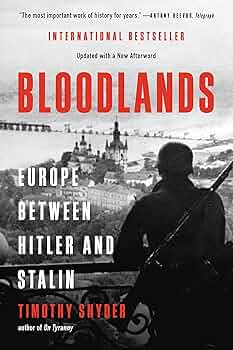
On a scale of 1 to 10, how demoralized, depressed, and soul-dead do you want to be? Ten? Well, have I got a book for you! 1 Bloodlands: Europe Between Hitler and Stalin examines the grim fate of Eastern Europe from 1933 to the death of Stalin. Beginning with Stalin’s imposed famines on Ukraine, moving through the Great Terror, the devils’ alliance in which the two dictators divided Poland between themselves and began butchering its people, and then Hitler’s attempt to create an invincible European empire by attacking the Soviet Union, at the same time mass-murdering millions. It is six hundred pages of murder, inhumanity, ideology, and insight — and while well worth reading, readers going in should brace themselves for its inhumanity, which begins with the evil systems themselves and then spreads to former victims.
Bloodlands is an interesting book, both in the horrors it captures and the way it integrates them into broader European history as a whole. Snyder writes that people tend to treat the Holocaust like something separate, a unique tangent that Hitler went on that was unrelated to any other part of European history — and that comparatively little is said about the Soviet death tolls, in large part because of the fall of the Iron Curtain and the inability of Soviet historians to say anything that would rebuke the Stalinist regime. Not only does Snyder look fully at Stalin’s famines, the great terror, and other mass killings from the Soviet side, but he fits them into the perspective of what Stalin was trying to create and what powers he feared. Despite knowing about the Russo-Japanese war of 1905, I’ve never considered how sharply Stalin feared more expansion from Japan in Asia, let alone that he viewed a Germano-Polish-Japanese encirclement as a very real threat to his dominion. The same is true for Hitler, though as mentioned the west is far more familiar with the Hitlerian death toll than Stalin’s. Even so, Synder reframes the western understanding of Hitler’s hateful actions toward European Jews. Stalin followed up on this sadism with the Great Terror, which began as a way of purging anyone who wasn’t behind Stalin’s interpretation of Marxism, and his regime, but expanded to persecute ethnic minorities. Things would get worse, though.
The Molotov-Ribbentrop act shocked the world, declaring nonaggression between Nazi Germany and the Soviet Union. Each was the long-avowed ideological enemy of the other; each drew life from hating the other and blaming it for all the world’s ills. And yet it had a purpose soon exposed, for the two unions soon divided up Poland between themselves, and there the blood truly began to flow as both powers attacked Poland’s intelligentsia, making sure the occupied territories were deprived of leadership. It was during this period that the Katyn Massacre took place, a mass shooting from the Soviets that murdered more than 22,000 Jewish Poles. Now, however, Hitler threw his hat into the running for the most homocidal man in European history. Hitler, having been isolating Jews from Reich-controlled society and shifting them to concentrating camps — decided that the Final Solution would no longer consist of expelling Jews from the Reich, but exterminating them even as the German army suddenly attacked the Soviet Union and its conquered territories like Ukraine. Synder points out that there is a difference between concentration camps and death camps, and that virtually all of Hitler’s “death factories” were in the Bloodlands: he intended, after the defeat of Stalin and the Soviet Union, to depopulate an area of as many as thirty million and then de-industrialize it, focusing instead on agriculture to feed the Reich. The enormity of Hitler’s demonic hate for the Jews was made manfiest in the fact that even while the German armies were actively retreating from the advance of the Soviets, Jews in cities that were about to conquered by the Soviet army were urged to take trains to “safety”. Those who took the chance were gassed.
It is in the back and forth between the Nazi and Soviet powers that this book truly waxes horrific, because we are witnessing the same people being murdered and brutalized by two different powers, both hateful against minorities despite the fact that one of them was ‘internationalist’. (At Yalta, Stalin would insist on making countries of the bloodlands more ethnically homogenous, forcefully moving Germans, Poles, and Ukrainians about to make it happen) Terror and death were constant, and in the end the victims became horrors themselves: German residents of Poland, for instance, were treated as enemy aliens and entire villages were raped — and these were not necessarily new settlers, but German-speaking Poles who had lived there for generations.
This is a….harrowing book. I stopped reading several times to focus on something else, just for a break. Snyder makes the text especially effective by opening up with a real person who lived, loved, laughed, and perished at the hands of these awful men and their collectivist cronies. This makes the horror personal, closing the door that might allow us to slip into the world of abstract statistics. But what makes it worth continuing through, though, is Synder’s thoughtfulness — both in trying to understand the way Stalin and Hitler were incorporating this evil into their attempts at creating some idealized empire, and in groping for what this dark part of European history has to say to us.
- To be honest, Bloodlands is not the most depressing book I’ve read. That would be something like The Rape of Nanking, The Cultural Revolution: A People’s History, or The Empire of Illusion. The latter’s section on the porn industry will make a reader want to hang the likes of Hugh Hefner. Still, this would make the top five easily. ↩︎

 Reading Freely
Man, and I thought Gulag Archipelago was a rough read…
Think I’ll AVOID this for now…………
Not for the faint of heart. It’s added two books to my “eventually” list, but certainly not anytime soon. (Red Famine and Iron Curtain: The Crushing of Eastern Europe). Maybe once my Grand Tour has got me more eastwards. Still reading the Lisbon book and it’s been interesting. Some gorgeous ‘noir’ shots of Lisbon during the war.
Iron Curtain is *excellent*. My review is here: https://cyberkittenspot.blogspot.com/2015/03/just-finished-reading-iron-curtain.html
…although you’ve already seen it…. [grin]
Hah, that was back in the blogger days! Just saw Applebaum did an intro for an edition of Arendent’s “Origins of Totalitarianism”. Really need to read her…
Applebaum is VERY good. She’s an auto-buy for me.
And I see that you mentioned The Captive Mind there as well!!
Indeed. One of the most eye-opening books I’ve read. Pretty gruesome in places though!